
Pulp Fiction, 1924 · page 64 of 172
Argosy All-Story Weekly, April 19, 1924 — page 64: what you’re looking at
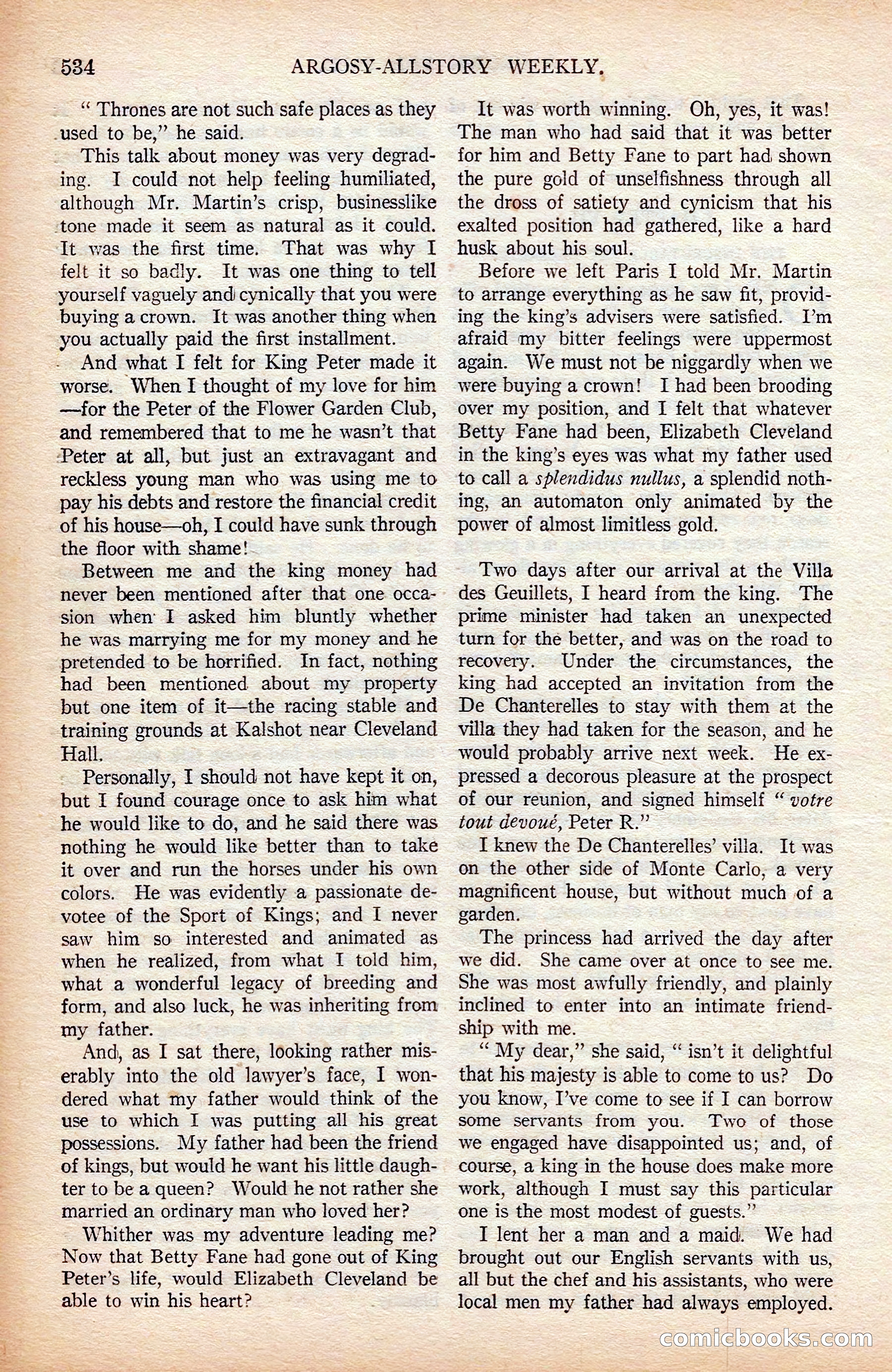
A restored page from Pulp Fiction, 1924. Page through the whole issue in the reader above.
📄 Transcribed text from this page (OCR, searchable)
Machine-transcribed from the original scan — historical spelling and the odd misread are preserved.
534 “Thrones are not such safe places as they -used to be,” he said. This talk about money was very degrad- ing. I could not help feeling humiliated, although Mr. Martin’s crisp, businesslike ‘tone made it seem as natural as it could. It was the first time. That was why I felt it so badly. It was one thing to tell yourself vaguely and cynically that you were buying acrown. It was another thing when you actually paid the first installment. And what I felt for King Peter made it worse. When I thought of my love for him —for the Peter of the Flower Garden Club, and remembered that to me he wasn’t that ‘Peter at all, but just an extravagant and reckless young man who was using me to pay his debts and restore the financial credit of his house—oh, I could have sunk through the floor with shame! Between me and the king money had never been mentioned after that one occa- sion when’ I asked him bluntly whether he was marrying me for my money and he pretended to be horrified. In fact, nothing had been mentioned about my property but one item of it—the racing stable and training grounds at Kalshot near Cleveland Hall. Personally, I should not have kept it on, but I found courage once to ask him what he would like to do, and he said there was nothing he would like better than to take it over and run the horses under his own colors. He was evidently a passionate de- votee of the Sport of Kings; and I never saw him so interested and animated as when he realized, from what [I told him, what a wonderful legacy of breeding and form, and also luck, he was inheriting from my father. And, as I sat there, looking rather mis- erably into the old lawyer’s face, I won- dered what my father would think of the use to which I was putting all his great possessions. My father had been the friend of kings, but would he want his little daugh- ter to be a queen? Would he not rather she married an ordinary man who loved her? - Whither was my adventure leading me? Now that Betty Fane had gone out of King Peter’s life, would Elizabeth Cleveland be able to win his heart? ARGOSY-ALLSTORY WEEKLY, It was worth winning. Oh, yes, it was! The man who had said that it was better for him and Betty Fane to part had shown the pure gold of unselfishness through all the dross of satiety and cynicism that his exalted position had gathered, like a hard husk about his soul. Before we left Paris I told Mr. Martin to arrange everything as he saw fit, provid- ing the king’s advisers were satisfied. I’m afraid my bitter feelings were uppermost again. We must not be niggardly when we were buying a crown! I had been brooding over my position, and I felt that whatever Betty Fane had been, Elizabeth Cleveland in the king’s eyes was what my father used to call a splendidus nullus, a splendid noth- ing, an automaton only animated by the power of almost limitless gold. Two days after our arrival at the Villa des Geuillets, I heard from the king. The prime minister had taken an unexpected turn for the better, and was on the road to recovery. Under the circumstances, the king had accepted an invitation from the De Chanterelles to stay with them at the villa they had taken for the season, and he would probably arrive next week. He ex- pressed a decorous pleasure at the prospect of our reunion, and signed himself “ votre tout devoué, Peter R.” I knew the De Chanterelles’ villa. It was on the other side of Monte Carlo, a very magnificent house, but without much of a garden. The princess had arrived the day after we did. She came over at once to see me. She was most awfully friendly, and plainly inclined to enter into an intimate friend- ship with me. “My dear,” she said, “isn’t it delightful that his majesty is able to come to us? Do you know, I’ve come to see if I can borrow some servants from you. Two of those we engaged have disappointed us; and, of course, 2 king in the house does make more work, although I must say this particular one is the most modest of guests.” I lent her a man and a maid. We had brought out our English servants with us, all but the chef and his assistants, who were local men my father had always employed. EOmMmiIGcboo cS (©)