
Pulp Fiction, 1924 · page 69 of 172
Argosy All-Story Weekly, April 19, 1924 — page 69: what you’re looking at
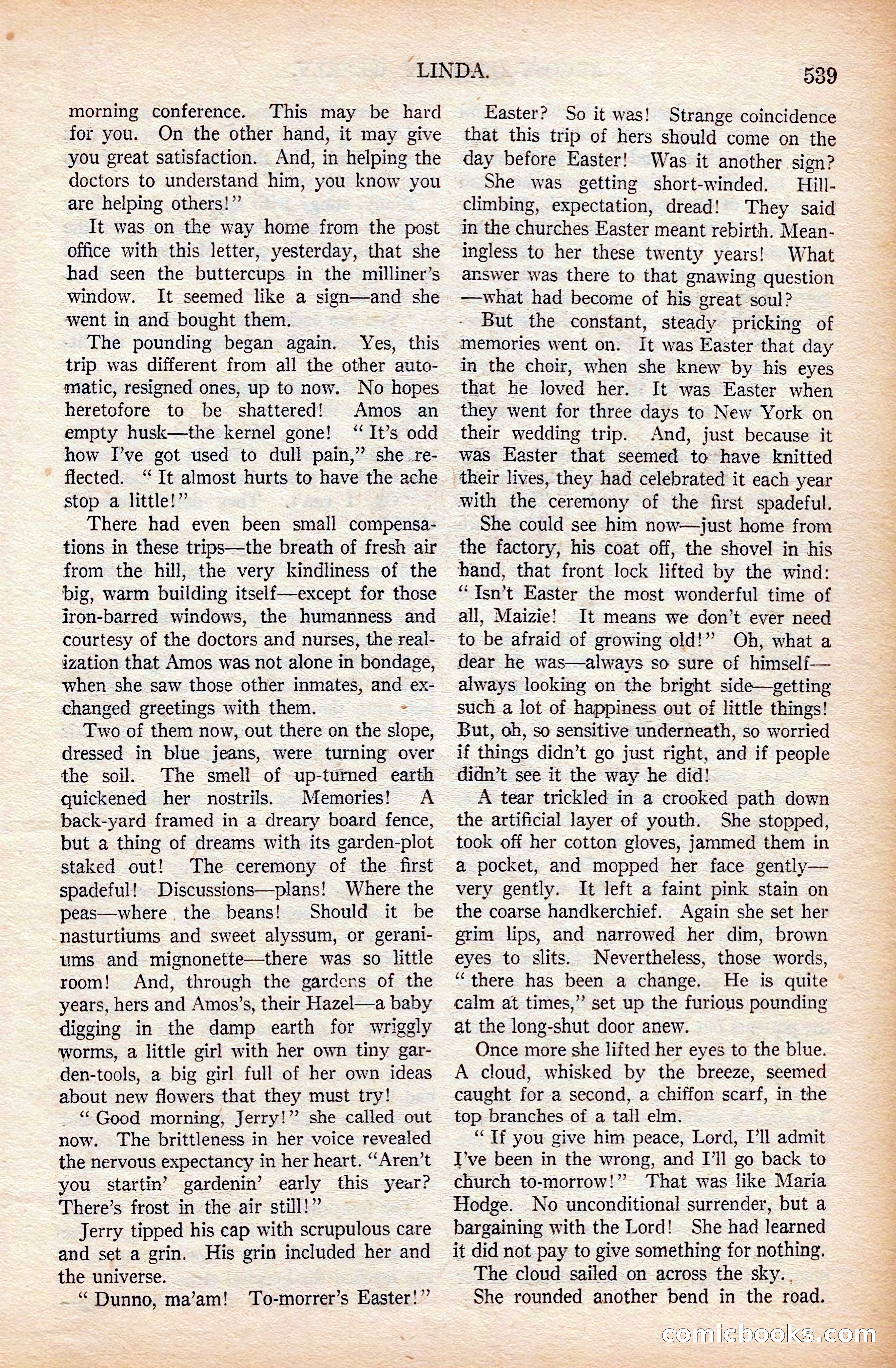
A restored page from Pulp Fiction, 1924. Page through the whole issue in the reader above.
📄 Transcribed text from this page (OCR, searchable)
Machine-transcribed from the original scan — historical spelling and the odd misread are preserved.
LINDA. morning conference. This may be hard for you. On the other hand, it may give you great satisfaction. And, in helping the doctors to understand him, you know you are helping others!” It was on the way home from the post office with this letter, yesterday, that she had seen the buttercups in the milliner’s window. It seemed like a sign—and she went in and bought them. The pounding began again. Yes, this trip was different from all the other auto- matic, resigned ones, up to now. No hopes heretofore to be shattered! Amos an empty husk—the kernel gone! “It’s odd how I’ve got used to dull pain,” she_re- flected. ‘It almost hurts to have the ache stop a little!” There had even been small compensa- tions in these trips—the breath of fresh air from the hill, the very kindliness of the big, warm building itself{—except for those iron-barred windows, the humanness and courtesy of the doctors and nurses, the real- ization that Amos was not alone in bondage, when she saw those other inmates, and ex- changed greetings with them. : Tio of them now, out there on the slope, Gressed in blue jeans, were turning over the soil. The smell of up-turned earth quickened her nostrils. Memories! A back-yard framed in a dreary board fence, but a thing of dreams with its garden-plot staked out! The ceremony of the first spadeful! Discussions—plans! Where the peas—where the beans! Should it be -nasturtiums and sweet alyssum, or geranl- ums and mignonette—there was so little room! And, through the gardens of the years, hers and Amos’s, their Hazel—a baby digging in the damp earth for wriggly worms, 2 little girl with her own tiny gar- den-tools, a big girl full of her own ideas about new flowers that they must try! _ “Good morning, Jerry!” she called out now. The brittleness in her voice revealed the nervous expectancy in her heart. “‘Aren’t you startin’ gardenin’ early this year? There’s frost in the air still!” Jerry tipped his cap with scrupulous care and set a grin. His grin included her and the universe. . “ Dunno, ma’am! To-morrer’s Easter!” 539 Easter? So it was! Strange coincidence that this trip of hers should come on the day before Easter! Was it another sign? She was getting short-winded. Hill- climbing, expectation, dread! They said in the churches Easter meant rebirth. Mean- ingless to her these twenty years! What answer was there to that gnawing question —what had become of his great soul? But the constant, steady pricking of memories went on. it was Easter that day in the choir, when she knew by his eyes that he loved her. It was Easter when they went for three days to New York on their wedding trip. And, just because it was Easter that seemed to have knitted their lives, they had celebrated it each year with the ceremony of the first spadeful. She could see him now—just home from the factory, his coat off, the shovel in his hand, that front lock lifted by the wind: “Isn’t Easter the most wonderful time of all, Maizie! It means we don’t ever need to be afraid of growing old!” Oh, what a dear he was—always so sure of himself— always looking on the bright side—getting such a lot of happiness out of little things! But, oh, so sensitive underneath, so worried if things didn’t go just right, and if people didn’t see it the way he did! A tear trickled in a crooked path down the artificial layer of youth. She stopped, took off her cotton gloves, jammed them in a pocket, and mopped her face gently— very gently. It left a faint pink stain on the coarse handkerchief. Again she set her grim lips, and narrowed her dim, brown eyes to slits. Nevertheless, those words, “there has been a change. He is quite calm at times,” set up the furious pounding at the long-shut door anew. Once more she lifted her eyes to the blue. A cloud, whisked by the breeze, seemed caught for a second, a chiffon scarf, in the top branches of a tall elm. “Tf you give him peace, Lord, I'll admit I’ve been in the wrong, and I'll go back to church to-morrow!” That was like Maria Hodge. No unconditional surrender, but a bargaining with the Lord! She had learned it did not pay to give something for nothing. The cloud sailed on across the sky. She rounded another bend in the road. CORMICLOOKS sO)