
Pulp Fiction, 1924 · page 73 of 172
Argosy All-Story Weekly, April 19, 1924 — page 73: what you’re looking at
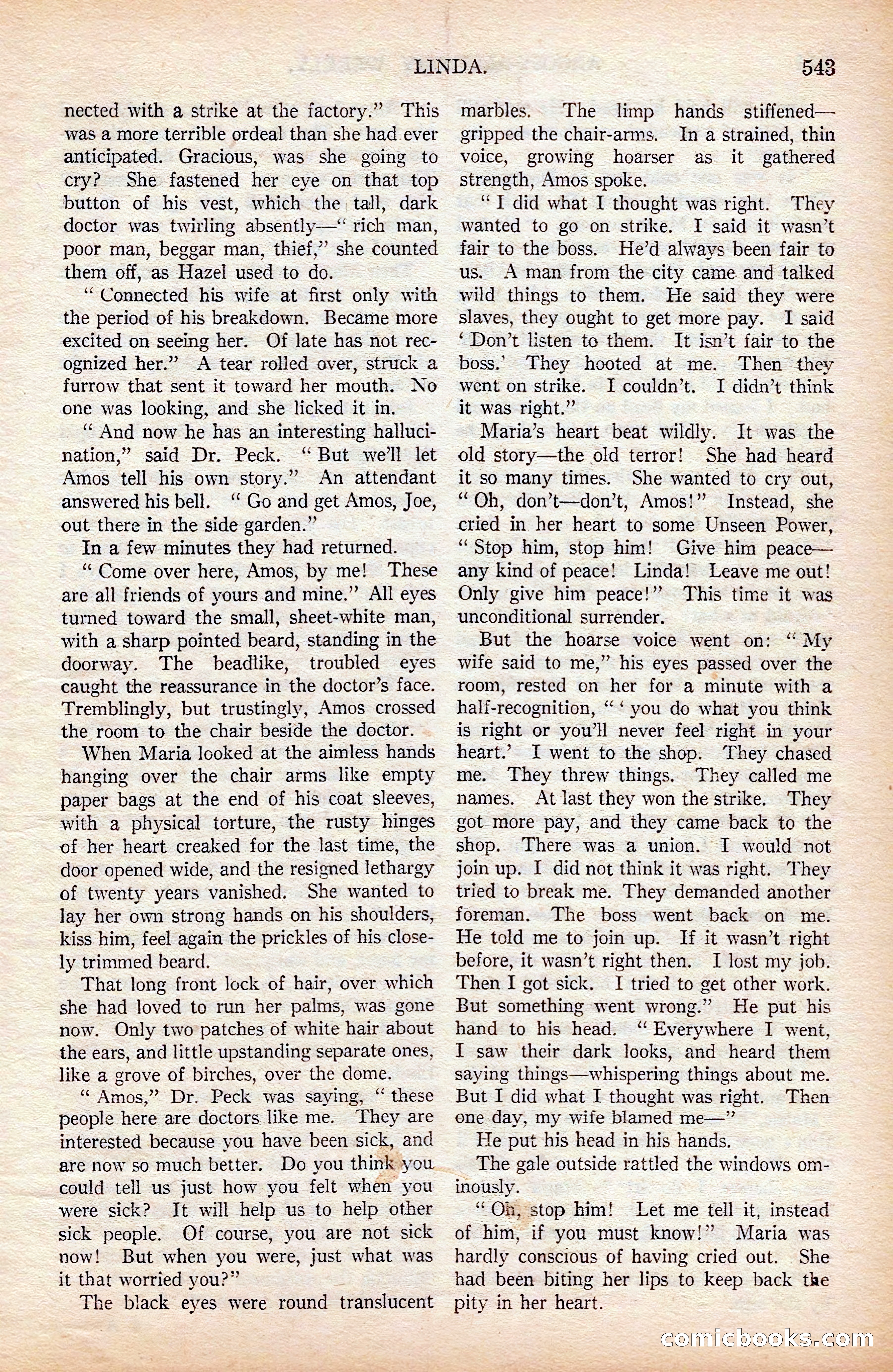
A restored page from Pulp Fiction, 1924. Page through the whole issue in the reader above.
📄 Transcribed text from this page (OCR, searchable)
Machine-transcribed from the original scan — historical spelling and the odd misread are preserved.
LINDA. nected with a strike at the factory.” This was a more terrible ordeal than she had ever anticipated. Gracious, was she going to cry? She fastened her eye on that top button of his vest, which the tall, dark doctor was twirling absently—‘ rich man, poor man, beggar man, thief,” she counted them off, as Hazel used to do. ‘““Connected his wife at first only with the period of his breakdown. Became more excited on seeing her. Of late has not rec- ognized her.” <A tear rolled over, struck a furrow that sent it toward her mouth. No one was looking, and she licked it in. ‘“ And now he has an interesting halluci- nation,” said Dr. Peck. ‘“ But we'll let Amos tell his own story.” An attendant answered his bell. ‘“‘ Go and get Amos, Joe, out there in the side garden.” In a few minutes they had returned. ‘Come over here, Amos, by me! These are all friends of yours and mine.” All eyes turned toward the small, sheet-white man, with a sharp pointed beard, standing in the doorway. The beadlike, troubled eyes caught the reassurance in the doctor’s face. Tremblingly, but trustingly, Amos crossed the room to the chair beside the doctor. When Maria looked at the aimless hands hanging over the chair arms like empty paper bags at the end of his coat sleeves, with a physical torture, the rusty hinges of her heart creaked for the last time, the door opened wide, and the resigned lethargy of twenty years vanished. She wanted to lay her own strong hands on his shoulders, kiss him, feel again the prickles of his close- ly trimmed beard. That long front lock of hair, over which she had loved to run her palms, was gone now. Only two patches of white hair about the ears, and little upstanding separate ones, like a grove of birches, over the dome. “ Amos,” Dr. Peck was saying, “ these people here are doctors like me. They are interested because you have been sick, and are now so much better. Do you think you could tell us just how you felt when you were sick? It will help us to help other sick people. Of course, you are not sick now! But when you were, just what was it that worried you?” The black eyes were round translucent 543 marbles. The limp hands © stiffened— gripped the chair-arms. In a strained, thin voice, growing hoarser as it gathered strength, Amos spoke. ‘“T did what I thought was right. They wanted to go on strike. I said it wasn’t fair to the boss. He’d always been fair to us. A man from the city came and talked wild things to them. He said they were slaves, they ought to get more pay. I said ‘Don’t listen toe them. It isn’t fair to the boss... They hooted at me. Then they went on strike. I couldn’t. I didn’t think it was right.” Maria’s heart beat wildly. It was the old story—the old terror! She had heard it so many times. She wanted to cry out, “Oh, don’t—don’t, Amos!” Instead, she cried in her heart to some Unseen Power, “Stop him, stop him! Give him peace— any kind of peace! Linda! Leave me out! Only give him peace!” This time it was unconditional surrender. But the hoarse voice went on: ‘ My wife said to me,” his eyes passed over the room, rested on her for a minute with a half-recognition, “‘‘ you do what you think is right or you'll never feel right in your heart.’ I went to the shop. They chased me. They threw things. They called me names. At last they won the strike. They got more pay, and they came back to the shop. There was a union. I would not join up. I did not think it was right. They tried to break me. They demanded another foreman. The boss went back on me. He told me to join up. If it wasn’t right before, it wasn’t right then. I lost my job. Then I got sick. I tried to get other work. But something went wrong.” He put his hand to his head. ‘“‘ Everywhere I went, I saw their dark looks, and heard them saying things—whispering things about me. But I did what I thought was right. Then one day, my wife blamed me—” He put his head in his hands. The gale outside rattled the windows om- inously. “Oh, stop him! Let me tell it, instead of him, if you must know!” Maria was hardly conscious of having cried out. She had been biting her lips to keep back the pity in her heart. Eomichbooks:co