
Pulp Fiction, 1924 · page 96 of 172
Argosy All-Story Weekly, April 19, 1924 — page 96: what you’re looking at
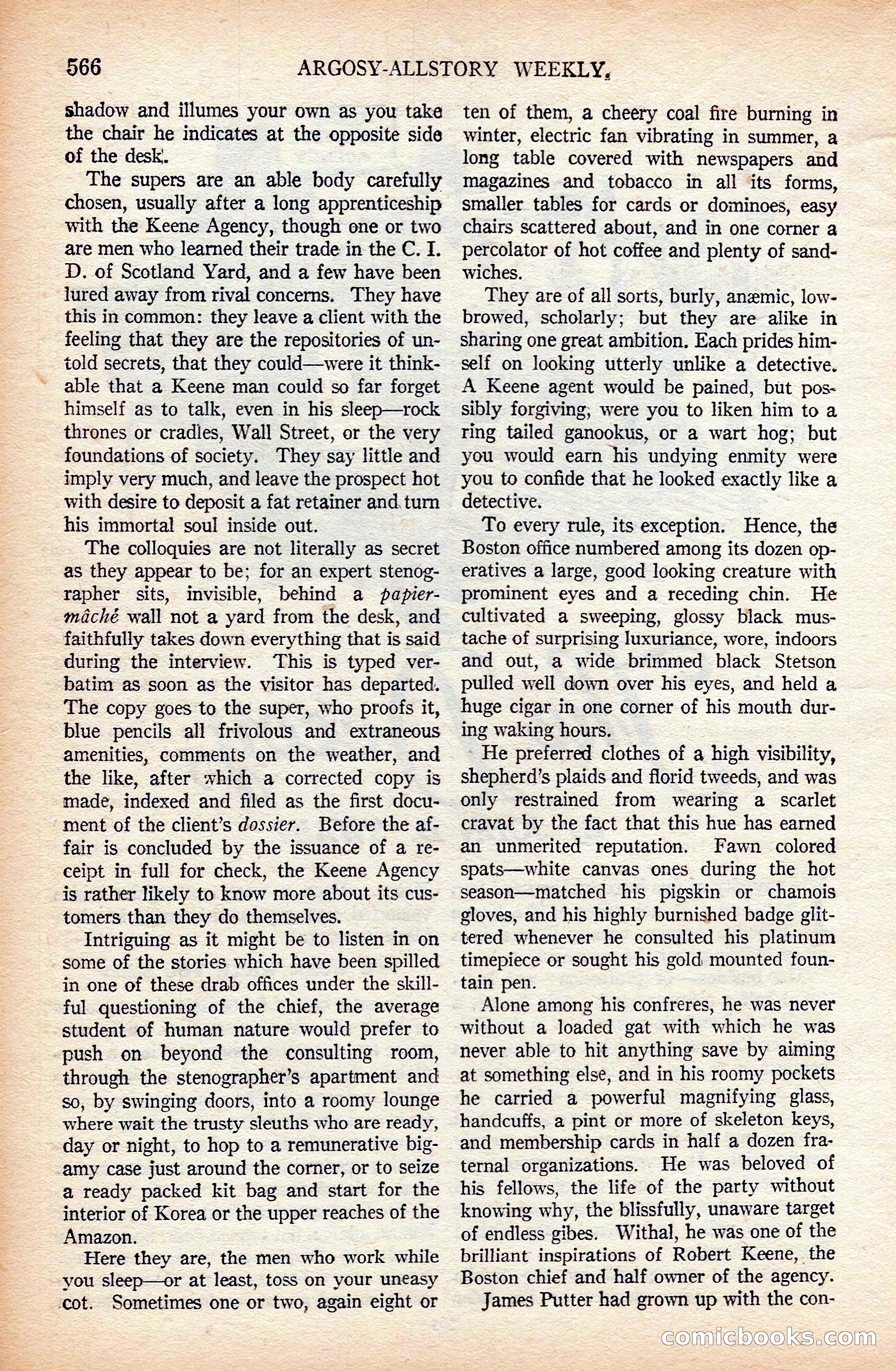
A restored page from Pulp Fiction, 1924. Page through the whole issue in the reader above.
📄 Transcribed text from this page (OCR, searchable)
Machine-transcribed from the original scan — historical spelling and the odd misread are preserved.
566 shadow and illumes your own as you take the chair he indicates at the opposite side of the desk. The supers are an able body carefully chosen, usually after a long apprenticeship with the Keene Agency, though one or two are men who learned their trade in the C. I. D. of Scotland Yard, and a few have been lured away from rival concerns. They have this in common: they leave a client with the feeling that they are the repositories of un- told secrets, that they could—were it think- able that a Keene man could so far forget himself as to talk, even in his sleep—rock thrones or cradles, Wall Street, or the very foundations of society. They say little and imply very much, and leave the prospect hot with desire to deposit a fat retainer and.turmm his immortal soul inside out. The colloquies are not literally as secret as they appear to be; for an expert stenog- rapher sits, invisible, behind a papier- maché wall not a yard from the desk, and faithfully takes down everything that is said during the interview. ‘This is typed ver- batim as soon as the visitor has departed. The copy goes to the super, who proofs it, blue pencils all frivolous and extraneous amenities, comments on the weather, and the like, after which a corrected copy is made, indexed and filed as the first docu- ment of the client’s dossier. Before the af- fair is concluded by the issuance of a re- ceipt in full for check, the Keene Agency is rather likely to know more about its cus- tomers than they do themselves. Intriguing as it might be to listen in on some of the stories which have been spilled in one of these drab offices under the skill- ful questioning of the chief, the average student of human nature would prefer to push on beyond the consulting room, through the stenographer’s apartment and so, by swinging doors, into a roomy lounge where wait the trusty sleuths who are ready, day or night, to hop to a remunerative big- amy case just around the corner, or to Seize a ready packed kit bag and start for the interior of Korea or the upper reaches of the Amazon. Here they are, the men who work while you sleep—or at least, toss on your uneasy cot. Sometimes one or two, again eight or ARGOSY-ALLSTORY WEEKLY, ten of them, a cheery coal fire burning in winter, electric fan vibrating in summer, a long table covered with newspapers and Magazines and tobacco in all its forms, smaller tables for cards or dominoes, easy chairs scattered about, and in one corner a percolator of hot coffee and plenty of sand- wiches. They are of all sorts, burly, anemic, low- browed, scholarly; but they are alike in sharing one great ambition. Each prides him- self on looking utterly unlike a detective. A Keene agent would be pained, but pos- sibly forgiving; were you to liken him to a ring tailed ganookus, or a wart hog; but you would earn his undying enmity were you to confide that he looked exactly like a detective. To every rule, its exception. Hence, the Boston office numbered among its dozen op- eratives a large, good looking creature with prominent eyes and a receding chin. He cultivated a sweeping, glossy black mus- tache of surprising Iuxuriance, wore, indoors and out, a wide brimmed black Stetson pulled well down over his eyes, and held a huge cigar in one corner of his mouth dur- ing waking hours. He preferred clothes of a high visibility, shepherd’s plaids and florid tweeds, and was only restrained from wearing a scarlet cravat by the fact that this hue has earned an unmerited reputation. Fawn colored spats—white canvas ones during the hot season—matched his pigskin or chamois gloves, and his highly burnished badge glit- tered whenever he consulted his platinum timepiece or sought his gold mounted foun- tain pen. Alone among his confreres, he was never without a loaded gat with which he was never able to hit anything save by aiming at something else, and in his roomy pockets he carried a powerful magnifying glass, handcuffs, a pint or more of skeleton keys, and membership cards in half a dozen fra- ternal organizations. He was beloved of his fellows, the life of the party without knowing why, the blissfully, unaware target of endless gibes. Withal, he was one of the brilliant inspirations of Robert Keene, the Boston chief and half owner of the agency. James Putter had grown up with the con- oO Eomicsdoo S (©)