
Pulp Fiction, 1924 · page 108 of 176
Argosy All-Story Weekly — page 108: what you’re looking at
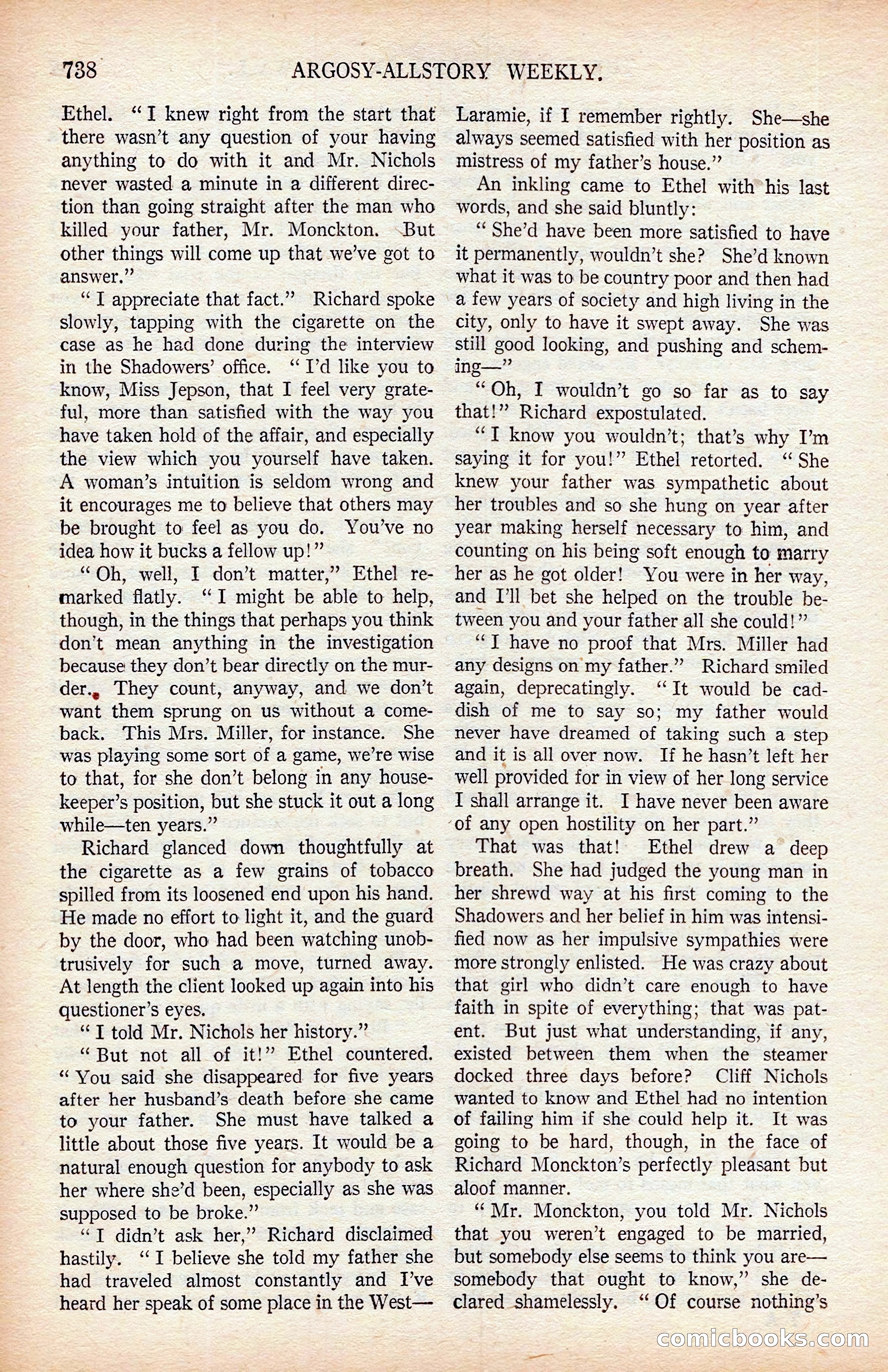
A restored page from Pulp Fiction, 1924. Page through the whole issue in the reader above.
📄 Transcribed text from this page (OCR, searchable)
Machine-transcribed from the original scan — historical spelling and the odd misread are preserved.
138 Ethel. ‘I knew right from the start that there wasn’t any question of your having anything to do with it and Mr. Nichols never wasted a minute in a different direc- tion than going straight after the man who killed your father, Mr. Monckton. «But other things will come up that we’ve got to answer.” ‘I appreciate that fact.” Richard spoke slowly, tapping with the cigarette on the case as he had done during the interview in the Shadowers’ office. ‘I'd like you to know, Miss Jepson, that I feel very grate- ful, more than satisfied with the way you have taken hold of the affair, and especially the view which you yourself have taken. A woman’s intuition is seldom wrong and it encourages me to believe that others may be brought to feel as you do. You’ve no idea how it bucks a fellow up!” Oh, well, I don’t matter,” Ethel re- marked flatly. ‘I might be able to help, though, in the things that perhaps you think don't mean anything in the investigation because they don’t bear directly on the mur- der., They count, anyway, and we don’t want them sprung on us without a come- back. This Mrs. Miller, for instance. She was playing some sort of a game, we’re wise to that, for she don’t belong in any house- keeper’s position, but she stuck it out a long while—ten years.” Richard glanced down thoughtfully at the cigarette as a few grains of tobacco spilled from its loosened end upon his hand. He made no effort to light it, and the guard by the door, who had been watching unob- trusively for such a move, turned away. At length the client looked up again into his questioner’s eyes. “T told Mr. Nichols her history.” “But not all of it!” Ethel countered. “You said she disappeared for five years after her husband’s death before she came to your father. She must have talked a little about those five years. It would be a natural enough question for anybody to ask her where she’d been, especially as she was supposed to be broke.” “T didn’t ask her,” Richard disclaimed hastily. ‘‘I believe she told my father she had traveled almost constantly and I’ve heard her speak of some place in the West— ARGOSY-ALLSTORY WEEKLY. Laramie, if I remember rightly. She—she always seemed satisfied with her position as mistress of my father’s house.” An inkling came to Ethel withhis last words, and she said bluntly: ““She’d have been more satisfied to have it permanently, wouldn’t she? She’d known what it was to be country poor and then had a few years of society and high living in the city, only to have it swept away. She was still good looking, and pushing and schem- “Oh, I wouldn’t go so far as to say that!” Richard expostulated. ‘““T know you wouldn’t; that’s why I’m saying it for you!” Ethel retorted. ‘She knew your father was sympathetic about her troubles and so she hung on year after year making herself necessary to him, and counting on his being soft enough to marry her as he got older! You were in her way, and I’ll bet she helped on the trouble be- tween you and your father all she could!” “J have no proof that Mrs. Miller had any designs on my father.” Richard smiled again, deprecatingly. ‘‘It would be cad- dish of me to say so; my father would never have dreamed of taking such a step and it is all over now. If he hasn’t left her well provided for in view of her long service I shall arrange it. I have never been aware ‘of any open hostility on her part.” That was that! Ethel drew a deep breath. She had judged the young man in her shrewd way at his first coming to the Shadowers and her belief in him was intensi- fied now as her impulsive sympathies were more strongly enlisted. He was crazy about that girl who didn’t care enough to have faith in spite of everything; that was pat- ent. But just what understanding, if any, existed between them when the steamer docked three days before? Cliff Nichols wanted to know and Ethel had no intention of failing him if she could help it. It was going to be hard, though, in the face of Richard Monckton’s perfectly pleasant but aloof manner. “Mr. Monckton, you told Mr. Nichols that you weren’t engaged to be married, but somebody else seems to think you are— somebody that ought to know,” she de- clared shamelessly. ‘“‘ Of course nothing’s CoOmmicaooks Eo