
Pulp Fiction, 1924 · page 113 of 176
Argosy All-Story Weekly — page 113: what you’re looking at
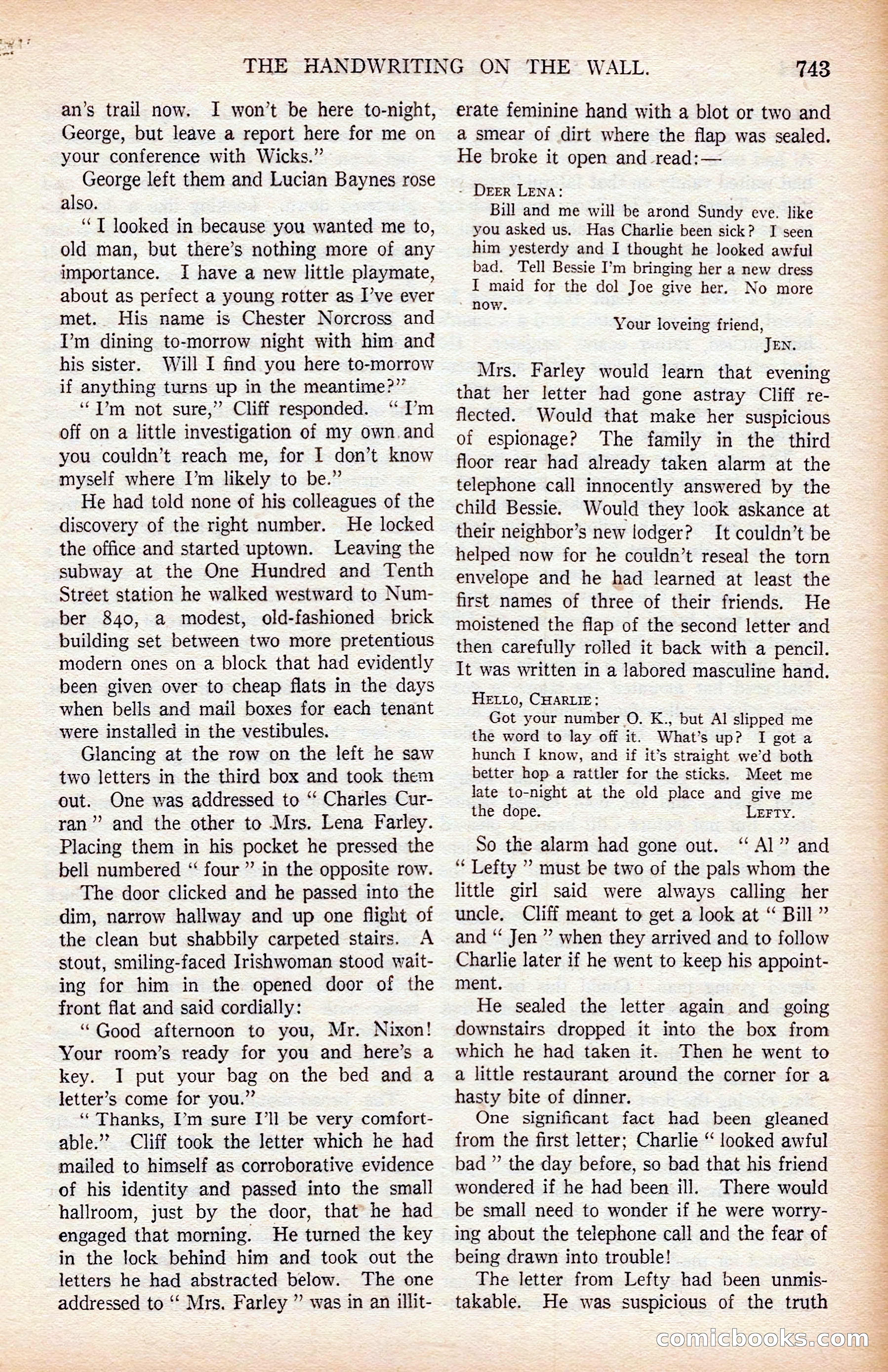
A restored page from Pulp Fiction, 1924. Page through the whole issue in the reader above.
📄 Transcribed text from this page (OCR, searchable)
Machine-transcribed from the original scan — historical spelling and the odd misread are preserved.
THE HANDWRITING ON THE WALL. an’s trail now. I won’t be here to-night, George, but leave a report here for me on your conference with Wicks.” George left them and Lucian Baynes rose also. ‘“T looked in because you wanted me to, old man, but there’s nothing more of any importance. I have a new little playmate, about as perfect a young rotter as I’ve ever met. His name is Chester Norcross and I’m dining to-morrow night with him and his sister. Will I find you here to-morrow if anything turns up in the meantime?” “I’m not sure,” Cliff responded. ‘“ Tm off on a little investigation of my own, and you couldn’t reach me, for I don’t know myself where I’m likely to be.” He had told none of his colleagues of the discovery of the right number. He locked the office and started uptown. Leaving the subway at the One Hundred and Tenth Street station he walked westward to Num- ber 840, a modest, old-fashioned brick building set between two more pretentious modern ones on a block that had evidently been given over to cheap flats in the days when bells and mail boxes for each tenant were installed in the vestibules. Glancing at the row on the left he saw two letters in the third box and took them out. One was addressed to “‘ Charles Cur- ran” and the other to Mrs. Lena Farley. Placing them in his pocket he pressed the bell numbered ‘‘ four ” in the opposite row. The door clicked and he passed into the dim, narrow hallway and up one flight of the clean but shabbily carpeted stairs. A stout, smiling-faced Irishwoman stood wait- ing for him in the opened door of the front flat and said cordially: “Good afternoon to you, Mr. Nixon! Your room’s ready for you and here’s a key. I put your bag on the bed and a letter’s come for you.” ‘* Thanks, I’m sure I’l]l be very comfort- able.’ Cliff took the letter which he had mailed to himself as corroborative evidence of his identity and passed into the small hallroom, just by the door, that he had engaged that morning. He turned the key in the lock behind him and took out the letters he had abstracted below. The one addressed to ‘‘ Mrs. Farley ” was in an illit- 743 erate feminine hand with a blot or two and a smear of dirt where the flap was sealed. He broke it open and read: — - Drer LENA: | Bill and me will be arond Sundy eve. like you asked us. Has Charlie been sick? I seen him yesterdy and I thought he looked awful bad. Tell Bessie I’m bringing her a new dress I maid for the dol Joe give her. No more now. Your loveing friend, JEN. Mrs. Farley would learn that evening that her letter had gone astray Cliff re- flected. Would that make her suspicious of espionage? The family in the third floor rear had already taken alarm at the telephone call innocently answered by the child Bessie. Would they look askance at their neighbor’s new lodger? It couldn’t be helped now for he couldn’t reseal the torn envelope and he had learned at least the first names of three of their friends. He moistened the flap of the second letter and then carefully rolled it back with a pencil. It was written in a labored masculine hand. HELLO, CHARLIE: Got your number O. K., but Al slipped me the word to lay off it. What’s up? I gota hunch I know, and if it’s straight we’d both better hop a rattler for the sticks. Meet me late to-night at the old place and give me the dope. Lerty. So the alarm had gone out. ‘ Al” and ‘‘ Lefty ” must be two of the pals whom the little girl said were always calling her uncle. Cliff meant to get a look at “ Bill ” and ‘‘ Jen ” when they arrived and to follow Charlie later if he went to keep his appoint- ment. He sealed the letter again and going downstairs dropped it into the box from which he had taken it. Then he went to a little restaurant around the corner for a hasty bite of dinner. One significant fact had been gleaned from the first letter; Charlie “ looked awful bad ” the day before, so bad that his friend wondered if he had been ill. There would be small need to wonder if he were worry- ing about the telephone call and the fear of being drawn into trouble! The letter from Lefty had been unmis- takable. He was suspicious of the truth Commicaooks (S@ : .