
Pulp Fiction, 1924 · page 12 of 176
Argosy All-Story Weekly — page 12: what you’re looking at
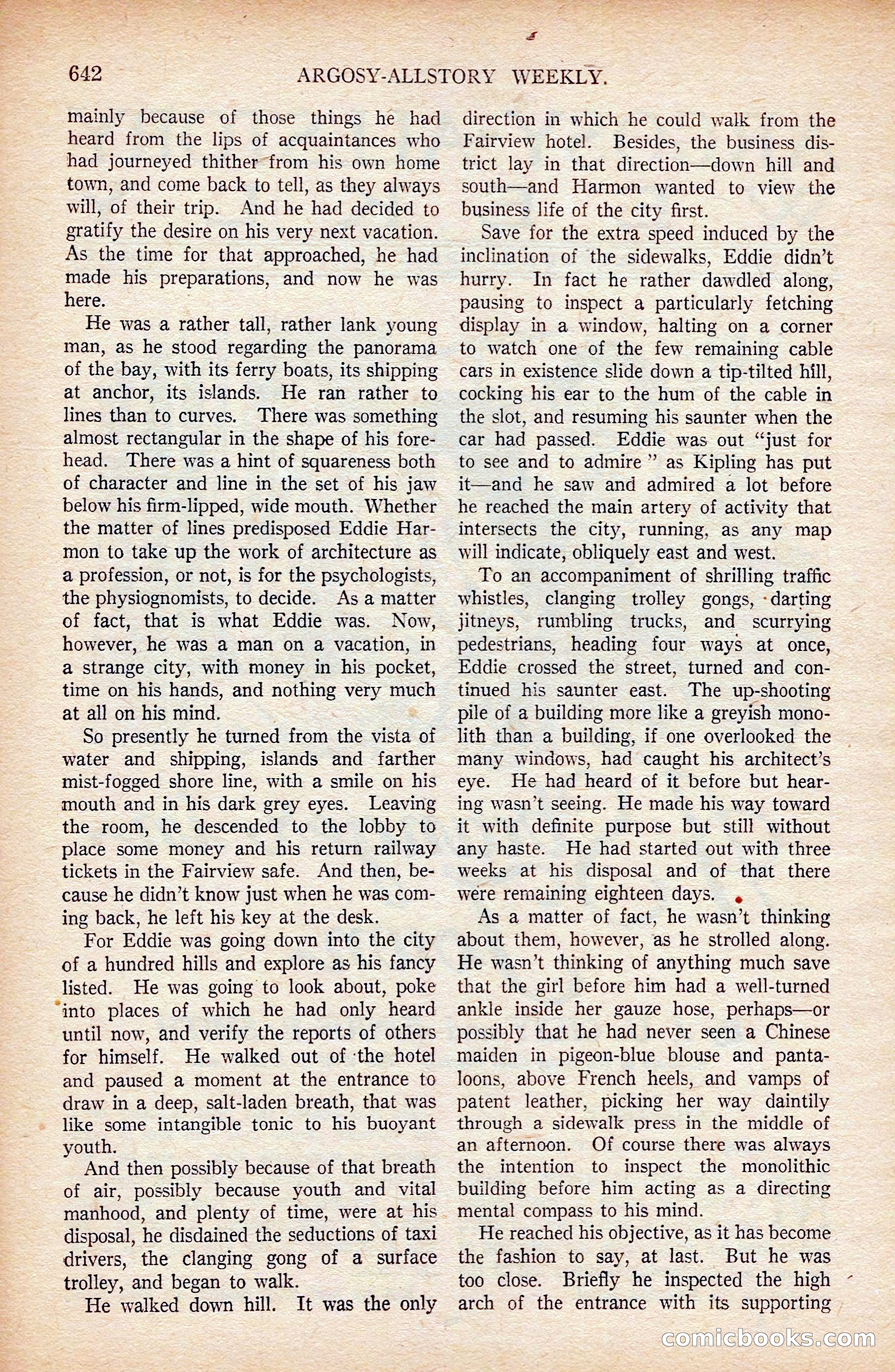
A restored page from Pulp Fiction, 1924. Page through the whole issue in the reader above.
📄 Transcribed text from this page (OCR, searchable)
Machine-transcribed from the original scan — historical spelling and the odd misread are preserved.
642 mainly because of those things he had heard from the lips of acquaintances who had journeyed thither-from his own home town, and come back to tell, as they always will, of their trip. And he had decided to gratify the desire on his very next vacation. As the time for that approached, he had made his preparations, and now he was here. | He was a rather tall, rather lank young man, as he stood regarding the panorama of the bay, with its ferry boats, its shipping at anchor, its islands. He ran rather to lines than to curves. There was something almost rectangular in the shape of his fore- head. There was a hint of squareness both of character and line in the set of his jaw below his firm-lipped, wide mouth. Whether the matter of lines predisposed Eddie Har- mon to take up the work of architecture as a profession, or not, is for the psychologists, the physiognomists, to decide. As a matter of fact, that is what Eddie was. Now, however, he was a man on a vacation, in a strange city, with money in his pocket, time on his hands, and nothing very much at all on his mind. So presently he turned from the vista of water and shipping, islands and farther mist-fogged shore line, with a smile on his mouth and in his dark grey eyes. Leaving the room, he descended to the lobby to place some money and his return railway tickets in the Fairview safe. And then, be- cause he didn’t know just when he was com- ing back, he left his key at the desk. For Eddie was going down into the city of a hundred hills and explore as his fancy listed. He was going to look about, poke “into places of which he had only heard until now, and verify the reports of others for himself. He walked out of ‘the hotel and paused a moment at the entrance to draw in a deep, salt-laden breath, that was like some intangible tonic to his buoyant youth. And then possibly because of that breath of air, possibly because youth and vital manhood, and plenty of time, were at his disposal, he disdained the seductions of taxi drivers, the clanging gong of a surface trolley, and began to walk. He walked down hill. It was the only & ARGOSY-ALLSTORY WEEKLY. direction in which he could walk from the Fairview hotel. Besides, the business dis- trict lay in that direction—down hill and south—and Harmon wanted to view the business life of the city first. Save for the extra speed induced by the inclination of the sidewalks, Eddie didn’t hurry. In fact he rather dawdled along, pausing to inspect a particularly fetching display in a window, halting on a corner to watch one of the few remaining cable cars in existence slide down a tip-tilted hill, cocking his ear to the hum of the cable in the slot, and resuming his saunter when the car had passed. Eddie was out “just for to see and to admire ” as Kipling has put it—and he saw and admired a lot before he reached the main artery of activity that intersects the city, running, as any map will indicate, obliquely east and west. To an accompaniment of shrilling traffic whistles, clanging trolley gongs, - darting jitneys, rumbling trucks, and scurrying pedestrians, heading four ways at once, Eddie crossed the street, turned and con- tinued his saunter east. The up-shooting pile of a building more like a greyish mono- lith than a building, if one overlooked the many windows, had caught his architect’s eye. He had heard of it before but hear- ing wasn’t seeing. He made his way toward it with definite purpose but still without any haste. He had started out with three weeks at his disposal and of that there were remaining eighteen days. , As a matter of fact, he wasn’t thinking about them, however, as he strolled along. He wasn’t thinking of anything much save that the girl before him had a well-turned ankle inside her gauze hose, perhaps—or possibly that he had never seen a Chinese maiden in pigeon-blue blouse and panta- loons, above French heels, and vamps of patent leather, picking her way daintily through a sidewalk press in the middle of an afternoon. Of course there was always the intention to inspect the monolithic building before him acting as a directing mental compass to his mind. He reached his objective, as it has become the fashion to say, at last. But he was too close. Briefly he inspected the high arch of the entrance with its supporting Eomichbooks (S@)