
Pulp Fiction, 1924 · page 146 of 176
Argosy All-Story Weekly — page 146: what you’re looking at
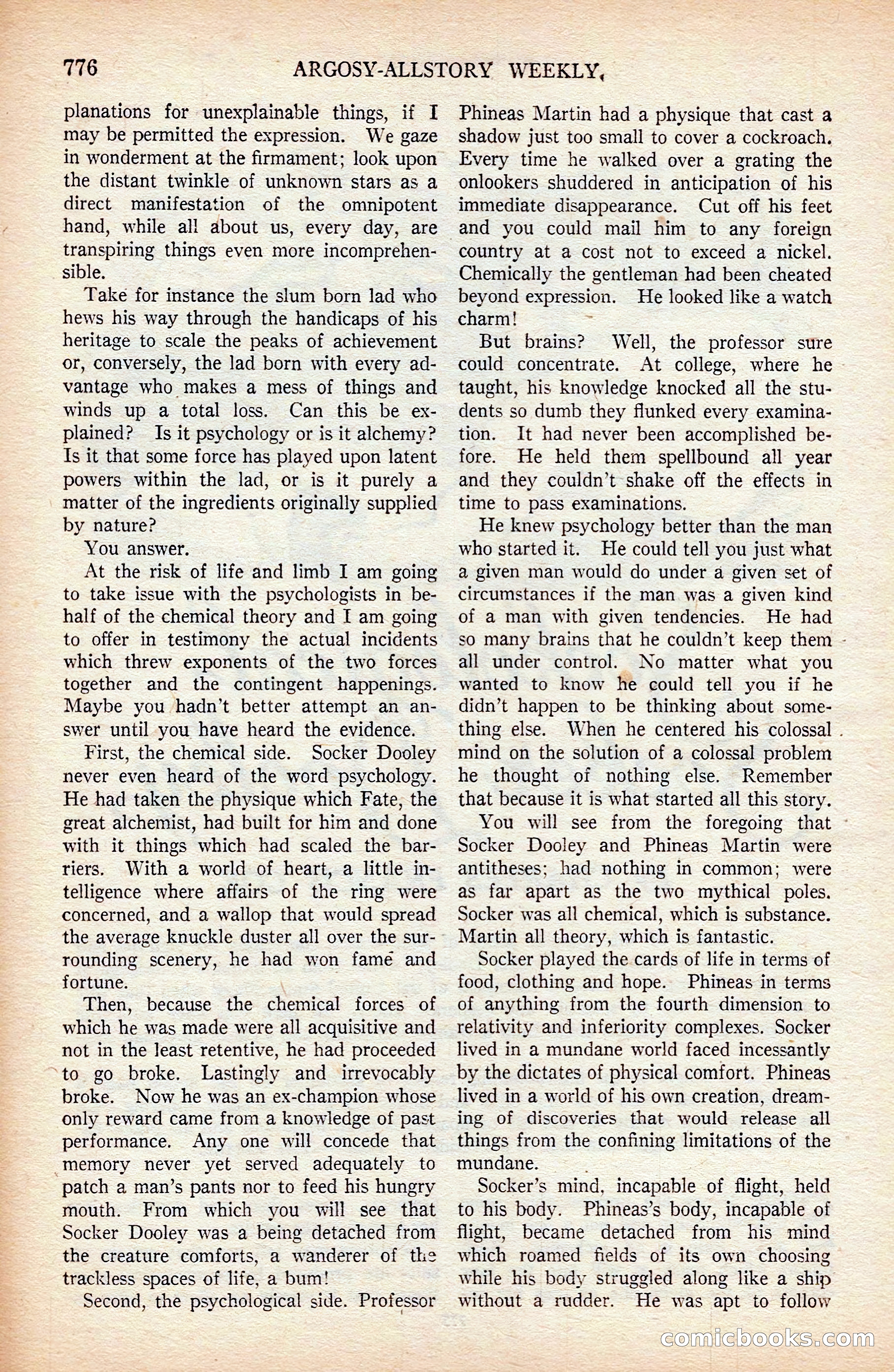
A restored page from Pulp Fiction, 1924. Page through the whole issue in the reader above.
📄 Transcribed text from this page (OCR, searchable)
Machine-transcribed from the original scan — historical spelling and the odd misread are preserved.
776 planations for unexplainable things, if I may be permitted the expression. We gaze in wonderment at the firmament; look upon the distant twinkle of unknown stars as a direct manifestation of the omnipotent hand, while al! about us, every day, are transpiring things even more incomprehen- sible. Take for instance the slum born lad who hews his way through the handicaps of his heritage to scale the peaks of achievement or, conversely, the lad born with every ad- vantage who makes a mess of things and winds up a total loss. Can this be ex- plained? Is it psychology or is it alchemy? Is it that some force has played upon latent powers within the lad, or is it purely a matter of the ingredients originally supplied by nature? You answer. At the risk of life and limb I am going to take issue with the psychologists in be- half of the chemical theory and I am going to offer in testimony the actual incidents which threw exponents of the two forces together and the contingent happenings. Maybe you hadn’t better attempt an an- swer until you have heard the evidence. First, the chemical side. Socker Dooley never even heard of the word psychology. He had taken the physique which Fate, the great alchemist, had built for him and done with it things which had scaled the bar- riers. With a world of heart, a little in- telligence where affairs of the ring were concerned, and a wallop that would spread the average knuckle duster all over the sur- rounding scenery, he had won fame and fortune. Then, because the chemical forces of which he was made were all acquisitive and not in the least retentive, he had proceeded ‘to go broke. Lastingly and irrevocably broke. Now he was an ex-champion whose only reward came from a knowledge of past performance. Any one will concede that memory never yet served adequately to patch a man’s pants nor to feed his hungry mouth. From which you will see that Socker Dooley was a being detached from the creature comforts, a wanderer of thi trackless spaces of life, a bum! Second, the psychological side. Professor ~ ARGOSY-ALLSTORY WEEKLY, Phineas Martin had a physique that cast a shadow just too small to cover a cockroach. Every time he walked over a grating the onlookers shuddered in anticipation of his immediate disappearance. Cut off his feet and you could mail him to any foreign country at a cost not to exceed a nickel. Chemically the gentleman had been cheated beyond expression. He looked like a watch charm! : But brains? Well, the professor sure could concentrate. At college, where he taught, his knowledge knocked all the stu- dents so dumb they flunked every examina- tion. It had never been accomplished be- fore. He held them spellbound all year and they couldn’t shake off the effects in time to pass examinations. He knew psychology better than the man who started it. He could tell you just what a given man would do under a given set of circumstances if the man was a given kind of a man with given tendencies. He had so many brains that he couldn’t keep them - all under control. No matter what you wanted to know he could tell you if he didn’t happen to be thinking about some- thing else. When he centered his colossal . mind on the solution of a colossal problem he thought of nothing else. Remember that because it is what started all this story. You will see from the foregoing that - Socker Dooley and Phineas Martin were antitheses; had nothing in common; were as far apart as the two mythical poles. Socker was all chemical, which is substance. Martin all theory, which is fantastic. Socker played the cards of life in terms of food, clothing and hope. Phineas in terms of anything from the fourth dimension to relativity and inferiority complexes. Socker lived in a mundane world faced incessantly by the dictates of physical comfort. Phineas lived in a world of his own creation, dream- ing of discoveries that would release all things from the confining limitations of the mundane. Socker’s mind, incapable of flight, held to his body. Phineas’s body, incapable of flight, became detached from his mind which roamed fields of its own choosing while his body struggled along like a ship without a rudder. He was apt to follow oO CORIC OO KSrCO