
Pulp Fiction, 1924 · page 16 of 176
Argosy All-Story Weekly — page 16: what you’re looking at
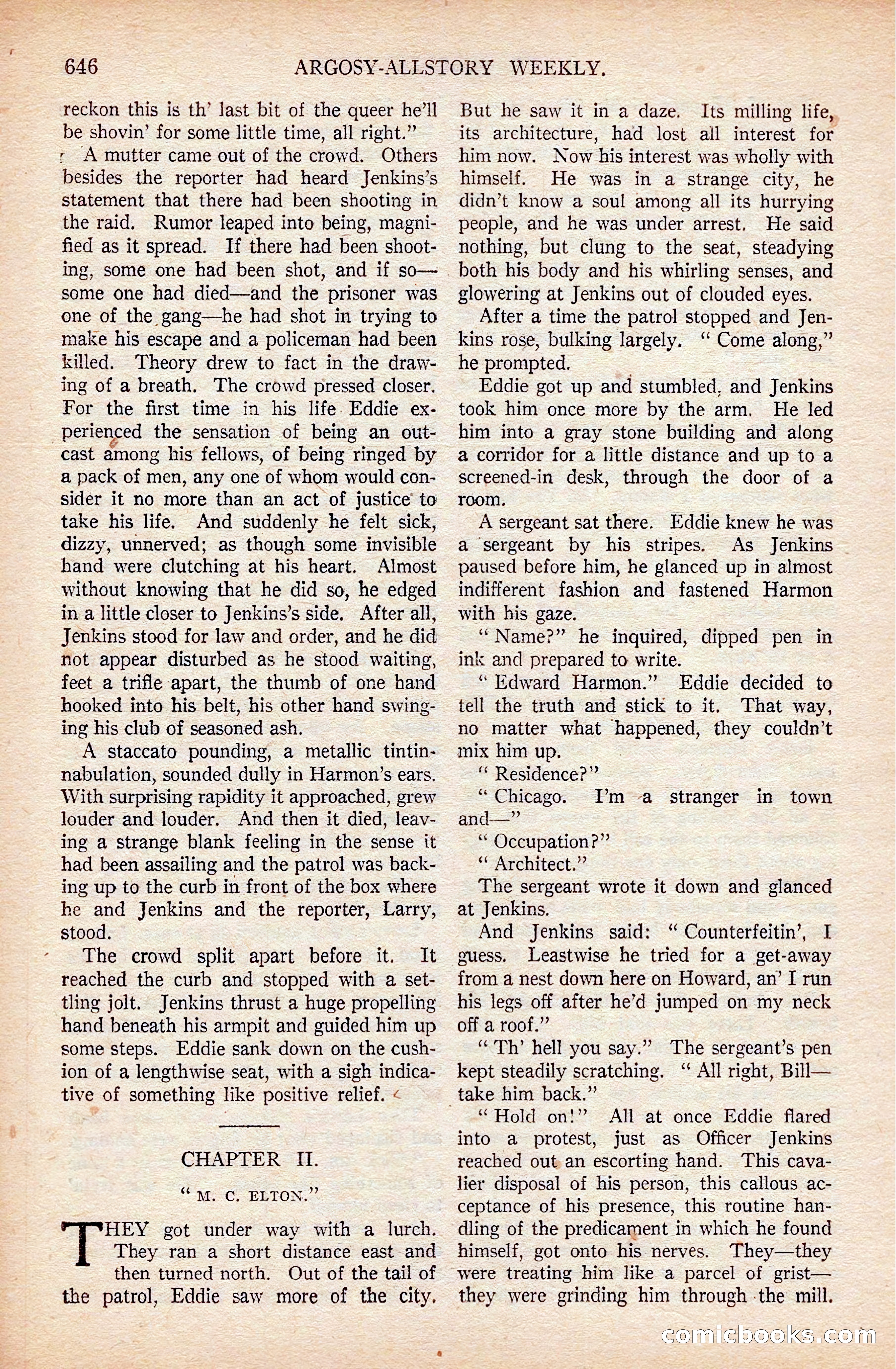
A restored page from Pulp Fiction, 1924. Page through the whole issue in the reader above.
📄 Transcribed text from this page (OCR, searchable)
Machine-transcribed from the original scan — historical spelling and the odd misread are preserved.
646 reckon this is th’ last bit of the queer he’ll be shovin’ for some little time, all right.” r A mutter came out of the crowd. Others besides the reporter had heard Jenkins’s statement that there had been shooting in the raid. Rumor leaped into being, magni- fied as it spread. If there had been shoot- ing, some one had been shot, and if so—~ some one had died—and the prisoner was one of the gang—he had shot in trying to make his escape and a policeman had been killed. Theory drew to fact in the draw- ing of a breath. The crowd pressed closer. For the first time in his life. Eddie ex- -perienced the sensation of being an out- cast among his fellows, of being ringed by a pack of men, any one of whom would con- sider it no more than an act of justice to take his life. And suddenly he felt sick, dizzy, unnerved; as though some invisible hand were clutching at his heart. Almost without knowing that he did so, he edged in a little closer to Jenkins’s side. After all, Jenkins stood for law and order, and he did not appear disturbed as he stood waiting, feet a trifle apart, the thumb of one hand hooked into his belt, his other hand swing- ing his club of seasoned ash. A staccato pounding, a metallic tintin- nabulation, sounded dully in Harmon’s ears. With surprising rapidity it approached, grew louder and louder. And then it died, leav- ing a strange blank feeling in the sense it had been assailing and the patrol was back- ing up to the curb in front of the box where he and Jenkins and the reporter, Larry, stood. The crowd split apart before it. It reached the curb and stopped with a set- tling jolt. Jenkins thrust a huge propelling hand beneath his armpit and guided him up some steps. Eddie sank down on the cush- ion of a lengthwise seat, with a sigh indica- tive of something like positive relief. < CHAPTER Ii. “uM. C. ELTON.” HEY got under way with a lurch. They ran a short distance east and then turned north. Out of the tail of the patrol, Eddie saw more of the city. ARGOSY-ALLSTORY WEEKLY, But he saw it in a daze. Its milling life, its architecture, had lost all interest for him now. Now his interest was wholly with himself. He was in a strange city, he didn’t know a soul among all its hurrying people, and he was under arrest. He said nothing, but clung to the seat, steadying _both his body and his whirling senses, and glowering at Jenkins out of clouded eyes. After a time the patrol stopped and Jen- kins rose, bulking largely. ‘‘ Come along,” he prompted. Eddie got up and stumbled. and Jenkins took him once more by the arm. He led him into a gray stone building and along a corridor for a little distance and up to a screened-in desk, through the door of a room. A sergeant sat there. Eddie knew he was a sergeant by his stripes. paused before him, he glanced up in almost indifferent fashion and fastened Harmon with his gaze. “Name?” he inquired, dipped pen in ink and prepared to write. “ Edward Harmon.” Eddie decided to tell the truth and stick to it. That way, no matter what happened, they couldn’t mix him up. ‘ Residence?” “Chicago. I’m -a stranger in town and—” “ Occupation?” ‘ Architect.” The sergeant wrote it down and glanced at Jenkins. And Jenkins said: ‘“ Counterfeitin’, I euess. Leastwise he tried for a get-away from a nest down here on Howard, an’ I run his legs off after he’d jumped on my neck off a roof.” ‘Th’ hell you say.” The sergeant’s pen kept steadily scratching. ‘“‘ All right, Bill— take him back.” “Hold on!” All at once Eddie flared into a protest, just as Officer Jenkins reached out an escorting hand. This cava- lier disposal of his person, this callous ac- ceptance of his presence, this routine han- dling of the predicament in which he found himself, got onto his nerves. They—they were treating him like a parcel of grist— they were grinding him through -the mill. Eomichdooks=co As Jenkins |