
Pulp Fiction, 1924 · page 30 of 176
Argosy All-Story Weekly — page 30: what you’re looking at
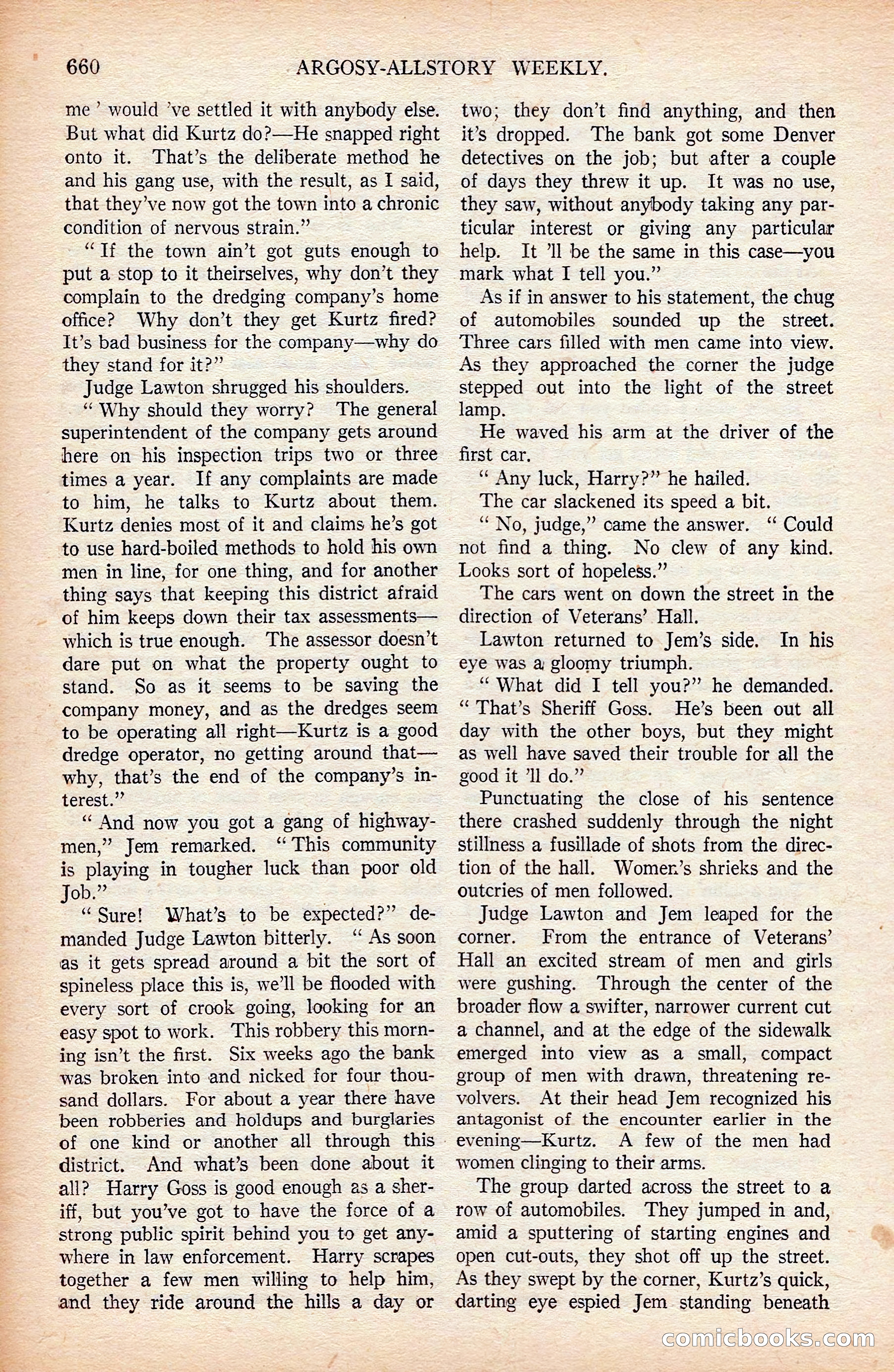
A restored page from Pulp Fiction, 1924. Page through the whole issue in the reader above.
📄 Transcribed text from this page (OCR, searchable)
Machine-transcribed from the original scan — historical spelling and the odd misread are preserved.
660 me’ would ’ve settled it with anybody else. But what did Kurtz do?—He snapped right onto it. That’s the deliberate method he and his gang use, with the result, as I said, that they’ve now got the town into a chronic condition of nervous strain.” “Tf the town ain’t got guts enough to put a stop to it theirselves, why don’t they complain to the dredging company’s home office? Why don’t they get Kurtz fired? It’s bad business for the company—why do they stand for it?”’ Judge Lawton shrugged his shoulders. “Why should they worry? The general superintendent of the company gets around here on his inspection trips two or three times a year. If any complaints are made to him, he talks to Kurtz about them. Kurtz denies most of it and claims he’s got to use hard-boiled methods to hold his own men in line, for one thing, and for another thing says that keeping this district afraid of him keeps down their tax assessments— which is true enough. The assessor doesn’t dare put on what the property ought to stand. So as it seems to be saving the company money, and as the dredges seem to be operating all right—Kurtz is a good dredge operator, no getting around that— why, that’s the end of the company’s in- terest.” “ And now you got a gang of highway- men,” Jem remarked. ‘“ This community is playing in tougher luck than poor old Jo ee “Sure! What’s to be expected?” de- manded Judge Lawton bitterly. “ As soon as it gets spread around a bit the sort of spineless place this is, we’ll be flooded with every sort of crook going, looking for an easy spot to work. This robbery this morn- ing isn’t the first. Six weeks ago the bank was broken into and nicked for four thou- sand dollars. For about a year there have been robberies and holdups and burglaries of one kind or another all through this - district. And what’s been done about it all? Harry Goss is good enough as a sher- iff, but you’ve got to have the force of a strong public spirit behind you to get any- where in law enforcement. Harry scrapes together a few men willing to help him, and they ride around the hills a day or ARGOSY-ALLSTORY WEEKLY, two; they don’t find anything, and then it’s dropped. The bank got some Denver detectives on the job; but after a couple of days they threw it up. It was no use, they saw, without anybody taking any par- ticular interest or giving any particular help. It ‘Il be the same in this case—you mark what I tell you.” As if in answer to his statement, the chug of automobiles sounded up the street. Three cars filled with men came into view. As they approached the corner the judge stepped out into the light of the street lamp. 3 He waved his arm at the driver of the first car, ‘““ Any luck, Harry?” he hailed. The car slackened its speed a bit. ‘No, judge,” came the answer. ‘“ Could not find a thing. No clew of any kind. Looks sort of hopeless.” The cars went on down the street in the direction of Veterans’ Hall. Lawton returned to Jem’s side. eye was a gloomy triumph. “What did I tell you?” he demanded. ‘““ That’s Sheriff Goss. He’s been out all day with the other boys, but they might as well have saved their trouble for all the good it ‘Il do.” Punctuating the close of his sentence there crashed suddenly through the night stillness a fusillade of shots from the direc- tion of the hall. Womer.’s shrieks and the outcries of men followed. Judge Lawton and Jem leaped for the corner. From the entrance of Veterans’ Hall an excited stream of men and girls were gushing. Through the center of the broader flow a swifter, narrower current cut a channel, and at the edge of the sidewalk emerged into view as a small, compact group of men with drawn, threatening re- volvers. At their head Jem recognized his antagonist of the encounter earlier in the eveninge—Kurtz. A few of the men had women clinging to their arms. The group darted across the street to a row of automobiles. They jumped in and, amid a sputtering of starting engines and open cut-outs, they shot off up the street. As they swept by the corner, Kurtz’s quick, darting eye espied Jem standing beneath In his EOmMmiIcGCDooks:co