
Pulp Fiction, 1924 · page 64 of 176
Argosy All-Story Weekly — page 64: what you’re looking at
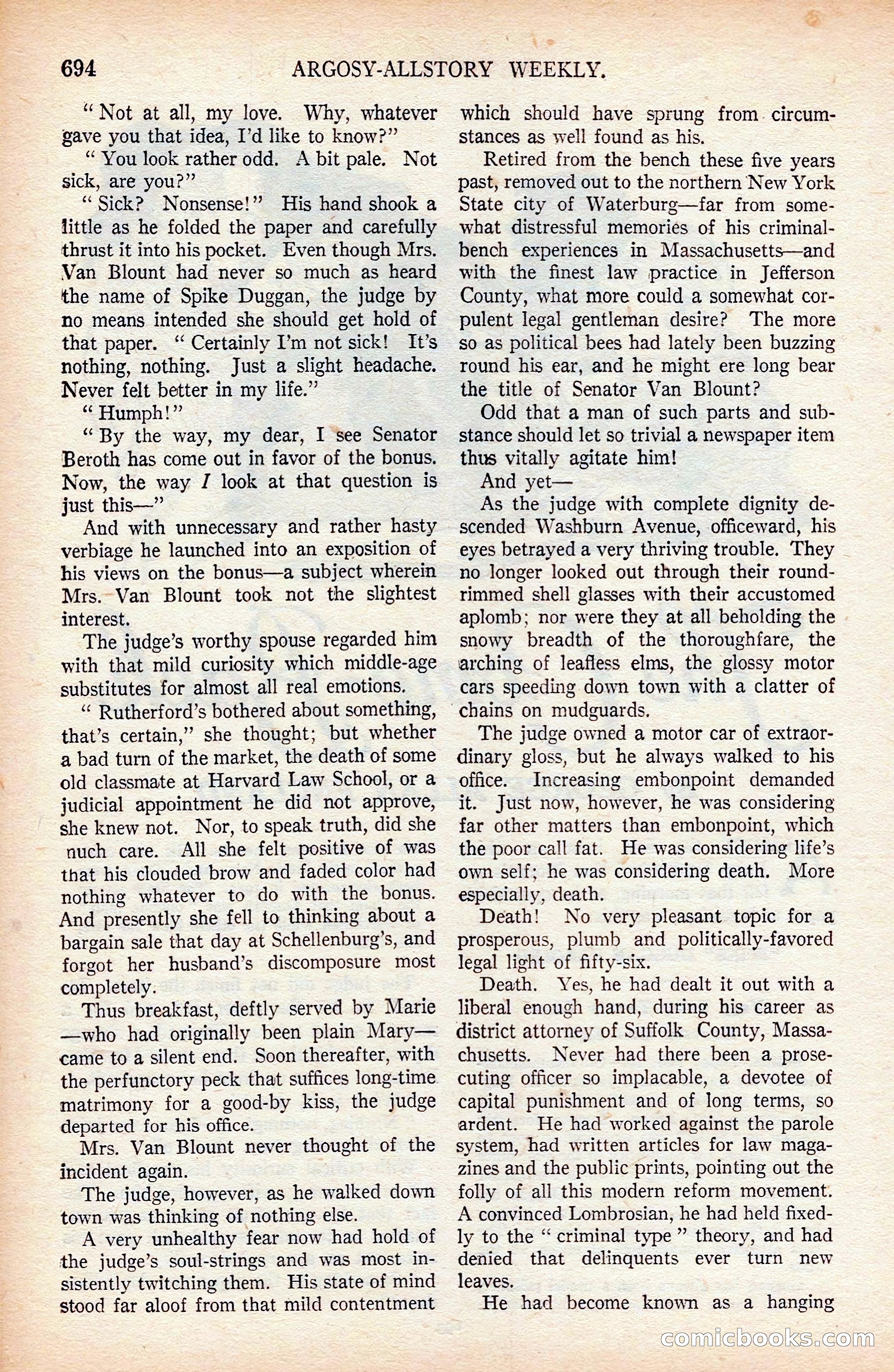
A restored page from Pulp Fiction, 1924. Page through the whole issue in the reader above.
📄 Transcribed text from this page (OCR, searchable)
Machine-transcribed from the original scan — historical spelling and the odd misread are preserved.
694 “Not at all, my love. Why, whatever gave you that idea, I’d like to know?” “You look rather odd. A bit pale. Not sick, are you?” *‘ Sick? Nonsense!” His hand shook a little as he folded the paper and carefully thrust it into his pocket. Even though Mrs. Van Blount had never so much as heard the name of Spike Duggan, the judge by no means intended she should get hold of that paper. ‘‘ Certainly I’m not sick! It’s nothing, nothing. Just a slight headache. Never felt better in my life.” *¢ Humph!” “By the way, my dear, I see Senator Beroth has come out in favor of the bonus. Now, the way J look at that question is just this—” And with unnecessary and rather hasty verbiage he launched into an exposition of his views on the bonus—a subject wherein Mrs.- Van Blount took not the slightest interest. The judge’s worthy spouse regarded him with that mild curiosity which middle-age substitutes for almost all real emotions. “ Rutherford’s bothered about something, that’s certain,” she thought; but whether a bad turn of the market, the death of some old classmate at Harvard Law School, or a judicial appointment he did not approve, she knew not. Nor, to speak truth, did she nuch care. All she felt positive of was that his clouded brow and faded color had nothing whatever to do with the bonus. And presently she fell to thinking about a bargain sale that day at Schellenburg’s, and forgot her husband’s discomposure most completely. Thus breakfast, deftly served by Marie —who had originally been plain Mary— came to a silent end. Soon thereafter, with the perfunctory peck that suffices long-time matrimony for a good-by kiss, the judge departed for his office. Mrs. Van Blount never thought of the incident again. The judge, however, as he walked down town was thinking of nothing else. A very unhealthy fear now had hold of the judge’s soul-strings and was most in- sistently twitching them. His state of mind stood far aloof from that mild contentment ARGOSY-ALLSTORY WEEKLY. Which should have sprung from. circum- stances as well found as his. Retired from the bench these five years past, removed out to the northern New York State city of Waterburg—far from some- what distressful memories of his criminal- bench experiences in Massachusetts—and with the finest law practice in Jefferson County, what more could a somewhat cor- pulent legal gentleman desire? The more so as political bees had lately been buzzing round his ear, and he might ere long bear the title of Senator Van Blount? Odd that a man of such parts and sub- stance should let so trivial a newspaper item thus vitally agitate him! And yet— As the judge with complete dignity de- scended Washburn Avenue, officeward, his eyes betrayed a very thriving trouble. They no longer looked out through their round- rimmed shell glasses with their accustomed aplomb; nor were they at all beholding the snowy breadth of the thoroughfare, the arching of leafless elms, the glossy motor cars speeding down town with a clatter of chains on mudguards, The judge owned a motor car of extraor- dinary gloss, but he always walked to his office. Increasing embonpoint demanded it. Just now, however, he was considering far other matters than embonpoint, which the poor call fat. He was considering life’s own self; he was considering death. More especially, death. Death! No very pleasant topic for a prosperous, plumb and politically-favored legal light of fifty-six. Death. Yes, he had dealt it out with a liberal enough hand, during his career as district attorney of Suffolk County, Massa- chusetts. Never had there been a prose- cuting officer so implacable, a devotee of capital punishment and of long terms, so ardent. He had worked against the parole system, had written articles for law maga- zines and the public prints, pointing out the folly of all this modern reform movement. A convinced Lombrosian, he had held fixed- ly to the ‘‘ criminal type ” theory, and had denied that delinquents ever turn new leaves. He had become known as a hanging oO Commicoooks (c©)