
Pulp Fiction, 1924 · page 68 of 176
Argosy All-Story Weekly — page 68: what you’re looking at
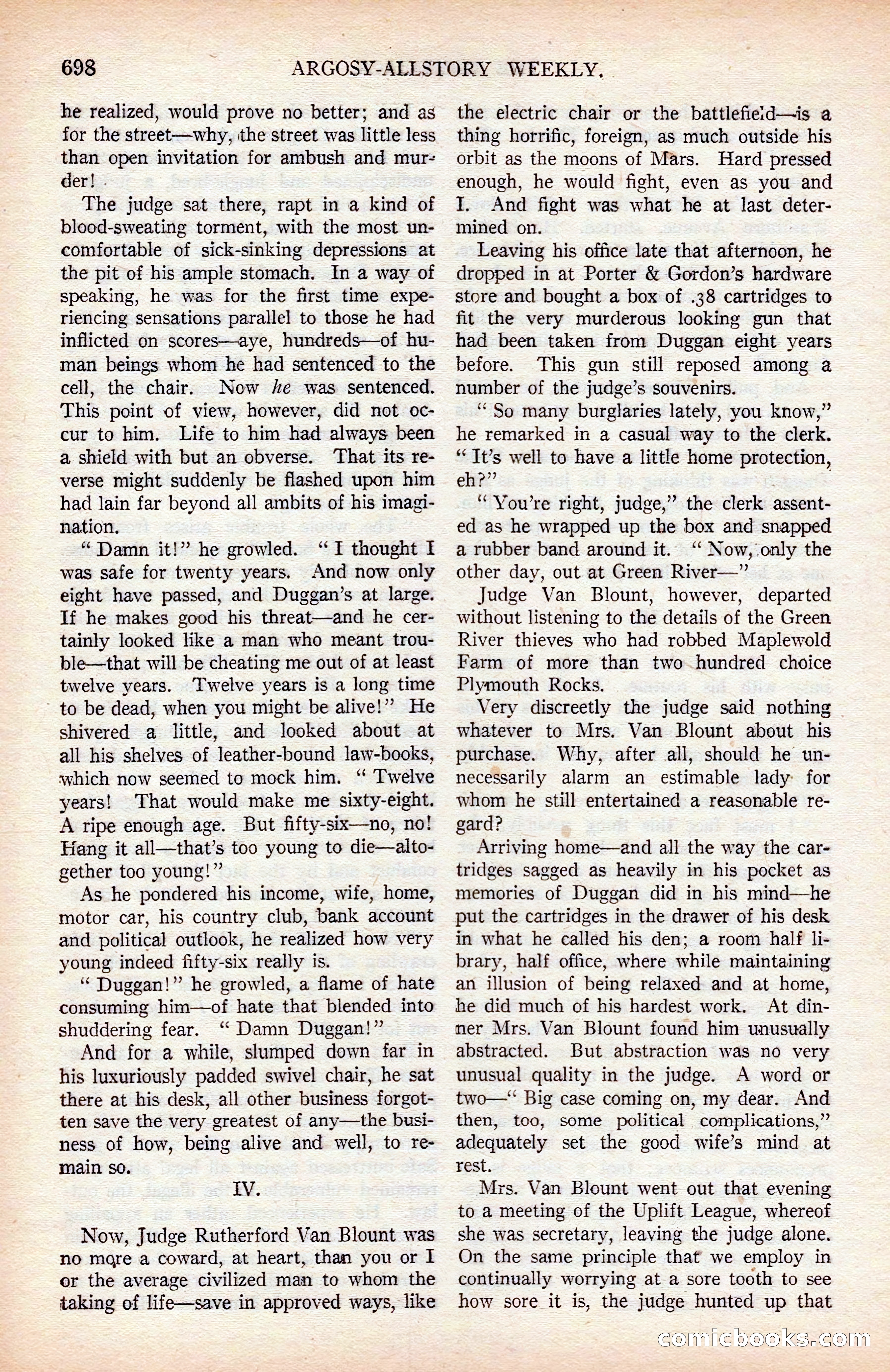
A restored page from Pulp Fiction, 1924. Page through the whole issue in the reader above.
📄 Transcribed text from this page (OCR, searchable)
Machine-transcribed from the original scan — historical spelling and the odd misread are preserved.
698 he realized, would prove no better; and as for the street—why, ‘the street was little less than open invitation for ambush and mur- der! . The judge sat there, rapt in a kind of blood-sweating torment, with the most un- comfortable of sick-sinking depressions at the pit of his ample stomach. In a way of speaking, he was for the first time expe- riencing sensations parallel to those he had inflicted on scores—aye, hundreds—of hu- man beings whom he had sentenced to the cell, the chair. Now se was sentenced. This point of view, however, did not oc- cur to him. Life to him had always been a shield with but an obverse. That its re- verse might suddenly be flashed upon him had lain far beyond all ambits of his imagi- nation. “ Damn it!” he growled. ‘I thought I was safe for twenty years. And now only eight have passed, and Duggan’s at large. If he makes good his threat—and he cer- tainly looked like a man who meant trou- ble—that will be cheating me out of at least twelve years. ‘Twelve years is a long time ~ to be dead, when you might be alive!” He shivered a little, and looked about at all his shelves of leather-bound law-books, which now seemed to mock him. ‘“ Twelve years! That would make me sixty-eight. A ripe enough age. But fifty-six—no, no! Hang it all—that’s too young to die—alto- gether too young!” As he pondered his income, wife, home, motor car, his country club, bank account and political outlook, he realized how very young indeed fifty-six really is. ‘“ Duggan!” he growled, a flame of hate consuming him—of hate that blended into shuddering fear. ‘‘ Damn Duggan!” And for a while, slumped down far in his luxuriously padded swivel chair, he sat there at his desk, all other business forgot- ten save the very greatest of any—the busi- ness of how, being alive and well, to re- main so. TV. Now, Judge Rutherford Van Blount was no more a coward, at heart, than you or lL or the average civilized man to whom the taking of life—save in approved ways, like ARGOSY-ALLSTORY WEEKLY, | the electric chair or the battlefieid—is a thing horrific, foreign, as much outside his orbit as the moons of Mars. Hard pressed enough, he would fight, even as you and I. And fight was what he at last deter- mined on. Leaving his office late that afternoon, he dropped in at Porter & Gordon’s hardware store and bought a box of .38 cartridges to fit the very murderous looking gun that had been taken from Duggan eight years before. This gun still reposed among a number of the judge’s souvenirs. ‘So many burglaries lately, you know,” he remarked in a casual way to the clerk. ““Tt’s well to have a little home protection, eh?” ; “Yow’re right, judge,” the clerk assent- ed as he wrapped up the box and snapped a rubber band around it. ‘“ Now, only the other day, out at Green River—” Judge Van Blount, however, departed without listening to the details of the Green River thieves who had robbed Maplewold Farm of more than two hundred choice Plymouth Rocks. Very discreetly the judge said nothing whatever to Mrs. Van Blount about his purchase. Why, after all, should he un- necessarily alarm an estimable lady: for whom he still entertained a reasonable re- gard? Arriving home—and all the way the car- tridges sagged as heavily in his pocket as memories of Duggan did in his mind—he put the cartridges in the drawer of his desk in what he called his den; a room half li- brary, half office, where while maintaining an illusion of being relaxed and at home, he did much of his hardest work. At din- mer Mrs. Van Blount found him unusually abstracted. But abstraction was no very unusual quality in the judge. A word or two—‘‘ Big case coming on, my dear. And then, too, some political complications,” adequately set the good wife’s mind at rest. Mrs. Van Blount went out that evening to a meeting of the Uplift League, whereof she was secretary, leaving the judge alone. On the same principle that we employ in continually worrying at a sore tooth to see how sore it is, the judge hunted up that Conmmicaoolks (S@)