
Pulp Fiction, 1924 · page 70 of 176
Argosy All-Story Weekly — page 70: what you’re looking at
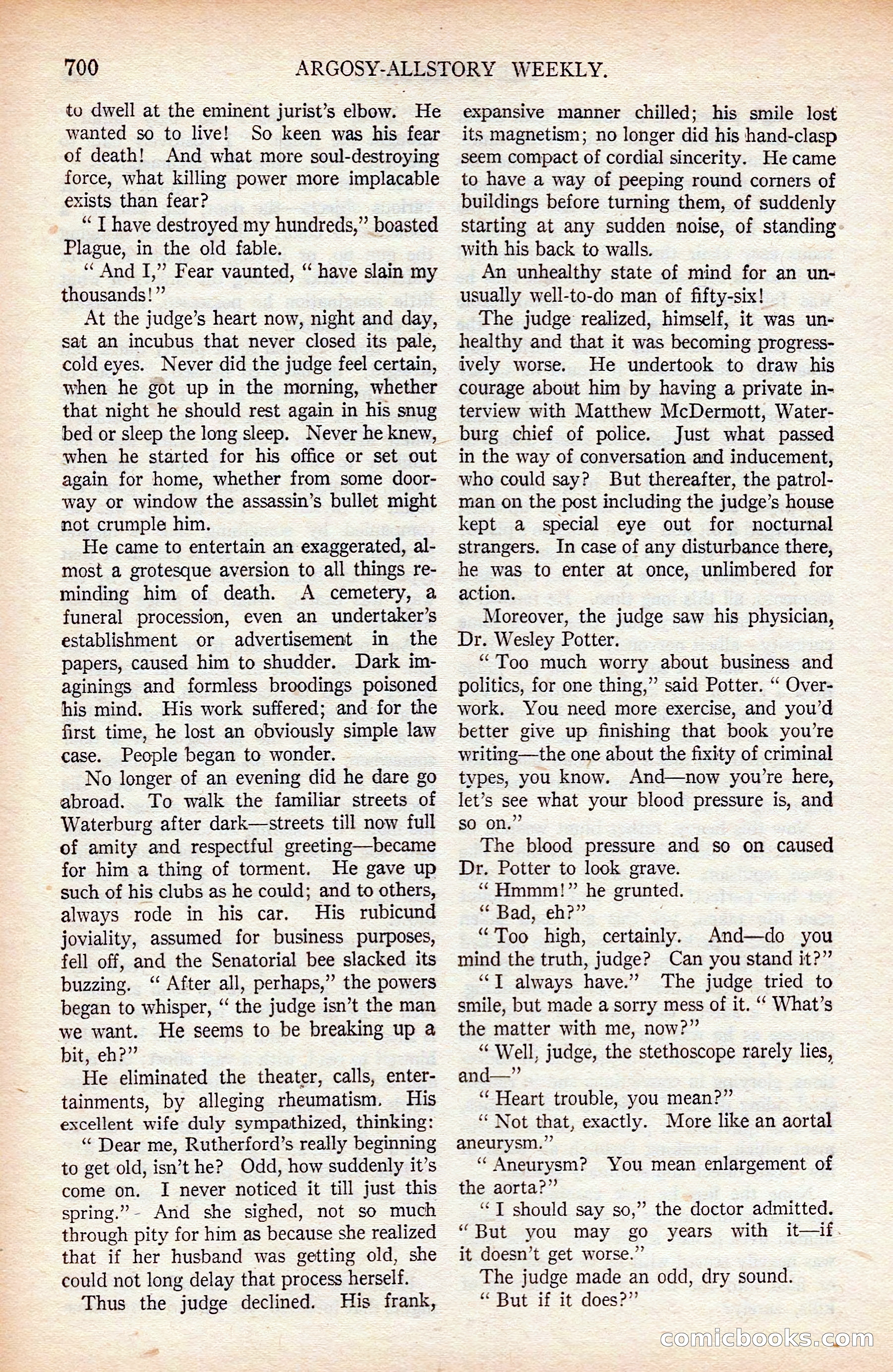
A restored page from Pulp Fiction, 1924. Page through the whole issue in the reader above.
📄 Transcribed text from this page (OCR, searchable)
Machine-transcribed from the original scan — historical spelling and the odd misread are preserved.
700 to dwell at the eminent jurist’s elbow. He wanted so to live! So keen was his fear of death! And what more soul-destroying force, what killing power more implacable exists than fear? “T have destroyed my hundreds,” boasted Plague, in the old fable. “And I,” Fear vaunted, “ have slain my thousands!” At the judge’s heart now, night and day, sat an incubus that never closed its pale, cold eyes. Never did the judge feel certain, when he got up in the morning, whether that night he should rest again in his snug bed or sleep the long sleep. Never he knew, when he started for his office or set out again for home, whether from some door- way or window the assassin’s bullet might mot crumple him. He came to entertain an exaggerated, al- most a grotesque aversion to all things re- minding him of death. A cemetery, a funeral procession, even an undertaker’s establishment or advertisement in the papers, caused him to shudder. Dark im- aginings and formless broodings poisoned his mind. His work suffered; and for the first time, he lost an obviously simple law case. People began to wonder. No longer of an evening did he dare go abroad. To walk the familiar streets of Waterburg after dark—streets till now full of amity and respectful greeting—became for him a thing of torment. He gave up such of his clubs as he could; and to others, always rode in his car. His rubicund joviality, assumed for business purposes, fell off, and the Senatorial bee slacked its buzzing. “ After all, perhaps,” the powers began to whisper, ‘“‘ the judge isn’t the man we want. He seems to be breaking up a bit, eh?” He eliminated the theater, calls, enter- tainments, by alleging rheumatism. His excellent wife duly sympathized, thinking: “ Dear me, Rutherford’s really beginning to get old, isn’t he? Odd, how suddenly it’s come on. I never noticed it till just this spring.”- And she sighed, not so much through pity for him as because she realized that if her husband was getting old, she could not long delay that process herself. Thus the judge declined. His frank, ARGOSY-ALLSTORY WEEKLY. expansive manner chilled; his smile lost its magnetism; no longer did his hand-clasp seem compact of cordial sincerity. He came to have a way of peeping round corners of buildings before turning them, of suddenly starting at any sudden noise, of standing with his back to walls. An unhealthy state of mind for an un- usually well-to-do man of fifty-six! The judge realized, himself, it was un- healthy and that it was becoming progress- ively worse. He undertook to draw his courage about him by having a private in- terview with Matthew McDermott, Water- burg chief of police. Just what passed in the way of conversation and inducement, who could say? But thereafter, the patrol- man on the post including the judge’s house kept a special eye out for nocturnal strangers. In case of any disturbance there, he was to enter at once, unlimbered for action. Moreover, the judge saw his physician, Dr. Wesley Potter. “Too much worry about business and politics, for one thing,” said Potter. “ Over- work. You need more exercise, and you’d better give up finishing that book you're writing—the one about the fixity of criminal types, you know. And—now you're here, let’s see what your blood pressure is, and so on.” The blood pressure and so on caused Dr. Potter to look grave. “Hmmm!” he grunted. ** Bad, eh?” : “Too high, certainly. And—do you mind the truth, judge? Can you stand it?” ‘““T always have.” The judge tried to smile, but made a sorry mess of it. “‘ What’s the matter with me, now?” “Well, judge, the stethoscope rarely lies, and—” “Heart trouble, you mean?” ‘Not that, exactly. More like an aortal aneurysm.” ‘“* Aneurysm? the aorta?” ‘“T should say so,” the doctor admitted. You mean enlargement of “But you may go years with it—if. it doesn’t get worse.” The judge made an odd, dry sound. “ But if it does?” oO Comicoooks