
Pulp Fiction, 1924 · page 72 of 176
Argosy All-Story Weekly — page 72: what you’re looking at
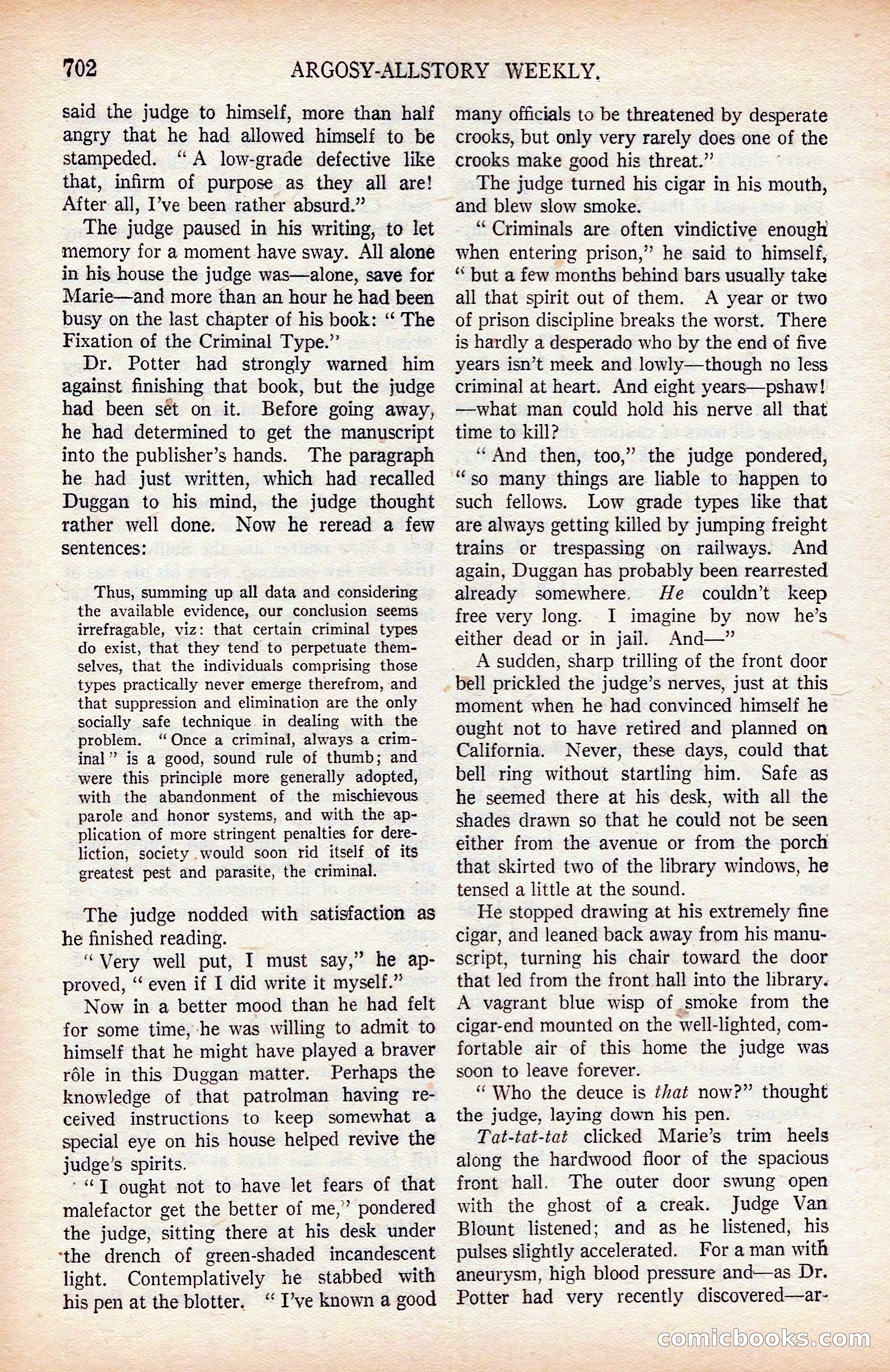
A restored page from Pulp Fiction, 1924. Page through the whole issue in the reader above.
📄 Transcribed text from this page (OCR, searchable)
Machine-transcribed from the original scan — historical spelling and the odd misread are preserved.
102 said the judge to himself, more than half angry that he had allowed himself to be stampeded. ‘A low-grade defective like that, infirm of purpose as they all are! After all, I’ve been rather absurd.” The judge paused in his writing, to let memory for a moment have sway. All alone in his house the judge was—alone, save for Marie—and more than an hour he had been busy on the last chapter of his book: ‘“‘ The Fixation of the Criminal Type.”’ Dr. Potter had strongly warned him against finishing that book, but the judge had been sét on it. Before going away, he had determined to get the manuscript into the publisher’s hands. The paragraph he had just written, which had recalled Duggan to his mind, the judge thought rather well done. Now he reread a few sentences: Thus, summing up all data and considering the available evidence, our conclusion seems irrefragable, viz: that certain criminal types do exist, that they tend to perpetuate them- selves, that the individuals comprising those types practically never emerge therefrom, and that suppression and elimination are the only socially safe technique in dealing with the problem. ‘Once a criminal, always a crim- inal” is a good, sound rule of thumb; and were this principle more generally adopted, with the abandonment of the mischievous parole and honor systems, and with the ap- plication of more stringent penalties for dere- liction, society would soon rid itself of its ereatest pest and parasite, the criminal. The judge nodded with satisfaction as he finished reading. ‘Very well put, I must say,” he ap- proved, ‘‘ even if I did write it myself.” Now in a better mood than he had felt for some time, -he was willing to admit to himself that he might have played a braver réle in this Duggan matter. Perhaps the knowledge of that patrolman having re- ceived instructions to keep somewhat a special eye on his house helped revive the judge’s spirits. '“T ought not to have let fears of that malefactor get the better of me,’ pondered the judge, sitting there at his desk under ‘the drench of green-shaded incandescent light. Contemplatively he stabbed with his pen at the blotter. ‘“ I’ve known a good already somewhere. ARGOSY-ALLSTORY WEEKLY. many officials to be threatened by desperate crooks, but only very rarely does one of the crooks make good his threat.” The judge turned his cigar in his mouth, and blew slow smoke. “Criminals are often vindictive enough when entering prison,” he said to himself, ‘“ but a few months behind bars usually take all that spirit out of them. A year or two of prison discipline breaks the worst. There is hardly a desperado who by the end of five years isn’t meek and lowly—though no less criminal at heart. And eight years—pshaw! —what man could hold his nerve all that time to kill? ‘And then, too,” the judge pondered, “so many things are liable to happen to such fellows. Low grade types like that are always getting killed by jumping freight trains or trespassing on railways. And again, Duggan has probably been rearrested He couldn’t keep free very long. I imagine by now he’s either dead or in jail. And—” A sudden, sharp trilling of the front door bell prickled the judge’s nerves, just at this moment when he had convinced himself he ought not to have retired and planned on California. Never, these days, could that bell ring without startling him. Safe as he seemed there at his desk, with all the shades drawn so that he could not be seen either from the avenue or from the porch that skirted two of the library windows, he tensed a little at the sound. He stopped drawing at his extremely fine cigar, and leaned back away from his manu- script, turning his chair toward the door that led from the front hall into the library. A vagrant blue wisp of smoke from the cigar-end mounted on the well-lighted, com- fortable air of this home the judge was soon to leave forever. | “ Who the deuce is ‘kat now?” thought the judge, laying down his pen. Tat-tat-tat clicked Marie’s trim heels along the hardwood floor of the spacious front hall. The outer door swung open with the ghost of a creak. Judge Van Blount listened; and as he listened, his pulses slightly accelerated. For a man with aneurysm, high blood pressure and—as Dr. Potter had very recently discovered—ar- Comicdooks (S@) |