
Pulp Fiction, 1924 · page 84 of 176
Argosy All-Story Weekly — page 84: what you’re looking at
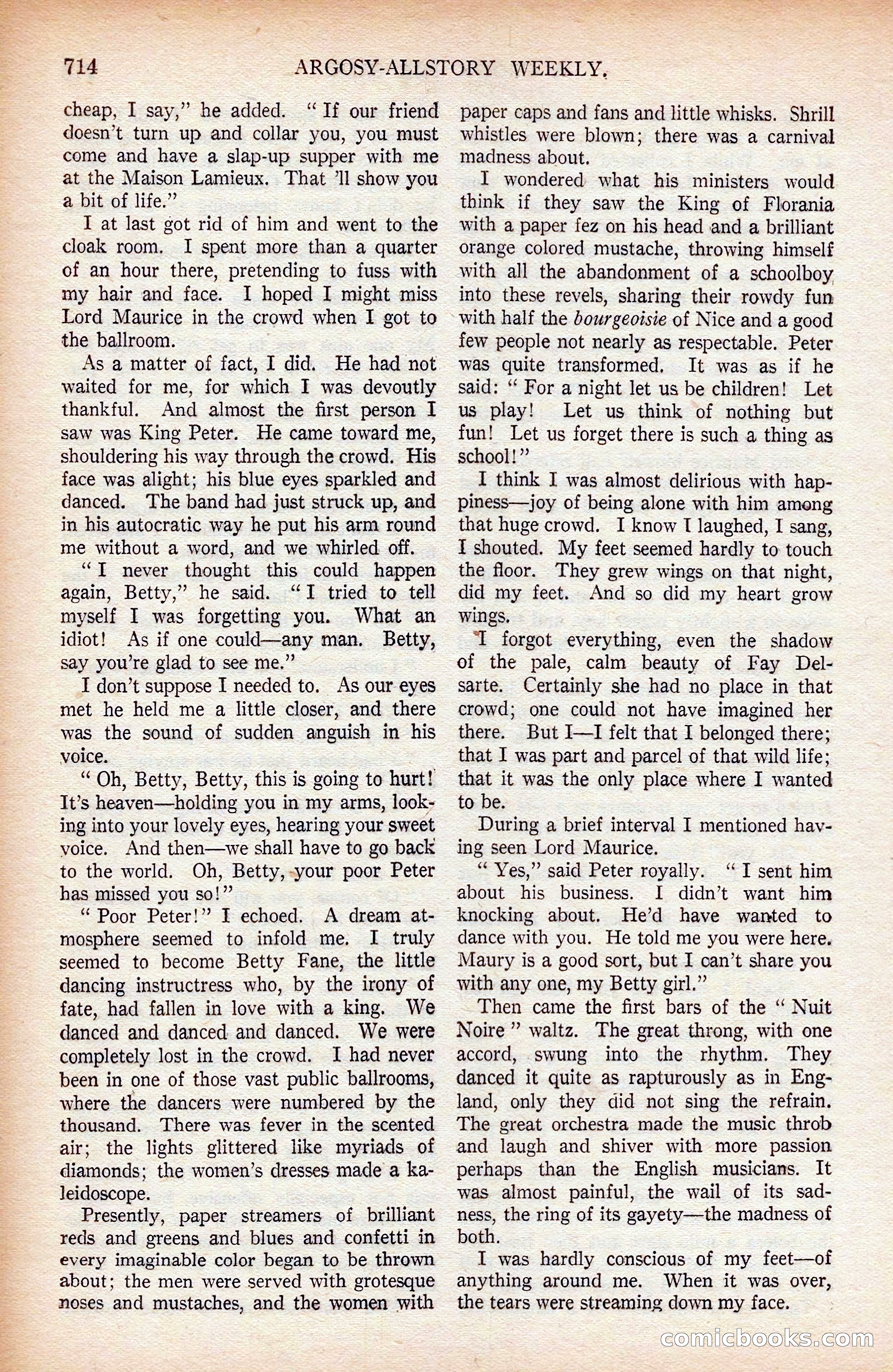
A restored page from Pulp Fiction, 1924. Page through the whole issue in the reader above.
📄 Transcribed text from this page (OCR, searchable)
Machine-transcribed from the original scan — historical spelling and the odd misread are preserved.
714 cheap, I say,” he added. “Jf our friend doesn’t turn up and collar you, you must come and have a slap-up supper with me at the Maison Lamieux. That ll show you a bit of life.” I at last got rid of him and went to the cloak room. I spent more than a quarter of an hour there, pretending to fuss with my hair and face. I hoped I might miss Lord Maurice in the crowd when I got to the ballroom. As a matter of fact, I did. He had not waited for me, for which I was devoutly thankful. And almost the first person I saw was Kine Peter. He came toward me, shouldering his way through the crowd. His face was alight; his blue eyes sparkled and danced. The band had just struck up, and in his autocratic way he put his arm round me without a word, and we whirled off. “JT never thought this could happen again, Betty,” he said. “TI tried to tell myself I was forgetting you. What an idiot! As if one could—any man. Betty, say you’re glad to see me.” I don’t suppose I needed to. As our eyes met he held me a little closer, and there was the sound of sudden anguish in his voice. “Oh, Betty, Betty, this is going to hurt! It’s heaven—holding you in my arms, look- ing into your lovely eyes, hearing your sweet voice. And then—we shall have to go back to the world. Oh, Betty,-your poor Peter has missed you so!” “ Poor Peter!” I echoed. A dream at- mosphere seemed to infold me. I truly seemed to become Betty Fane, the little dancing instructress who, by the irony of fate, had fallen in love with a king. We danced and danced and danced. We were completely lost in the crowd. I had never been in one of those vast public ballrooms, where the dancers were numbered by the thousand. There was fever in the scented air; the lights glittered like myriads of diamonds; the women’s dresses made a ka- leidoscope. Presently, paper streamers of brilliant reds and greens and blues and confetti in every imaginable color began to be thrown about; the men were served with grotesque noses and mustaches, and the women with ARGOSY-ALLSTORY WEEKLY, paper caps and fans and little whisks. Shrill whistles were blown; there was a carnival madness about. I wondered what his ministers would think if they saw the King of Florania with a paper fez on his head and a brilliant orange colored mustache, throwing himself with all the abandonment of a schoolboy into these revels, sharing their rowdy fun with half the bourgeoisie of Nice and a good few people not nearly as respectable. Peter was quite transformed. It was as if he said: “ For a night let us be children! Let us play! Let us think of nothing but fun! Let us forget there is such a thing as school!” I think I was almost delirious with hap- piness—joy of being alone with him among that huge crowd. I know I laughed, I sang, T shouted. My feet seemed hardly to touch the floor. They grew wings on that night, did my feet. And so did my heart grow wings, I forgot everything, even the shadow of the pale, calm beauty of Fay Del- sarte. Certainly she had no place in that crowd; one could not have imagined her there. But I—TI felt that I belonged there; that I was part and parcel of that wild life; that it was the only place where I wanted to be. During a brief interval I mentioned hav- ing seen Lord Maurice. “Yes,” said Peter royally. “TI sent him about his business. I didn’t want him knocking about. He’d have wanted to dance with you. He told me you were here. Maury is a good sort, but I can’t share you with any one, my Betty girl.” Then came the first bars of the ‘‘ Nuit Noire ” waltz. The great throng, with one accord, swung into the rhythm. They danced it quite as rapturously as in Eng- land, only they did not sing the refrain. The great orchestra made the music throb and laugh and shiver with more passion perhaps than the English musicians. It was almost painful, the wail of its sad- ness, the ring of its gayety—the madness of both. I was hardly conscious of my feet—of anything around me. When it was over, the tears were streaming down my face. CoORmicoookSse©