
Pulp Fiction, 1924 · page 101 of 168
Argosy All-Story Weekly — page 101: what you’re looking at
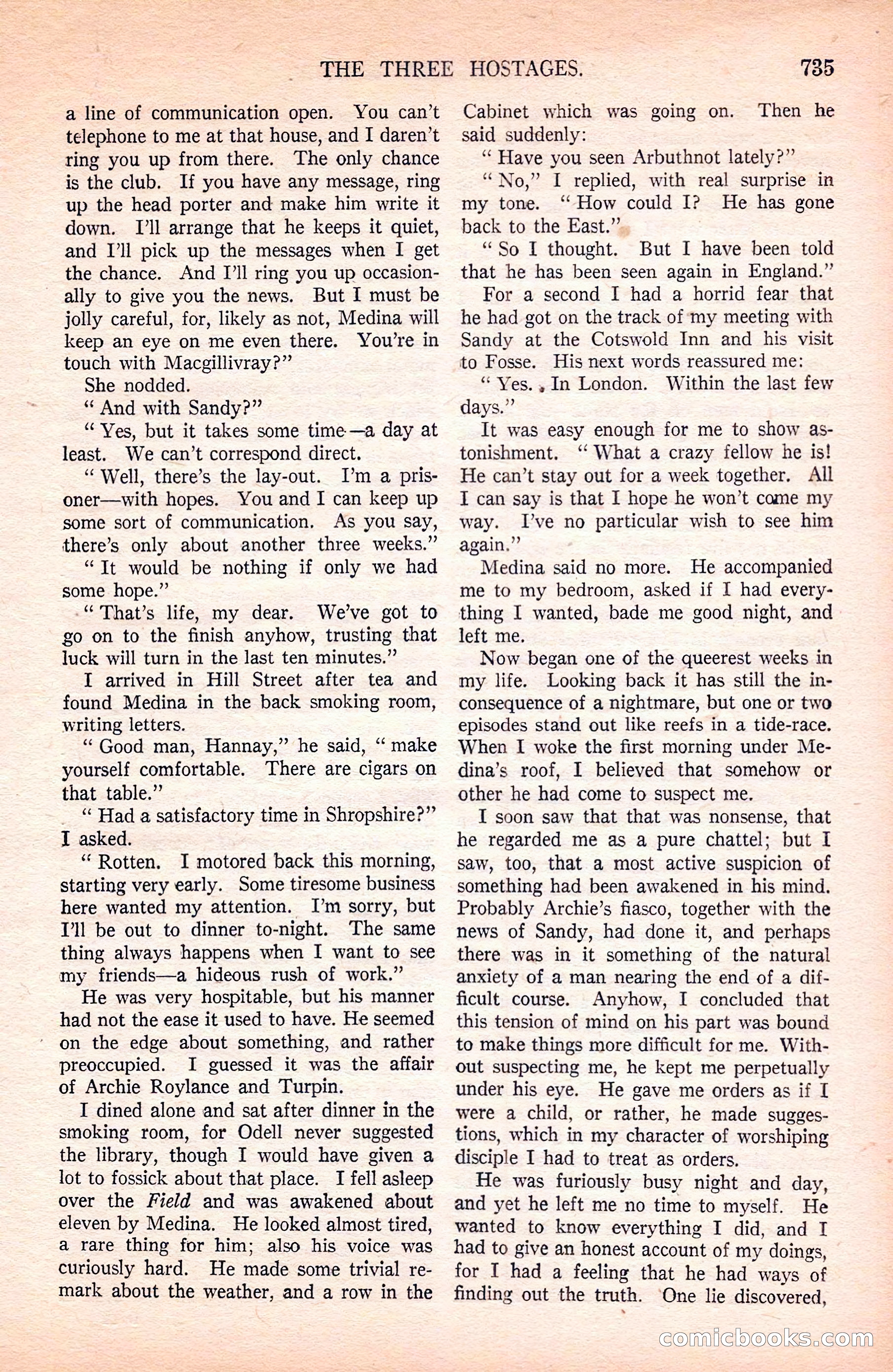
A restored page from Pulp Fiction, 1924. Page through the whole issue in the reader above.
📄 Transcribed text from this page (OCR, searchable)
Machine-transcribed from the original scan — historical spelling and the odd misread are preserved.
THE THREE HOSTAGES. a line of communication open. You can’t telephone to me at that house, and I daren’t ring you up from there. The only chance is the club. If you have any message, ring up the head porter and make him write it down. I'll arrange that he keeps it quiet, and I’ll pick up the messages when I get the chance. And I’ll ring you up occasion- ally to give you the news. But I must be jolly careful, for, likely as not, Medina will keep an eye on me even there. You're in touch with Macgillivray?”’ She nodded. “And with Sandy?” “Ves, but it takes some time —a day at least. We can’t correspond direct. ‘Well, there’s the lay-out. I’m a pris- oner—with hopes. You and I can keep up some sort of communication. As you say, there’s only about another three weeks.” “Tt would be nothing if only we had some hope.” -“'That’s life, my dear. We've got to go on to the finish anyhow, trusting that luck will turn in the last ten minutes.” I arrived in Hill Street after tea and found Medina in the back smoking room, writing letters. “Good man, Hannay,’ he said, ‘“‘ make yourself comfortable. There are cigars on that table.”’ _ “Had a satisfactory time in Shropshire?” I asked. “ Rotten. I motored back this morning, starting very early. Some tiresome business here wanted my attention. I’m sorry, but I’ll be out to dinner to-night. The same thing always happens when I want to see my friends—a hideous rush of work.” He was very hospitable, but his manner had not the ease it used to have. He seemed on the edge about something, and rather preoccupied. I guessed it was the affair of Archie Roylance and Turpin. I dined alone and sat after dinner in the smoking room, for Odell never suggested the library, though I would have given a lot to fossick about that place. I fell asleep over the Field and was awakened about eleven by Medina. He looked almost tired, a rare thing for him; also his voice was curiously hard. He made some trivial re- mark about the weather, and a row in the (635) Cabinet which was going on. Then he said suddenly: ‘Have you seen Arbuthnot lately?” “No,” I replied, with real surprise in my tone. “How could I? He has gone back to the East.” ‘So I thought. But I have been told that he has been seen again in England.” For a second I had a horrid fear that he had got on the track of my meeting with Sandy at the Cotswold Inn and his visit to Fosse. His next words reassured me: “ Yes., In London. Within the last few days.” It was easy enough for me to show as- tonishment. ‘‘ What a crazy fellow he is! He can’t stay out for a week together. All I can say is that I hope he won’t come my way. I’ve no particular wish to see him again,” Medina said no more. He accompanied me to my bedroom, asked if I had every- thing I wanted, bade me good night, and left me. Now began one of the queerest weeks in my life. Looking back it has still the in- consequence of a nightmare, but one or two episodes stand out like reefs in a tide-race. When I woke the first morning under Me- dina’s roof, I believed that somehow or other he had come to suspect me. IT soon saw that that was nonsense, that he regarded me as a pure chattel; but I saw, too, that a most active suspicion of something had been awakened in his mind. Probably Archie’s fiasco, together with the news of Sandy, had done it, and perhaps there was in it something of the natural anxiety of a man nearing the end of a dif- ficult course. Anyhow, I concluded that this tension of mind on his part was bound to make things more difficult for me. With- out suspecting me, he kept me perpetually under his eye. He gave me orders as if I were a child, or rather, he made sugges- tions, which in my character of worshiping disciple I had to treat as orders. He was furiously busy night and day, and yet he left me no time to myself. He wanted to know everything I did, and I had to give an honest account of my doings, for I had a feeling that he had ways of finding out the truth. ‘One lie discovered, oO CcomicloOokSs (C@