
Pulp Fiction, 1924 · page 108 of 168
Argosy All-Story Weekly — page 108: what you’re looking at
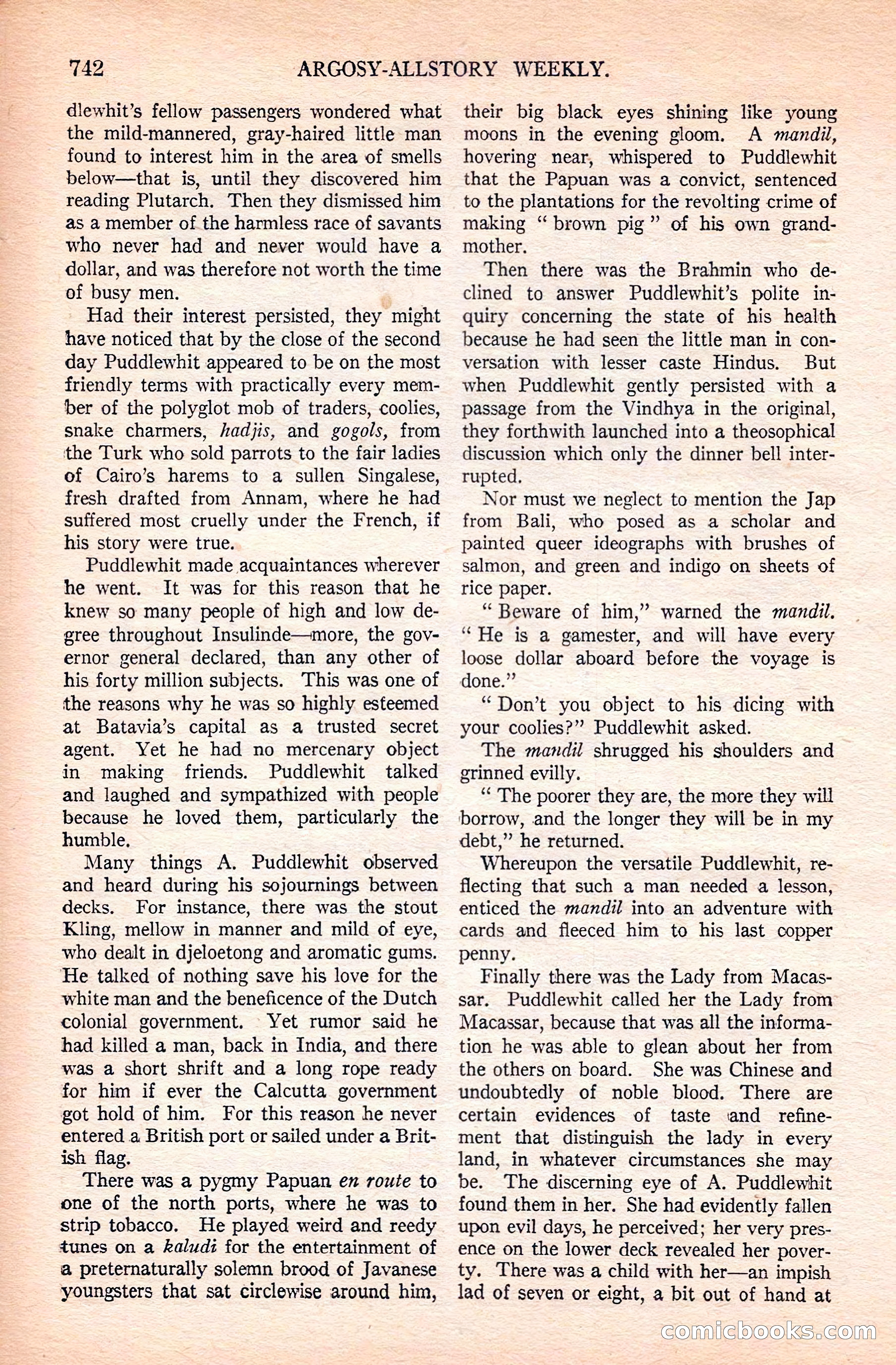
A restored page from Pulp Fiction, 1924. Page through the whole issue in the reader above.
📄 Transcribed text from this page (OCR, searchable)
Machine-transcribed from the original scan — historical spelling and the odd misread are preserved.
742 diewhit’s fellow passengers wondered what the mild-mannered, gray-haired little man found to interest him in the area of smells below—that is, until they discovered him reading Plutarch. Then they dismissed him as a member of the harmless race of savants who never had and never would have a dollar, and was therefore not worth the time of busy men. Had their interest persisted, they might have noticed that by the close of the second day Puddlewhit appeared to be on the most friendly terms with practically every mem- ber of the polyglot mob of traders, coolies, snake charmers, hadjis, and gogols, from the Turk who sold parrots to the fair ladies of Cairo’s harems to a sullen Singalese, fresh drafted from Annam, where he had suffered most cruelly under the French, if his story were true. Puddlewhit made acquaintances wherever he went. It was for this reason that he knew so many people of high and low de- gree throughout Insulinde—more, the gov- ernor general declared, than any other of his forty million subjects. This was one of the reasons why he was so highly esteemed at Batavia’s capital as a trusted secret agent. Yet he had no mercenary object in making friends. Puddlewhit talked and laughed and sympathized with people because he loved them, particularly the humble, Many things A. Puddlewhit observed and heard during his sojournings between decks. For instance, there was the stout Kling, mellow in manner and mild of eye, who dealt in djeloetong and aromatic gums. He talked of nothing save his love for the white man and the beneficence of the Dutch colonial government. Yet rumor said he had killed a man, back in India, and there was a short shrift and a long rope ready for him if ever the Calcutta government got hold of him. For this reason he never entered a British port or sailed under a Brit- ish flag. There was a pygmy Papuan en route to one of the north ports, where he was to strip tobacco. He played weird and reedy tunes on 2 aludit for the entertainment of a preternaturally solemn brood of Javanese youngsters that sat circlewise around him, ARGOSY-ALLSTORY WEEKLY. their big black eyes shining like young moons in the evening gloom. <A mandil, hovering near, whispered to Puddlewhit that the Papuan was a convict, sentenced to the plantations for the revolting crime of making ‘ brown pig” of his own grand- mother. Then there was the Brahmin who de- clined to answer Puddlewhit’s polite in- quiry concerning the state of his health because he had seen the little man in con- versation with lesser caste Hindus. But when Puddlewhit gently persisted with a passage from the Vindhya in the original, they forthwith launched into a theosophical discussion which only the dinner bell inter- rupted, Nor must we neglect to mention the Jap from Bali, who posed as a scholar and painted queer ideographs with brushes of salmon, and green and indigo on sheets of rice paper. “Beware of him,” warned the mandil. ‘He is a gamester, and will have every loose dollar aboard before the voyage is done.” “Don’t you object to his dicing with your coolies?” Puddlewhit asked. The mandi shrugged his shoulders and grinned evilly. ‘The poorer they are, the more they will borrow, and the longer they will be in my debt,” he returned. Whereupon the versatile Puddlewhit, re- flecting that such a man needed a lesson, enticed the mandil into an adventure with cards and fleeced him to his last copper penny. Finally there was the Lady from Macas- sar. Puddlewhit called her the Lady from Macassar, because that was all the informa- tion he was able to glean about her from the others on board. She was Chinese and undoubtedly of noble blood. There are certain evidences of taste «and refine- ment that distinguish the lady in every land, in whatever circumstances she may be. The discerning eye of A. Puddlewhit found them in her. She had evidently fallen upon evil days, he perceived; her very pres- ence on the lower deck revealed her pover- ty. There was a child with her—an impish lad of seven or eight, a bit out of hand at COMMICLOOoOKS Com