
Pulp Fiction, 1924 · page 115 of 168
Argosy All-Story Weekly — page 115: what you’re looking at
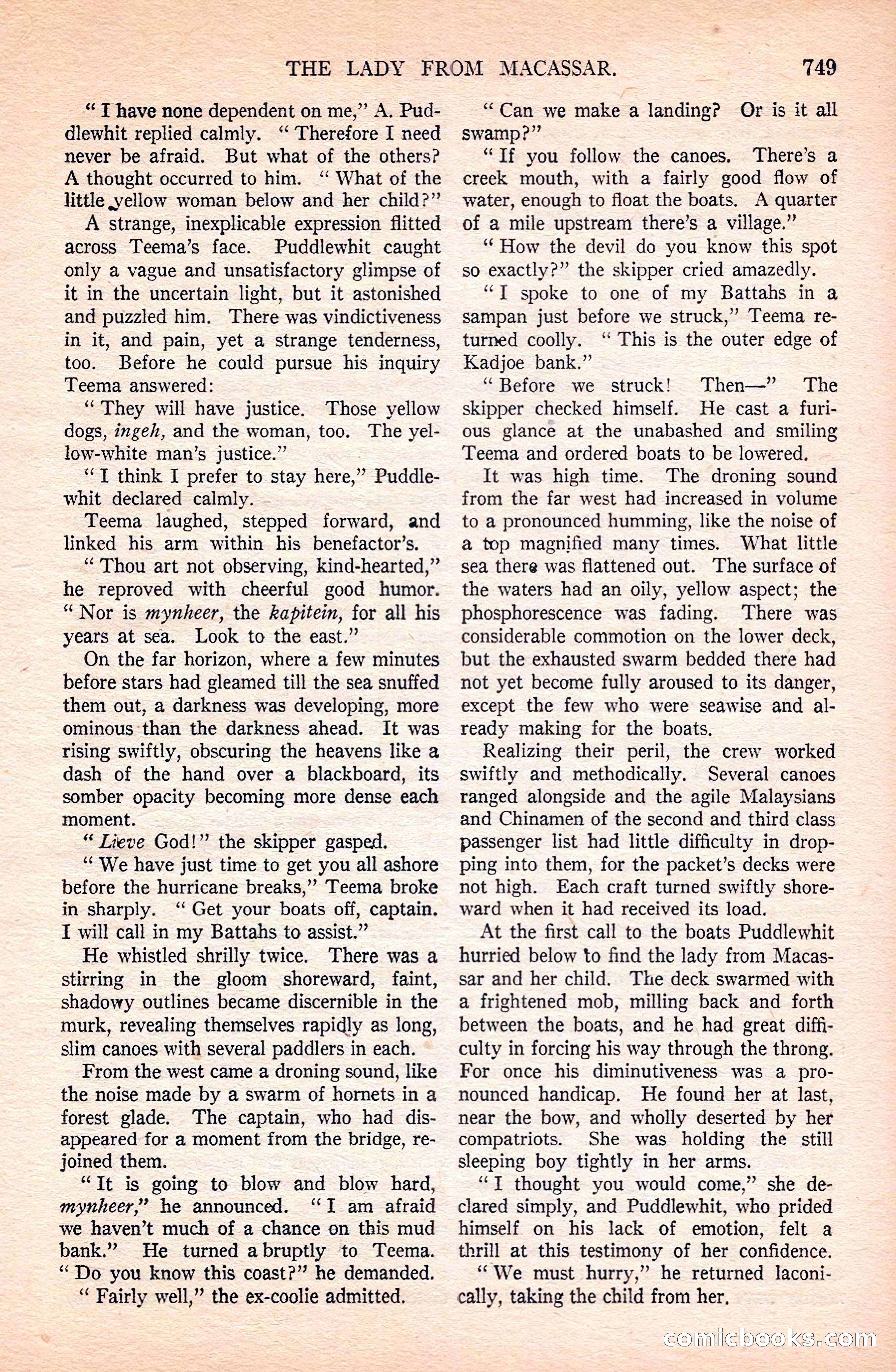
A restored page from Pulp Fiction, 1924. Page through the whole issue in the reader above.
📄 Transcribed text from this page (OCR, searchable)
Machine-transcribed from the original scan — historical spelling and the odd misread are preserved.
THE LADY FROM MACASSAR. *“‘T have none dependent on me,” A. Pud- dlewhit replied calmly. ‘‘ Therefore I need never be afraid. But what of the others? A thought occurred to him. ‘“‘ What of the little yellow woman below and her child?” A strange, inexplicable expression flitted across Teema’s face. Puddlewhit caught only a vague and unsatisfactory glimpse of it in the uncertain light, but it astonished and puzzled him. There was vindictiveness in it, and pain, yet a strange tenderness, too. Before he could pursue his inquiry Teema answered: “They will have justice. Those yellow dogs, ingeh, and the woman, too. The yel- low-white man’s justice.” *‘T think I prefer to stay here,” Puddle- whit declared calmly. Teema laughed, stepped forward, and linked his arm within his benefactor’s. “Thou art not observing, kind-hearted,” he reproved with cheerful good humor. “Nor is mynheer, the kapitein, for all his years at sea. Look to the east.” On the far horizon, where a few minutes before stars had gleamed till the sea snuffed them out, a darkness was developing, more ominous than the darkness ahead. It was rising swiftly, obscuring the heavens like a dash of the hand over a blackboard, its somber opacity becoming more dense each moment. “ Lieve God!” the skipper gasped. ‘We have just time to get you all ashore before the hurricane breaks,” Teema broke in sharply. ‘“‘ Get your boats off, captain. I will call in my Battahs to assist.” He whistled shrilly twice. There was a stirring in the gloom shoreward, faint, shadowy outlines became discernible in the murk, revealing themselves rapidly as long, slim canoes with several paddlers in each. From the west came a droning sound, like the noise made by a swarm of hornets in a forest glade. The captain, who had dis- appeared for a moment from the bridge, re- joined them. “Tt is going to blow and blow hard, mynheer,’ he announced. ‘I am afraid we haven’t much of a chance on this mud bank.” He turned abruptly to Teema. “Do you know this coast?” he demanded. “ Fairly well,” the ex-coolie admitted. 749 ““Can we make a landing? Or is it all swamp?”’ “If you follow the canoes. ‘There’s a creek mouth, with a fairly good flow of water, enough to float the boats. A quarter of a mile upstream there’s a village.” “How the devil do you know this spot so exactly?” the skipper cried amazedly. ‘““J spoke to one of my Battahs in a sampan just before we struck,’ Teema re- turned coolly. ‘‘ This is the outer edge of Kadjoe bank.” “Before we struck! Then—” The skipper checked himself. He cast a furi- ous glance at the unabashed and smiling Teema and ordered boats to be lowered. It was high time. The droning sound from the far west had increased in volume to a pronounced humming, like the noise of a top magnified many times. What little sea there was flattened out. The surface of the waters had an oily, yellow aspect; the phosphorescence was fading. There was considerable commotion on the lower deck, but the exhausted swarm bedded there had not yet become fully aroused to its danger, except the few who were seawise and al- ready making for the boats. Realizing their peril, the crew worked swiftly and methodically. Several canoes ranged alongside and the agile Malaysians and Chinamen of the second and third class passenger list had little difficulty in drop- ping into them, for the packet’s decks were not high. Each craft turned swiftly shore- ward when it had received its load. At the first call to the boats Puddlewhit hurried below to find the lady from Macas- sar and her child. The deck swarmed with a frightened mob, milling back and forth between the boats, and he had great diffi- culty in forcing his way through the throng. For once his diminutiveness was a pro- nounced handicap. He found her at last, near the bow, and wholly deserted by her compatriots. She was holding the still sleeping boy tightly in her arms. “JY thought you would come,” she de- clared simply, and Puddlewhit, who prided himself on his lack of emotion, felt a thrill at this testimony of her confidence. ““We must hurry,” he returned laconi- cally, taking the child from her, CoOMmmicoookkSse©