
Pulp Fiction, 1924 · page 39 of 168
Argosy All-Story Weekly — page 39: what you’re looking at
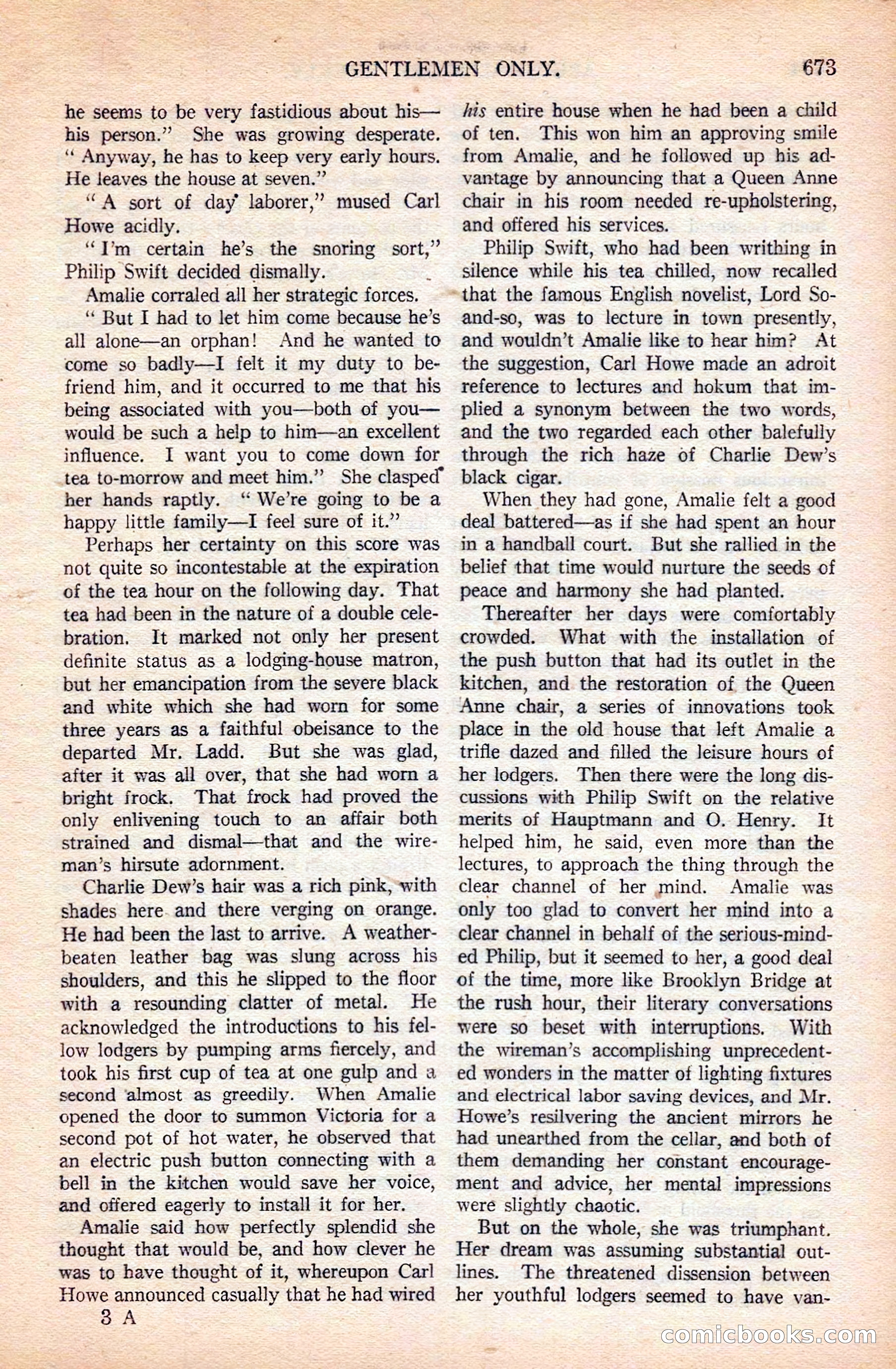
A restored page from Pulp Fiction, 1924. Page through the whole issue in the reader above.
📄 Transcribed text from this page (OCR, searchable)
Machine-transcribed from the original scan — historical spelling and the odd misread are preserved.
GENTLEMEN he seems to be very fastidious about his— his person.” She was growing desperate. ‘* Anyway, he has to keep very early hours. He leaves the house at seven.” ‘““A sort of day’ laborer,” mused Carl Howe acidly. ““T’m certain he’s the snoring = Philip Swift decided dismally. Amalie corraled all her strategic forces. “ But I had to let him come because he’s all alone—an orphan! And he wanted to come so badly—I felt it my duty to be- friend him, and it occurred to me that his being associated with you—both of you— would be such a help to him—an excellent influence. I want you to come down for tea to-morrow and meet him.” She clasped” her hands raptly. ‘“ We’re going to be a happy little family—I feel sure of it.” Perhaps her certainty on this score was not quite so incontestable at the expiration of the tea hour on the following day. That tea had been in the nature of a double cele- bration. It marked not only her present definite status as a lodging-house matron, but her emancipation from the severe black and white which she had worn for some three years as a faithful obeisance to the departed Mr. Ladd. But she was glad, after it was all over, that she had worn a bright frock. That frock had proved the only enlivening touch to an affair both strained and dismal—that and the wire- man’s hirsute adornment. Charlie Dew’s hair was a rich pink, ‘with shades here. and there verging on orange. He had been the last to arrive. A weather- beaten leather bag was slung across his shoulders, and this he slipped to the floor with a resounding clatter of metal. He acknowledged the introductions to his fel- low lodgers by pumping arms fiercely, and took his first cup of tea at one gulp and a second almost as greedily. When Amalie opened the door to summon Victoria for a second pot of hot water, he observed that an electric push button connecting with a bell in the kitchen would save her voice, and offered eagerly to install it for her. Amalie said how perfectly splendid she thought that would be, and how clever he was to have thought of it, whereupon Carl Howe announced casually that he had wired oA ONLY. 6735 his entire house when he had been a child of ten. This won him an approving smile from Amalie, and he followed up his ad- vantage by announcing that a Queen Anne chair in his room needed re-upholstering, and offered his services. Philip Swift, who had been writhing in silence while his tea chilled, now recalled “that the famous English novelist, Lord So- and-so, was to lecture in town presently, and wouldn’t Amalie like to hear him? At the suggestion, Carl Howe made an adroit reference to lectures and hokum that im- plied a synonym between the two words, and the two regarded each other balefully through the rich haze of Charlie Dew’s black cigar. When they had gone, Amalie felt a good deal battered—as if she had spent an hour in a handball court. But she rallied in the belief that time would nurture the seeds of peace and harmony she had planted. Thereafter her days were comfortably crowded. What with the installation of the push button that had its outlet in the kitchen, and the restoration of the Queen Anne chair, a series of innovations took place in the old house that left Amalie a trifle dazed and filled the leisure hours of her lodgers. Then there were the long dis- cussions with Philip Swift on the relative merits of Hauptmann and O. Henry. It helped him, he said, even more than the lectures, to approach the thing through the clear channel of her mind. Amalie was only too glad to convert her mind into a clear channel in behalf of the serious-mind- ed Philip, but it seemed to her, a good deal of the time, more like Brooklyn Bridge at the rush hour, their literary conversations were so beset with interruptions. With the wireman’s accomplishing unprecedent- ed wonders in the matter of lighting fixtures and electrical labor saving devices, and Mr. Howe’s resilvering the ancient mirrors he had unearthed from the cellar, and both of them demanding her constant encourage- ment and advice, her mental impressions weré slightly chaotic. But on the whole, she was triumphant. Her dream was assuming substantial out- lines. The threatened dissension between her youthful lodgers seemed to have van- oO COMMGCELOO S (C@)