
Pulp Fiction, 1924 · page 48 of 168
Argosy All-Story Weekly — page 48: what you’re looking at
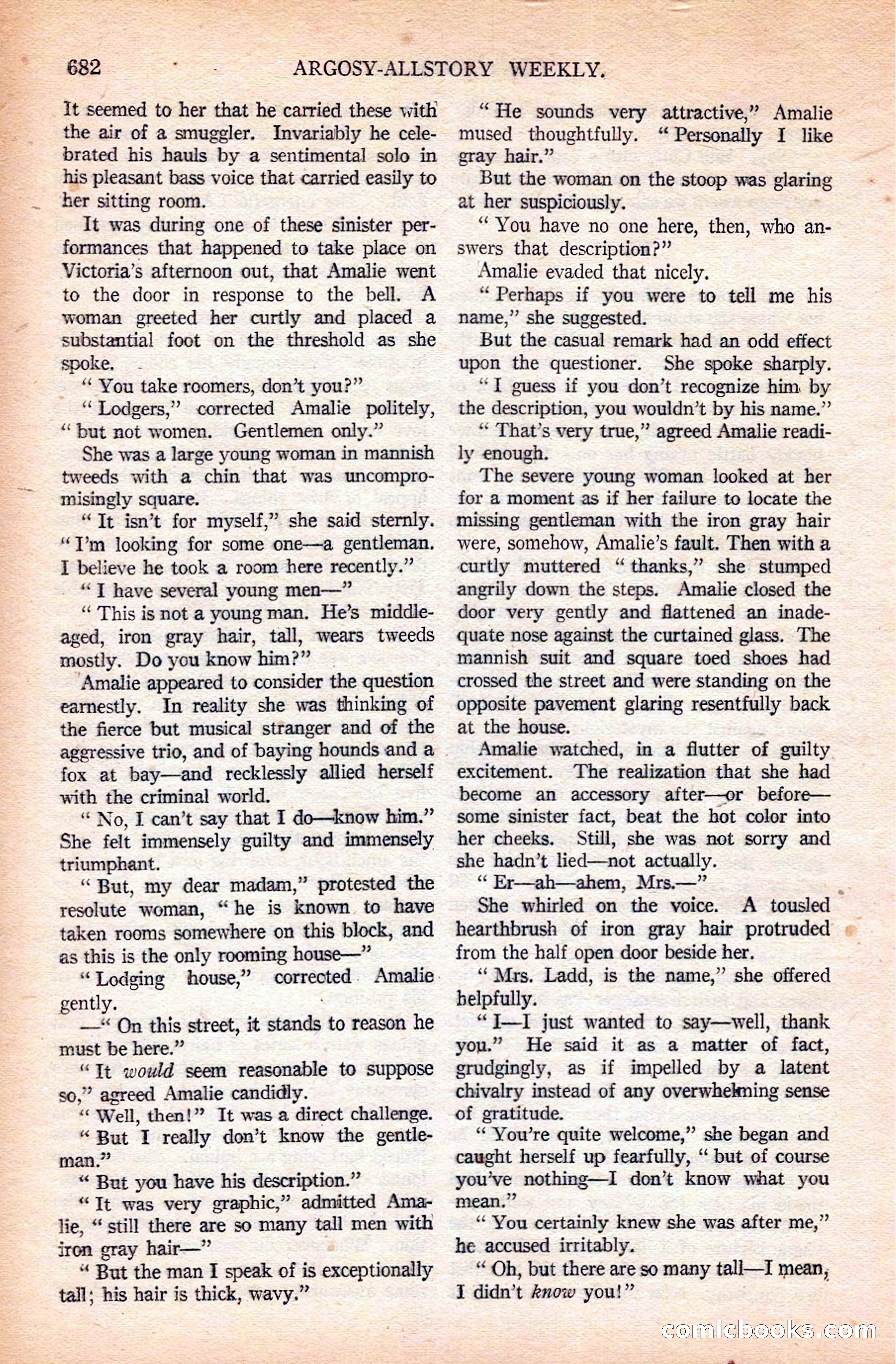
A restored page from Pulp Fiction, 1924. Page through the whole issue in the reader above.
📄 Transcribed text from this page (OCR, searchable)
Machine-transcribed from the original scan — historical spelling and the odd misread are preserved.
— 682 it seemed to her that he carried these with the air of a smuggler. Invariably he cele- brated his hauls by a sentimental solo in his pleasant bass voice that carried easily to her sitting room. It was during one of these sinister per- formances that happened to take place on Victoria’s afternoon out, that Amalie went to the door in response to the bell. A woman greeted her curtly and placed a substantial foot on the threshold as she spoke, - “You take roomers, don’t you?” ‘“‘ Lodgers,” corrected Amalie politely, “but not women. Gentlemen only.” She was a large young woman in mannish tweeds with a chin that was uncompro- misingly square. “Jt isn’t for myself,” she said sternly. “T’m looking for some one—a gentleman. I believe he took a room here recently.” “T have several young men—” “ This is not a young man. He’s middle- aged, iron gray hair, tall, wears tweeds mostly. Do you know him?” ‘Amalie appeared to consider the question earnestly. In reality she was thinking of the fierce but musical stranger and of the ageressive trio, and of baying hounds and a | fox at bay—and recklessly allied herself with the criminal world. “No, I can’t say that I do—know him.” She felt immensely guilty and immensely triumphant. “But, my dear madam,” protested the resolute woman, “he is known to have taken rooms somewhere on this block, and as this is the only rooming house—” “Lodging house,” gently. —* On this street, it stand to reason he must be here.” “Tt would seem reasonable to suppose so,” agreed Amalie candidly. ““ Well, then!” It was a direct challenge. “But I really don’t know the gentle- man.” “ But you have his description.” “Tt was very graphic,’ admitted Ama- lie, “ still there are so many tall men with iron eray hair—” “ But the man I speak of is exceptionally tall; his hair is thick, wavy.” corrected. Amalie. ARGOSY-ALLSTORY WEEKLY. “He sounds very attractive,” Amalie mused thoughtfully. “ Personally I like gray hair.” But the woman on the stoop was glaring at her suspiciously. “You have no one here, then, who an- swers that description?” Amalie evaded that nicely. “Perhaps if you were to tell me his name,” she suggested. But the casual remark had an odd effect upon the questioner. She spoke sharply. “TI guess if you don’t recognize him. by the description, you wouldn’t by his name.” “ That’s very true,” agreed Amalie readi- ly enough. The severe young woman looked at her for a moment as if her failure to locate the missing gentleman with the iron gray hair were, somehow, Amalie’s fault. Then with a curtly muttered “thanks,” she stumped angrily down the steps. Amalie closed the door very gently and flattened an inade- quate nose against the curtained glass. The mannish suit and square toed shoes had crossed the street and were standing on the opposite pavement glaring resentfully back at the house. Amalie watched, in a flutter of guilty excitement. The realization that she had become an accessory after—or before— some sinister fact, beat the hot color into her cheeks. Still, she was not sorry and she hadn’t lied—not actually. “ Er—ah—ahem, Mrs.—” a She whirled on the voice. A _ tousled hearthbrush of iron gray hair protruded from the half open door beside her. “Mrs. Ladd, is the name,” she offered helpfully. “J—TI just wanted to say—well, thank you.” He said it as a matter of fact, grudgingly, as if impelled by a latent chivalry instead of any overwhekning sense of gratitude. ‘“‘'You’re quite welcome,” she began and caught herself up fearfully, “‘ but of course you’ve nothing—I don’t know what you mean.” “You certainly knew she was after me,” he accused irritably. “Oh, but there are so many tall—I mean, J didn’t know you!” oO CORMICLOO S (Ol —- |