
Pulp Fiction, 1924 · page 80 of 168
Argosy All-Story Weekly — page 80: what you’re looking at
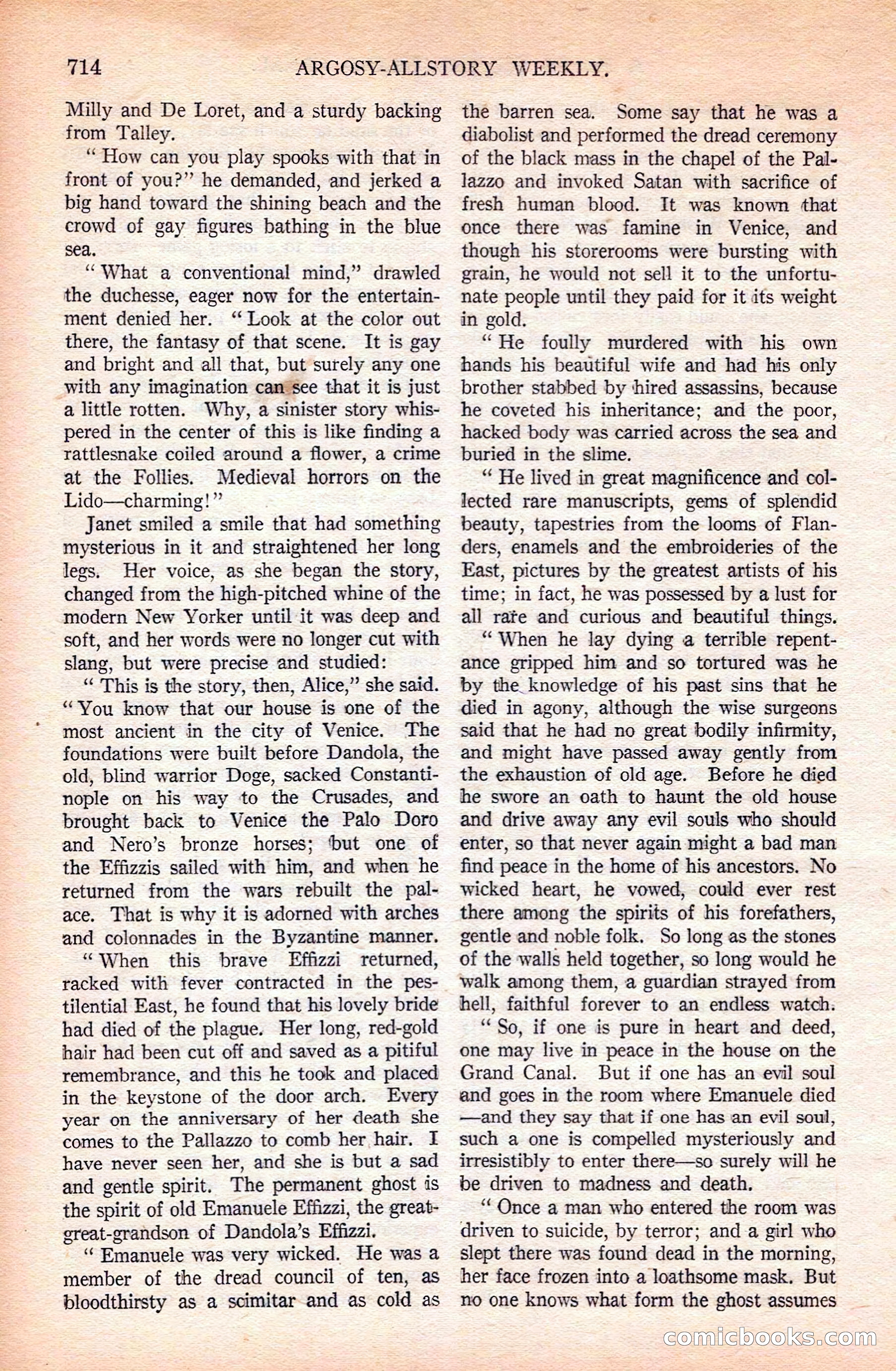
A restored page from Pulp Fiction, 1924. Page through the whole issue in the reader above.
📄 Transcribed text from this page (OCR, searchable)
Machine-transcribed from the original scan — historical spelling and the odd misread are preserved.
= 714 ARGOSY-ALLSTORY WEEKLY. Milly and De Loret, and a sturdy backing from Talley. “How can you play spooks with that in front of you?” he demanded, and jerked a big hand toward the shining beach and the crowd of gay figures bathing in the blue sea. “What a conventional mind,” drawled the duchesse, eager now for the entertain- ment denied her. ‘‘ Look at the color out there, the fantasy of that scene. It is gay and bright and all that, but surely any one with any imagination cansee that it is just a little rotten. Why, a sinister story whis- pered in the center of this is like finding a rattlesnake coiled around a flower, a crime at the Follies. Medieval horrors on the Lido—charming!” Janet smiled a smile that had something mysterious in it and straightened her long legs. Her voice, as she began the story, changed from the high-pitched whine of the modern New Yorker until it was deep and soft, and her words were no longer cut with slang, but were precise and studied: “ This is the story, then, Alice,” she said. “You know that our house is one of the most ancient in the city of Venice. The foundations were built before Dandola, the old, blind warrior Doge, sacked Constanti- nople on his way to the Crusades, and brought back to Venice the Palo Doro and Nero’s bronze horses; but one of the Effizzis sailed with him, and when he returned from the wars rebuilt the pal- ace. That is why it is adorned with arches and colonnades in the Byzantine manner. “When this brave Effizzi returned, racked with fever contracted in the pes- tilential East, he found that his lovely bride had died of the plague. Her long, red-gold hair had been cut off and saved as a pitiful remembrance, and this he took and placed in the keystone of the door arch. Every year on the anniversary of her death she comes to the Pallazzo to comb her hair. I have never seen her, and she is but a sad and gentle spirit. The permanent ghost is the spirit of old Emanuele Effizzi, the great- ereat-grandson of Dandola’s Effizzi. ‘¢ Emanuele was very wicked. He was a member of the dread council of ten, as bloodthirsty as a scimitar and as cold as the barren sea. Some say that he was a diabolist and performed the dread ceremony of the black mass in the chapel of the Pal- Jazzo and invoked Satan with sacrifice of fresh human blood. It was known that once there was famine in Venice, and though his storerooms were bursting with grain, he would not sell it to the unfortu- nate people until they paid for it its weight in gold. “He foully murdered with his own hands his beautiful wife and had his only brother stabbed by ‘hired assassins, because he coveted his inheritance; and the poor, hacked body was carried across the sea and buried in the slime. “ He lived in great magnificence and col- lected rare manuscripts, gems of splendid beauty, tapestries from the looms of Flan- ders, enamels and the embroideries of the East, pictures by the greatest artists of his time; in fact, he was possessed by a lust for all rate and curious and beautiful things. “When he lay dying a terrible repent- ance gripped him and so tortured was he by the knowledge of his past sins that he died in agony, although the wise surgeons said that he had no great bodily infirmity, and might have passed away gently from the exhaustion of old age. Before he died he swore an oath to haunt the old house and drive away any evil souls who should enter, so that never again might a bad man find peace in the home of his ancestors. No wicked heart, he vowed, could ever rest there among the spirits of his forefathers, gentle and noble folk. So long as the stones of the walls held together, so long would he walk among them, a guardian strayed from hell, faithful forever to an endless watch: “So, if one is pure in heart and deed, one may live in peace in the house on the Grand Canal. But if one has an evil soul and goes in the room where Emanuele died —and they say that if one has an evil soul, such a one is compelled mysteriously and irresistibly to enter there—so surely will he be driven to madness and death. “Once a man who entered the room was driven to suicide, by terror; and-a girl who slept there was found dead in the morning, her face frozen into a loathsome mask. But no one knows what form the ghost assumes _ CoOMmcoookSse©