
Pulp Fiction, 1924 · page 85 of 168
Argosy All-Story Weekly — page 85: what you’re looking at
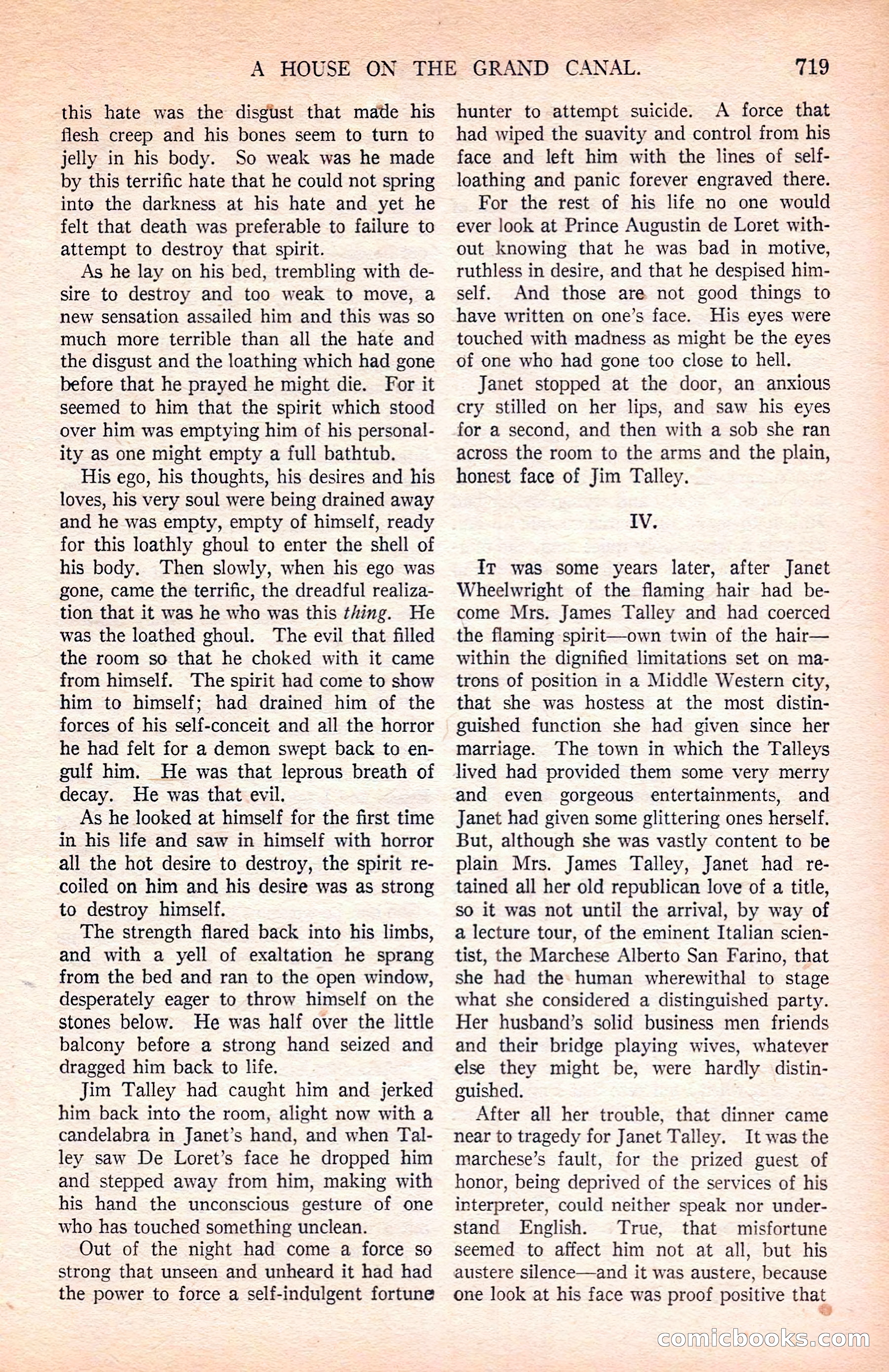
A restored page from Pulp Fiction, 1924. Page through the whole issue in the reader above.
📄 Transcribed text from this page (OCR, searchable)
Machine-transcribed from the original scan — historical spelling and the odd misread are preserved.
A HOUSE ON THE GRAND CANAL. this hate was the disgust that made his flesh creep and his bones seem to turn to jelly in his body. So weak was he made by this terrific hate that he could not spring inte the darkness at his hate and yet he felt that death was preferable to failure to attempt to destroy that spirit. As he lay on his bed, trembling with de- sire to destroy and too weak to move, a new sensation assailed him and this was so much more terrible than all the hate and the disgust and the loathing which had gone before that he prayed he might die. For it seemed to him that the spirit which stood over him was emptying him of his personal- ity as one might empty a full bathtub. His ego, his thoughts, his desires and his loves, his very soul were being drained away and he was empty, empty of himself, ready for this loathly ghoul to enter the shell of his body. Then slowly, when his ego was gone, came the terrific, the dreadful realiza- tion that it was he who was this thing. He was the loathed ghoul. The evil that filled the room so that he choked with it came from himself. The spirit had come to show him to himself; had drained him of the forces of his self-conceit and all the horror he had felt for a demon swept back to en- gulf him. He was that leprous breath of decay. He was that evil. As he looked at himself for the first time in his life and saw in himself with horror all the hot desire to destroy, the spirit re- coiled on him and his desire was as strong to destroy himself. The strength flared back into his limbs, and with a yell of exaltation he sprang from the bed and ran to the open window, desperately eager to throw himself on the stones below. He was half over the little balcony before a strong hand seized and dragged him back to life. Jim Talley had caught him and jerked him back into the room, alight now with a candelabra in Janet’s hand, and when Tal- ley saw De Loret’s face he dropped him and stepped away from him, making with his hand the unconscious gesture of one who has touched something unclean. Out of the night had come a force so strong that unseen and unheard it had had the power to force a self-indulgent fortune 719 hunter to attempt suicide. A force that had wiped the suavity and control from his face and left him with the lines of self- loathing and panic forever engraved there. For the rest of his life no one would ever look at Prince Augustin de Loret with- out knowing that he was bad in motive, ruthless in desire, and that he despised him- self. And those are not good things to have written on one’s face. His eyes were touched with madness as might be the eyes of one who had gone too close to hell. Janet stopped at the door, an anxious cry stilled on her lips, and saw his eyes for a second, and then with a sob she ran across the room to the arms and the plain, honest face of Jim Talley. IV. It was some years later, after Janet Wheelwright of the flaming hair had be- come Mrs. James Talley and had coerced the flaming spirit—own twin of the hair— within the dignified limitations set on ma- trons of position in a Middle Western city, that she was hostess at the most distin- guished function she had given since her marriage. The town in which the Talleys lived had provided them some very merry and even gorgeous entertainments, and Janet had given some glittering ones herself. But, although she was vastly content to be plain Mrs. James Talley, Janet had re- tained all her old republican love of a title, so it was not until the arrival, by way of a lecture tour, of the eminent Italian scien- tist, the Marchese Alberto San Farino, that she had the human wherewithal to stage what she considered a distinguished party. Her husband’s solid business men friends and their bridge playing wives, whatever else they might be, were hardly distin- guished. After all her trouble, that dinner came near to tragedy for Janet Talley. It was the marchese’s fault, for the prized guest of honor, being deprived of the services of his interpreter, could neither speak nor under- stand English. True, that misfortune seemed to affect him not at all, but his austere silence—and it was austere, because one look at his face was proof positive that S CoOmicloooks (S@)