
Pulp Fiction, 1924 · page 92 of 168
Argosy All-Story Weekly — page 92: what you’re looking at
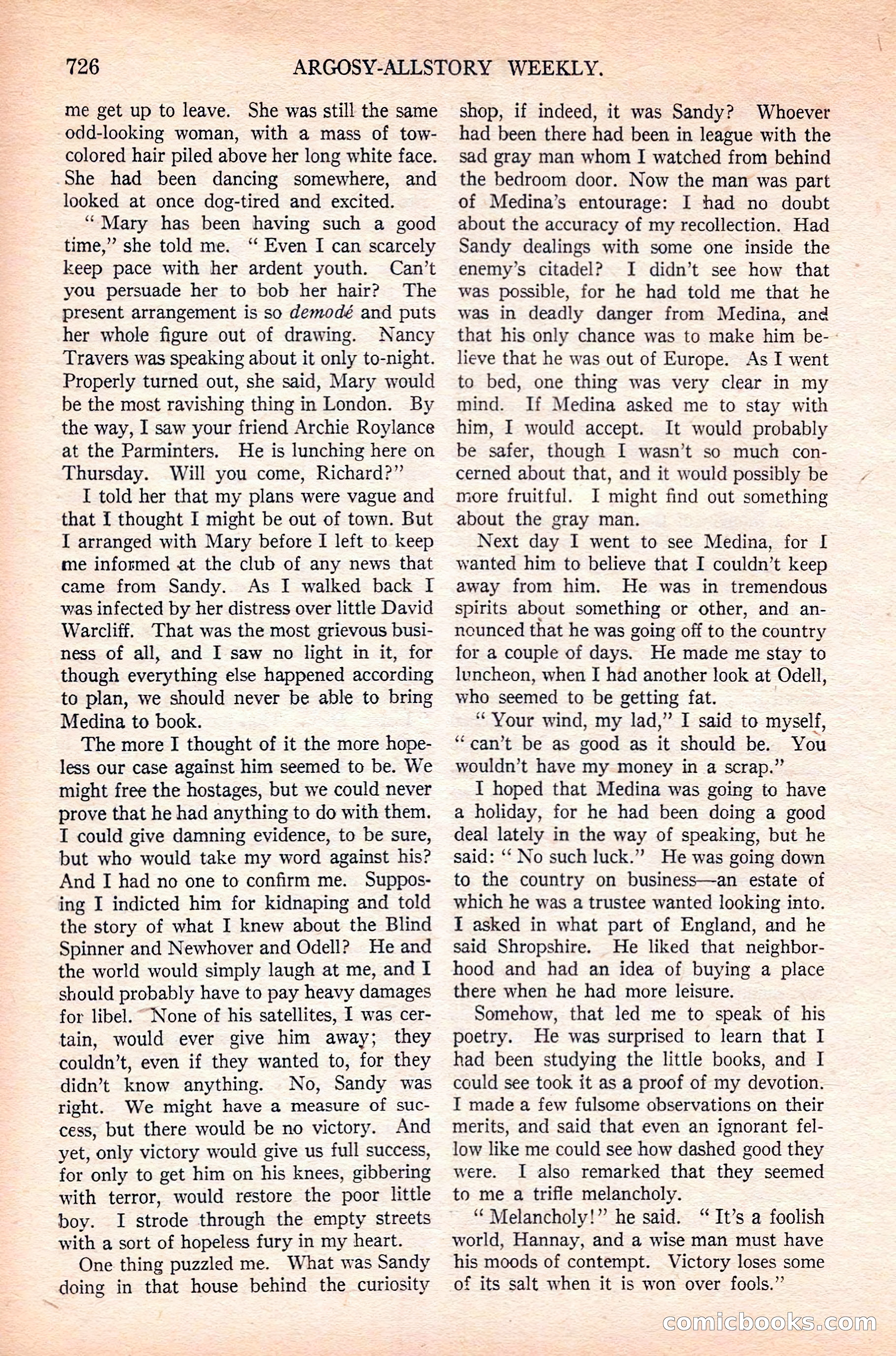
A restored page from Pulp Fiction, 1924. Page through the whole issue in the reader above.
📄 Transcribed text from this page (OCR, searchable)
Machine-transcribed from the original scan — historical spelling and the odd misread are preserved.
726 me get up to leave. She was still the same odd-looking woman, with a mass of tow- colored hair piled above her long white face. She had been dancing somewhere, and looked at once dog-tired and excited. ‘““Mary has been having such a good time,” she told me. ‘ Even I can scarcely keep pace with her ardent youth. Can’t you persuade her to bob her hair? The present arrangement is so demodé and puts her whole figure out of drawing. Nancy Travers was speaking about it only to-night. Properly turned out, she said, Mary would be the most ravishing thing in London. By the way, I saw your friend Archie Roylance at the Parminters. He is lunching here on Thursday. Will you come, Richard?” I told her that my plans were vague and that I thought I might be out of town. But I arranged with Mary before I left to keep me informed at the club of any news that came from Sandy. As I walked back I was infected by her distress over little David Warcliff. That was the most grievous busi- ness of all, and I saw no light in it, for though everything else happened according to plan, we should never be able to bring Medina to book. The more I thought of it the more hope- less our case against him seemed to be. We might free the hostages, but we could never prove that he had anything to do with them. I could give damning evidence, to be sure, but who would take my word against his? And I had no one to confirm me. Suppos- ing I indicted him for kidnaping and told the story of what I knew about the Blind Spinner and Newhover and Odell? He and the world would simply laugh at me, and I should probably have to pay heavy damages for libel. “None of his satellites, I was cer- tain, would ever give him away; they couldn’t, even if they wanted to, for they didn’t know anything. No, Sandy was right. We might have a measure of suc- cess, but there would be no victory. And yet, only victory would give us full success, for only to get him on his knees, gibbering with terror, would restore the poor little boy. I strode through the empty streets with a sort of hopeless fury in my heart. One thing puzzled me. What was Sandy doing in that house behind the curiosity ARGOSY-ALLSTORY WEEKLY. shop, if indeed, it was Sandy? Whoever had been there had been in league with the sad gray man whom I watched from behind the bedroom door. Now the man was part of Medina’s entourage: I had no doubt about the accuracy of my recollection. Had Sandy dealings with some one inside the enemy’s citadel? I didn’t see how that was possible, for he had told me that he was in deadly danger from Medina, and that his only chance was to make him be- - lieve that he was out of Europe. As I went to bed, one thing was very clear in my mind. If Medina asked me to stay with him, I would accept. It would probably be safer, though I wasn’t so much con- cerned about that, and it would possibly be more fruitful. I might find out something about the gray man. Next day I went to see Medina, for I wanted him to believe that I couldn’t keep away from him. He was in tremendous spirits about something or other, and an- nounced that he was going off to the country for a couple of days. He made me stay to luncheon, when I had another look at Odell, who seemed to be getting fat. “Your wind, my lad,” I said to myself, “can’t be as good as it should be. You wouldn’t have my money in a scrap.” I hoped that Medina was going to have a holiday, for he had been doing a good deal lately in the way of speaking, but he said: ‘‘ No such luck.” He was going down to the country on business—an estate of which he was a trustee wanted looking into. I asked in what part of England, and he said Shropshire. He liked that neighbor- hood and had an idea of buying a place there when he had more leisure. Somehow, that led me to speak of his poetry. He was surprised to learn that I had been studying the little books, and I could see took it as a proof of my devotion. I made a few fulsome observations on their merits, and said that even an ignorant fel- low like me could see how dashed good they were. I also remarked that they seemed to me a trifle melancholy. “Melancholy!” he said. “It’s a foolish world, Hannay, and a wise man must have his moods of contempt. Victory loses some of its salt when it is won over fools.” LI COMmicloookKs (C@