
Pulp Fiction, 1924 · page 102 of 166
Argosy All-Story Weekly — page 102: what you’re looking at
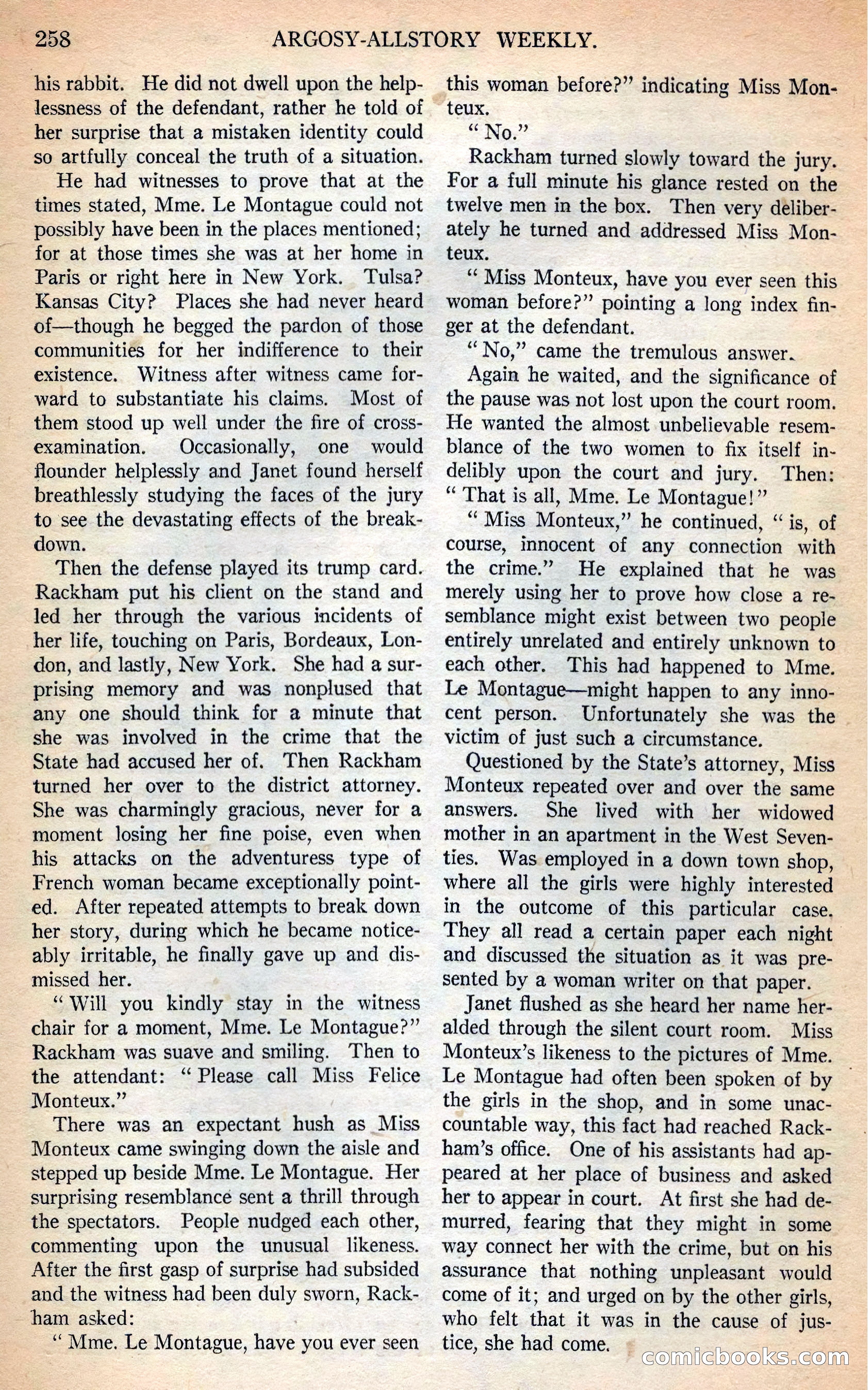
A restored page from Pulp Fiction, 1924. Page through the whole issue in the reader above.
📄 Transcribed text from this page (OCR, searchable)
Machine-transcribed from the original scan — historical spelling and the odd misread are preserved.
his rabbit. He did not dwell upon the help- lessness of the defendant, rather he told of her surprise that a mistaken identity could so artfully conceal the truth of a situation. He had witnesses to prove that at the times stated, Mme. Le Montague could not possibly have been in the places mentioned; for at those times she was at her home in Paris or right here in New York. Tulsa? Kansas City? Places she had never heard of—though he begged the pardon of those communities for her indifference to their existence. Witness after witness came for- ward to substantiate his claims. Most of them stood up well under the fire of cross- examination. Occasionally, one would flounder helplessly and Janet found herself breathlessly studying the faces of the jury to see the devastating effects of the break- down. Then the defense played its trump card. Rackham put his client on the stand and led her through the various incidents of her life, touching on Paris, Bordeaux, Lon- don, and lastly, New York. She had a sur- prising memory and was nonplused that any one should think for a minute that she was involved in the crime that the State had accused her of. Then Rackham turned her over to the district attorney. She was charmingly gracious, never for a moment losing her fine poise, even when his attacks on the adventuress type of French woman became exceptionally point- ed. After repeated attempts to break down her story, during which he became notice- ably irritable, he finally gave up and dis- missed her. “Will you kindly stay in the witness chair for a moment, Mme. Le Montague?” Rackham was suave and smiling. Then to the attendant: ‘“‘ Please call Miss Felice Monteux.” There was an expectant hush as Miss Monteux came swinging down the aisle and stepped up beside Mme. Le Montague. Her surprising resemblance sent a thrill through the spectators. People nudged each other, commenting upon the unusual likeness. After the first gasp of surprise had subsided and the witness had been duly sworn, Rack- ham asked: ‘“Mme. Le Montague, have you ever seen ARGOSY-ALLSTORY WEEKLY. this woman before?” indicating Miss Mon- teux, | <4 No.” Rackham turned slowly toward the jury. For a full minute his glance rested on the twelve men in the box. Then very deliber- ately he turned and addressed Miss Mon- teux. ‘“ Miss Monteux, have you ever seen this woman before?” pointing a long index fin- ger at the defendant. “No,” came the tremulous answer. Again he waited, and the significance of the pause was not lost upon the court room. He wanted the almost unbelievable resem- blance of the two women to fix itself in- delibly upon the court and jury. Then: ‘ That is all, Mme. Le Montague!” “ Miss Monteux,” he continued, “is, of course, innocent of any connection with the crime.” He explained that he was merely using her to prove how close a re- semblance might exist between two people entirely unrelated and entirely unknown to each other. This had happened to Mme. Le Montague—might happen to any inno- cent person. Unfortunately she was the victim of just such a circumstance. Questioned by the State’s attorney, Miss Monteux repeated over and over the same answers. She lived with her widowed mother in an apartment in the West Seven- ties. Was employed in a down town shop, where all the girls were highly interested in the outcome of this particular case. They all read a certain paper each night and discussed the situation as it was pre- sented by a woman writer on that paper. Janet flushed as she heard her name her- alded through the silent court room. Miss Monteux’s likeness to the pictures of Mme. Le Montague had often been spoken of by — the girls in the shop, and in some unac- countable way, this fact had reached Rack- ham’s office. One of his assistants had ap- peared at her place of business and asked her to appear in court. At first she had de- murred, fearing that they might in some way connect her with the crime, but on his assurance that nothing unpleasant would come of it; and urged on by the other girls, who felt that it was in the cause of jus- tice, she had come. : : comichbooksncom