
Pulp Fiction, 1924 · page 118 of 166
Argosy All-Story Weekly — page 118: what you’re looking at
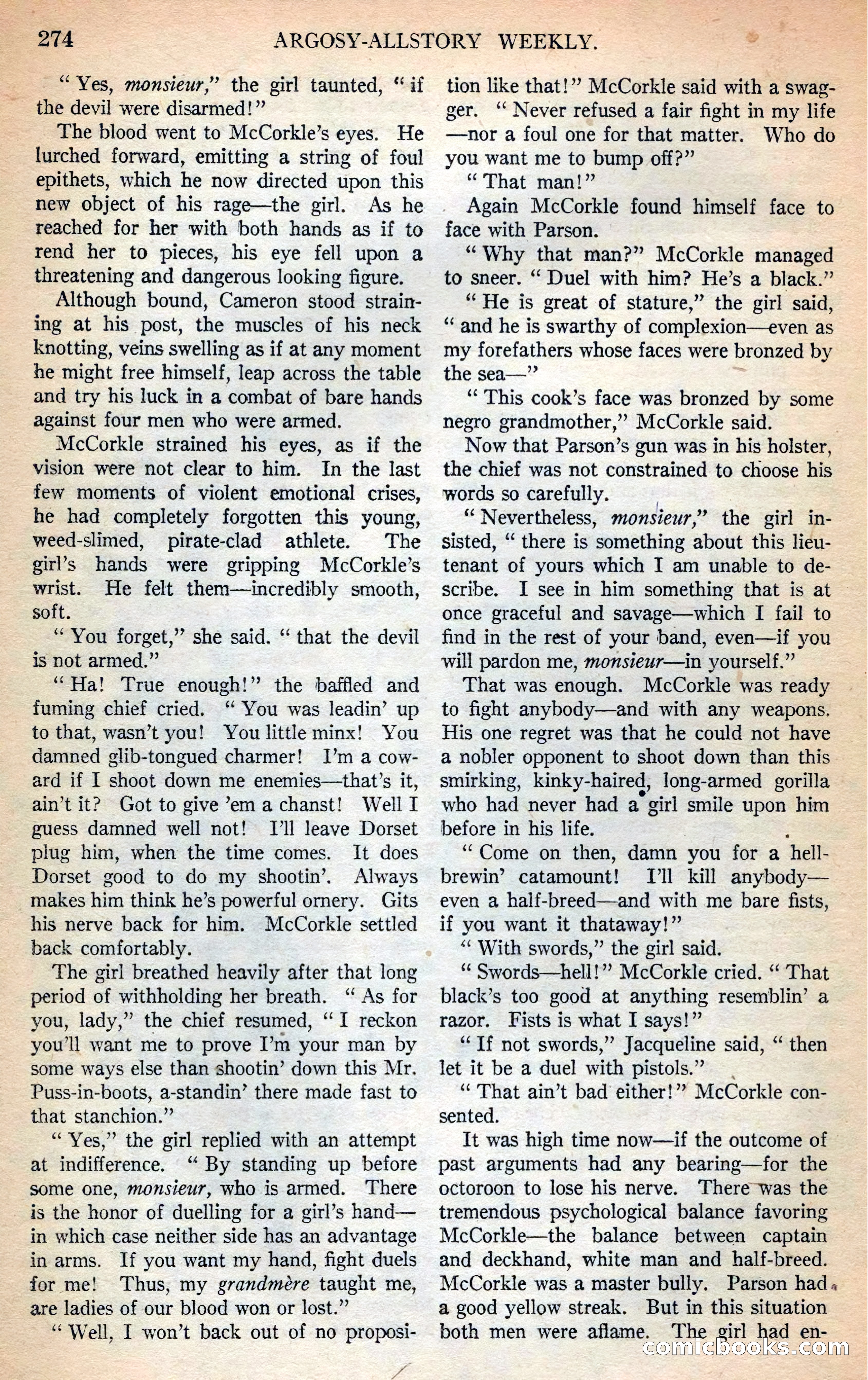
A restored page from Pulp Fiction, 1924. Page through the whole issue in the reader above.
📄 Transcribed text from this page (OCR, searchable)
Machine-transcribed from the original scan — historical spelling and the odd misread are preserved.
OA “Yes, monsieur,”’ the girl taunted, “ if the devil were disarmed!”’ _ The blood went to McCorkle’s eyes. He lurched forward, emitting a string of foul epithets, which he now directed upon this new object of his rage—the girl. As he reached for her with both hands as if to rend her to pieces, his eye fell upon a threatening and dangerous looking figure. Although bound, Cameron stood strain- ing at his post, the muscles of his neck knotting, veins swelling as if at any moment he might free himself, leap across the table and try his luck in a combat of bare hands against four men who were armed. McCorkle strained his eyes, as if the vision were not clear to him. In the last few moments of violent emotional crises, he had completely forgotten this young, weed-slimed, pirate-clad athlete. The girl’s hands were gripping McCorkle’s wrist. He felt them—incredibly smooth, soft. “You forget,” she said. ‘‘ that the devil is not armed.” “Ha! True enough!” the baffled and fuming chief cried. ‘“ You was leadin’ up to that, wasn’t you! You little minx! You damned glib-tongued charmer! I’m a cow- ard if I shoot down me enemies—that’s it, ain’t it? Got to give em achanst! Well I guess damned well not! I'll leave Dorset plug him, when the time comes. It does Dorset good to do my shootin’. Always makes him think he’s powerful ornery. Gits his nerve back for him. McCorkle settled back comfortably. The girl breathed heavily after that long period of withholding her breath. “ As for you, lady,” the chief resumed, “I reckon you'll want me to prove I’m your man by some ways else than shootin’ down this Mr. Puss-in-boots, a-standin’ there made fast to that stanchion.” “Yes,” the girl replied with an attempt at indifference. “ By standing up before some one, monsieur, who is armed. ‘There is the honor of duelling for a girl’s hand— in which case neither side has an advantage in arms. If you want my hand, fight duels for me! Thus, my grandmeére taught me, are ladies of our blood won or lost.” “Well, I won’t back out of no proposi- Ie PA ARGOSY-ALLSTORY WEEKLY. @ tion like that!” McCorkle said with a swag- ger. “ Never refused a fair fight in my life —nor a foul one for that matter. Who do you want me to bump off?” “That man!” Again McCorkle found himself face to face with Parson. “Why that man?” McCorkle managed to sneer. “ Duel with him? He’s a black.” “He is great of stature,” the girl said, ‘and he is swarthy of complexion—even as my forefathers whose faces were bronzed by the sea— ‘“ This cook’s face was bronzed by some negro grandmother,”’ McCorkle said. Now that Parson’s gun was in his holster, the chief was not constrained to choose his words so carefully. : ** Nevertheless, monsieur,” the girl in- sisted, ‘“‘ there is ‘something about this lieu- tenant of yours which I am unable to de- scribe. once graceful and savage—which [ fail to find in the rest of your band, even—if you will pardon me, monsieur—in yourself.” That was enough. McCorkle was ready to fight anybody—and with any weapons. His one regret was that he could not have a nobler opponent to shoot down than this smirking, kinky-haired, long-armed gorilla who had never had a * girl smile upon him before in his life. ‘““Come on then, damn you for a ‘hell- brewin’ catamount! Tl kill anybody— even a half-breed—and with me bare fists, if you want it thataway!” “‘ With swords,” the girl said. ** Swords—hell!”’ McCorkle cried. ‘‘ That black’s too good at anything resemblin’ a razor. Fists is what I says!” “If not swords,” Jacqueline said, ‘‘ then let it be a duel with pistols.” “ That ain’t bad either!’? McCorkle con- sented. I see in him something that is at — It was high time now—if the outcome of © past arguments had any bearing—for the octoroon to lose his nerve. There was the tremendous psychological balance favoring McCorkle—the balance between captain and deckhand, white man and half-breed. McCorkle was a master bully. Parson had a good yellow streak. But in this situation both men were aflame. ane irl had en- (COLA) OOKSTEO 4 in