
Pulp Fiction, 1924 · page 156 of 166
Argosy All-Story Weekly — page 156: what you’re looking at
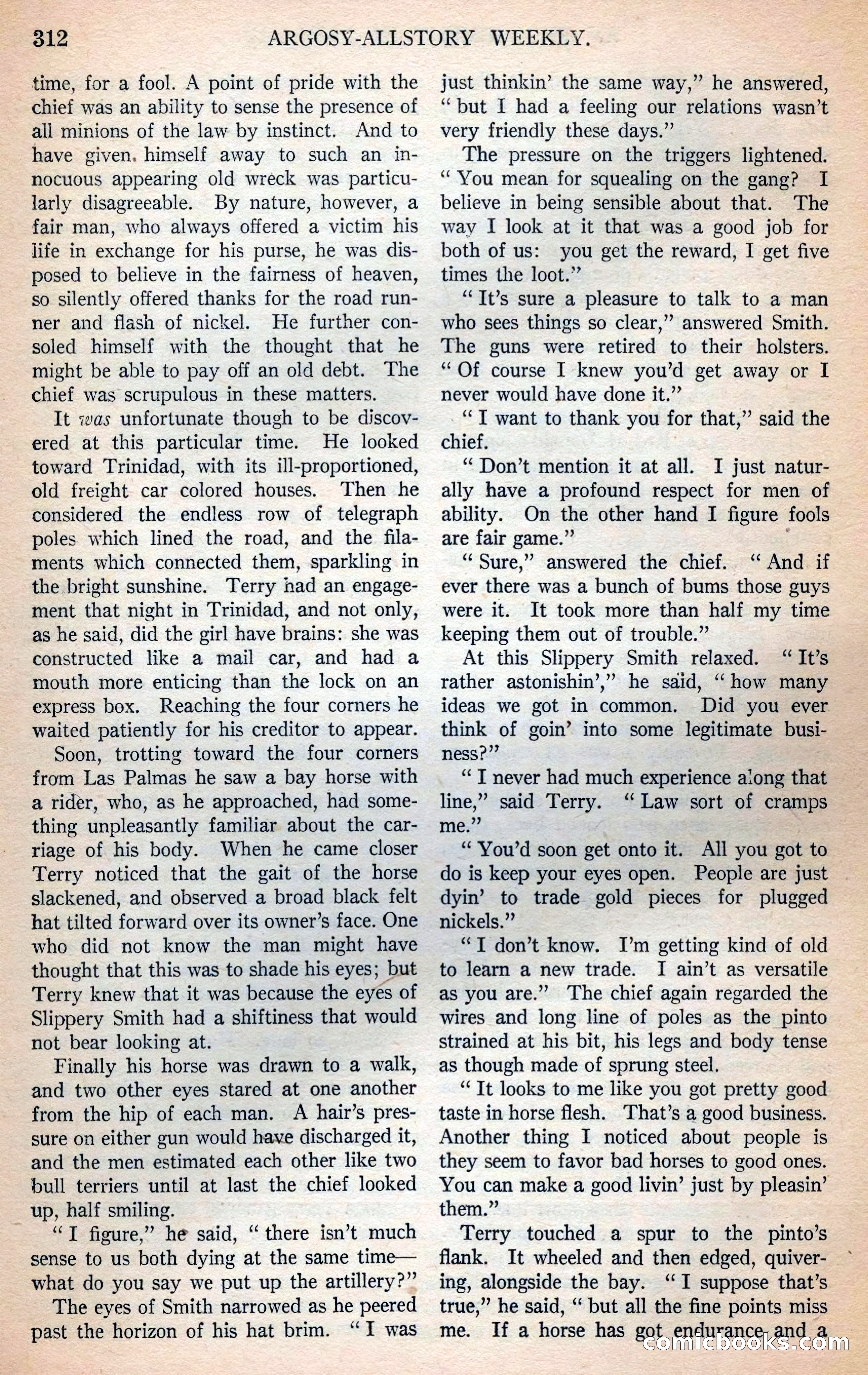
A restored page from Pulp Fiction, 1924. Page through the whole issue in the reader above.
📄 Transcribed text from this page (OCR, searchable)
Machine-transcribed from the original scan — historical spelling and the odd misread are preserved.
312 time, for a fool. A point of pride with the chief was an ability to sense the presence of all minions of the law by instinct. And to have given. himself away to such an in- nocuous appearing old wreck was particu- larly disagreeable. By nature, however, a fair man, who always offered a victim his life in exchange for his purse, he was dis- posed to believe in the fairness of heaven, so silently offered thanks for the road run- ner and flash of nickel. He further con- soled himself with the thought that he might be able to pay off an old debt. The chief was scrupulous in these matters. It was unfortunate though to be discov- ered at this particular time. He looked toward Trinidad, with its ill-proportioned, old freight car colored houses. Then he considered the endless row of telegraph poles which lined the road, and the fila- ments which connected them, sparkling in the bright sunshine. Terry had an engage- ment that night in Trinidad, and not only, as he said, did the girl have brains: she was constructed like a mail car, and had a mouth more enticing than the lock on an express box. Reaching the four corners he waited patiently for his creditor to appear. Soon, trotting toward the four corners from Las Palmas he saw a bay horse with a rider, who, as he approached, had some- thing unpleasantly familiar about the car- riage of his body. When he came closer Terry noticed that the gait of the horse slackened, and observed a broad black felt hat tilted forward over its owner’s face. One who did not know the man might have thought that this was to shade his eyes; but Terry knew that it was because the eyes of Slippery Smith had a shiftiness that would not bear looking at. Finally his horse was drawn to a walk, and two other eyes stared at one another from the hip of each man. A hair’s pres- sure on either gun would have discharged it, and the men estimated each other like two bull terriers until at last the chief looked up, half smiling. _ “T figure,” he said, “ there isn’t much sense to us both dying at the same time— what do you say we put up the artillery?” The eyes of Smith narrowed as he peered past the horizon of his hat brim. “I was ARGOSY-ALLSTORY WEEKLY. just thinkin’ the same way,” he answered, “but I had a feeling our relations wasn’t very friendly these days.” The pressure on the triggers lightened. “You mean for squealing on the gang? I believe in being sensible about that. The way I look at it that was a good job for both of us: you get the reward, I get five times the loot.” ‘“‘ It’s sure a pleasure to talk to a man who sees things so clear,” answered Smith. The guns were retired to their holsters. “Of course I knew you’d get away or I never would have done it.” ‘“‘T want to thank you for that,” said the chief. “Don’t mention it at all. I just natur- ally have a profound respect for men of ability. On the other hand I figure fools are fair game.” “‘ Sure,” answered the chief. ‘“ And if ever there was a bunch of bums those guys were it. It took more than half my time keeping them out of trouble.” At this Slippery Smith relaxed. “ It’s rather astonishin’,” he said, “ how many ideas we got in common. Did you ever think of goin’ into some legitimate busi- ness?” “‘T never had much experience along that line,” said Terry. ‘‘ Law sort of cramps me.” “You’d soon get onto it. All you got to do is keep your eyes open. People are just | dyin’ to trade gold pieces for plugged nickels.” “T don’t know. I’m getting kind of old to learn a new trade. I ain’t as versatile as you are.” The chief again regarded the wires and long line of poles as the pinto strained at his bit, his legs and body tense as though made of sprung steel. “‘It looks to me like you got pretty good taste in horse flesh. That’s a good business. Another thing I noticed about people is they seem to favor bad horses to good ones. You can make a good livin’ just by pleasin’ them.” Terry touched a spur to the pinto’s flank. It wheeled and then edged, quiver- ~ ing, alongside the bay. ‘I suppose that’s true,” he said, “ but all the fine points miss me. If a horse has got endurance and. a