
Pulp Fiction, 1924 · page 160 of 166
Argosy All-Story Weekly — page 160: what you’re looking at
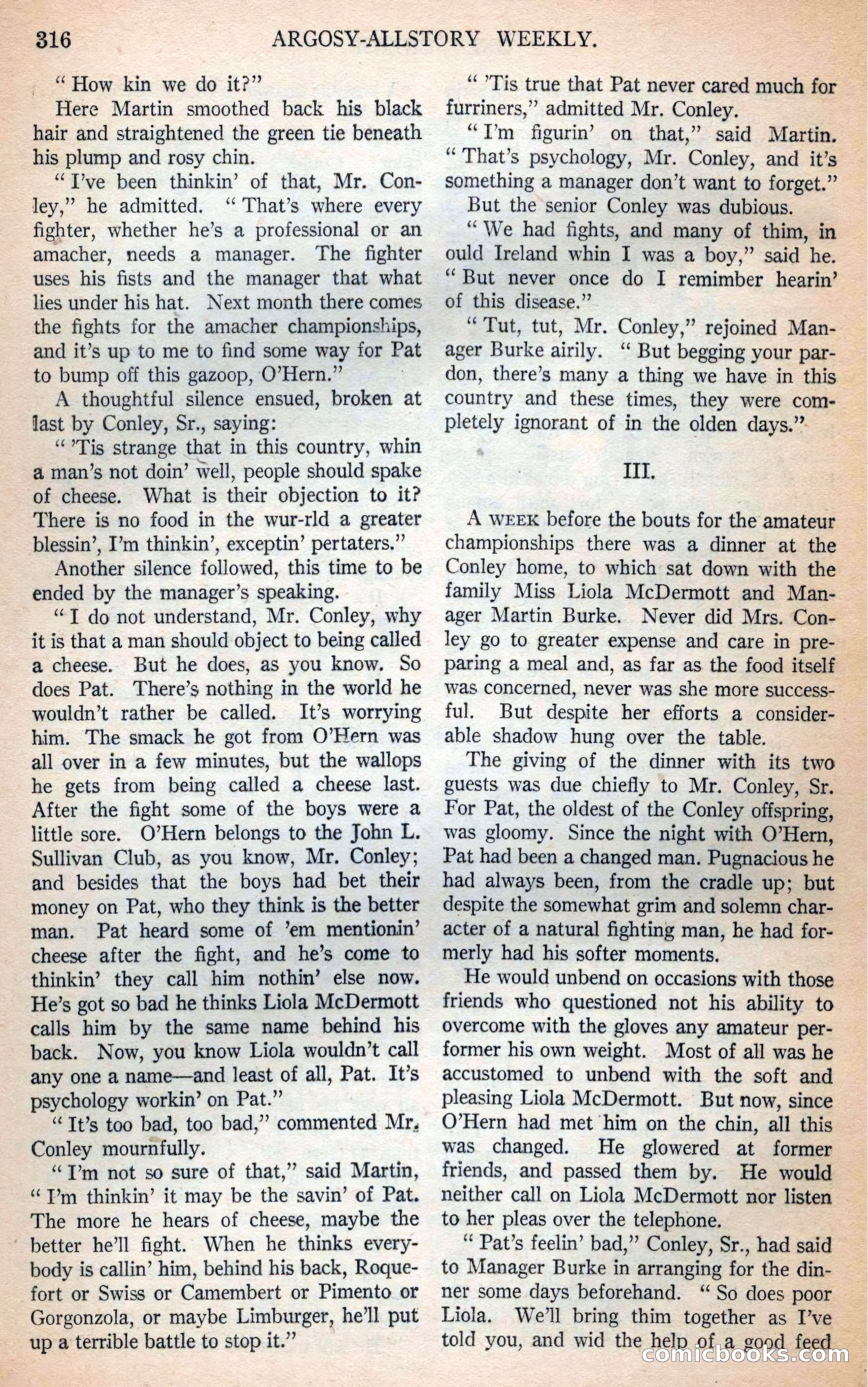
A restored page from Pulp Fiction, 1924. Page through the whole issue in the reader above.
📄 Transcribed text from this page (OCR, searchable)
Machine-transcribed from the original scan — historical spelling and the odd misread are preserved.
ol6 “How kin we do it?” Here Martin smoothed back his black hair and straightened the green tie beneath his plump and rosy chin. “T’ve been thinkin’ of that, Mr. Con- ley,” he admitted. ‘ That’s where every fighter, whether he’s a professional or an amacher, needs a manager. The fighter uses his fists and the manager that what lies under his hat. Next month there comes the fights for the amacher championships, and it’s up to me to find some way for Pat to bump off this gazoop, O’Hern.” 7 A thoughtful silence ensued, broken at last by Conley, Sr., saying: ‘Tis strange that in this country, whin a man’s not doin’ well, people should spake of cheese. What is their objection to it? There is no food in the wur-rld a greater blessin’, I’m thinkin’, exceptin’ pertaters.” Another silence followed, this time to be ended by the manager’s speaking. ‘T do not understand, Mr. Conley, why it is that a man should object to being called a cheese. But he does, as you know. So does Pat. There’s nothing in the world he wouldn’t rather be called. It’s worrying him. The smack he got from O’Hern was all over in a few minutes, but the wallops he gets from being called a cheese last. After the fight some of the boys were a little sore. O’Hern belongs to the John L. Sullivan Club, as you know, Mr. Conley; and besides that the boys had bet their money on Pat, who they think is the better man. Pat heard some of ’em mentionin’ cheese after the fight, and he’s come to thinkin’ they call him nothin’ else now. He’s got so bad he thinks Liola McDermott calls him by the same name behind his back. Now, you know Liola wouldn’t call any one a name—and least of all, Pat. It’s psychology workin’ on Pat.” “Tt’s too bad, too bad,” commented Mr. Conley mournfully. “Tm not so sure of that,” said Martin, “Pm thinkin’ it may be the savin’ of Pat. The more he hears of cheese, maybe the ~ better he’ll fight. When he thinks every- body is callin’ him, behind his back, Roque- fort or Swiss or Camembert or Pimento or Gorgonzola, or maybe Limburger, he’ll put up a terrible battle to stop it.” ARGOSY-ALLSTORY WEEKLY. ‘Tis true that Pat never cared much for furriners,” admitted Mr. Conley. “Tm figurin’ on that,” said Martin. ‘““That’s psychology, Mr. Conley, and it’s something a manager don’t want to forget.” But the senior Conley was dubious. “We had fights, and many of thim, in ould Ireland whin I was a boy,” said he. “But never once do I remimber hearin’ of this disease.” ‘Tut, tut, Mr. Conley,” rejoined Man- ager Burke airily. “ But begging your par- don, there’s many a thing we have in this country and these times, they were com- pletely ignorant of in the olden days.” III. A WEEK before the bouts for the amateur championships there was a dinner at the Conley home, to which sat down with the family Miss Liola McDermott and Man- ager Martin Burke. Never did Mrs. Con- ley go to greater expense and care in pre- paring a meal and, as far as the food itself was concerned, never was she more success- ful. But despite her efforts a consider- able shadow hung over the table. The giving of the dinner with its two guests was due chiefly to Mr. Conley, Sr. For Pat, the oldest of the Conley offspring, was gloomy. Since the night with O’Hern, Pat had been a changed man. Pugnacious he had always been, from the cradle up; but despite the somewhat grim and solemn char- acter of a natural fighting man, he had for- merly had his softer moments. He would unbend on occasions with those friends who questioned not his ability to overcome with the gloves any amateur per- former his own weight. Most of all was he accustomed to unbend with the soft and pleasing Liola McDermott. But now, since O’Hern had met him on the chin, all this was changed. He glowered at former friends, and passed them by. He would neither call on Liola McDermott nor listen to her pleas over the telephone. ‘‘ Pat’s feelin’ bad,” Conley, Sr., had said to Manager Burke in arranging for the din- ner some days beforehand. ‘ So does poor Liola. We'll bring thim together as I’ve told you, and wid the help of,.a \_good. feed __