
Pulp Fiction, 1924 · page 33 of 166
Argosy All-Story Weekly — page 33: what you’re looking at
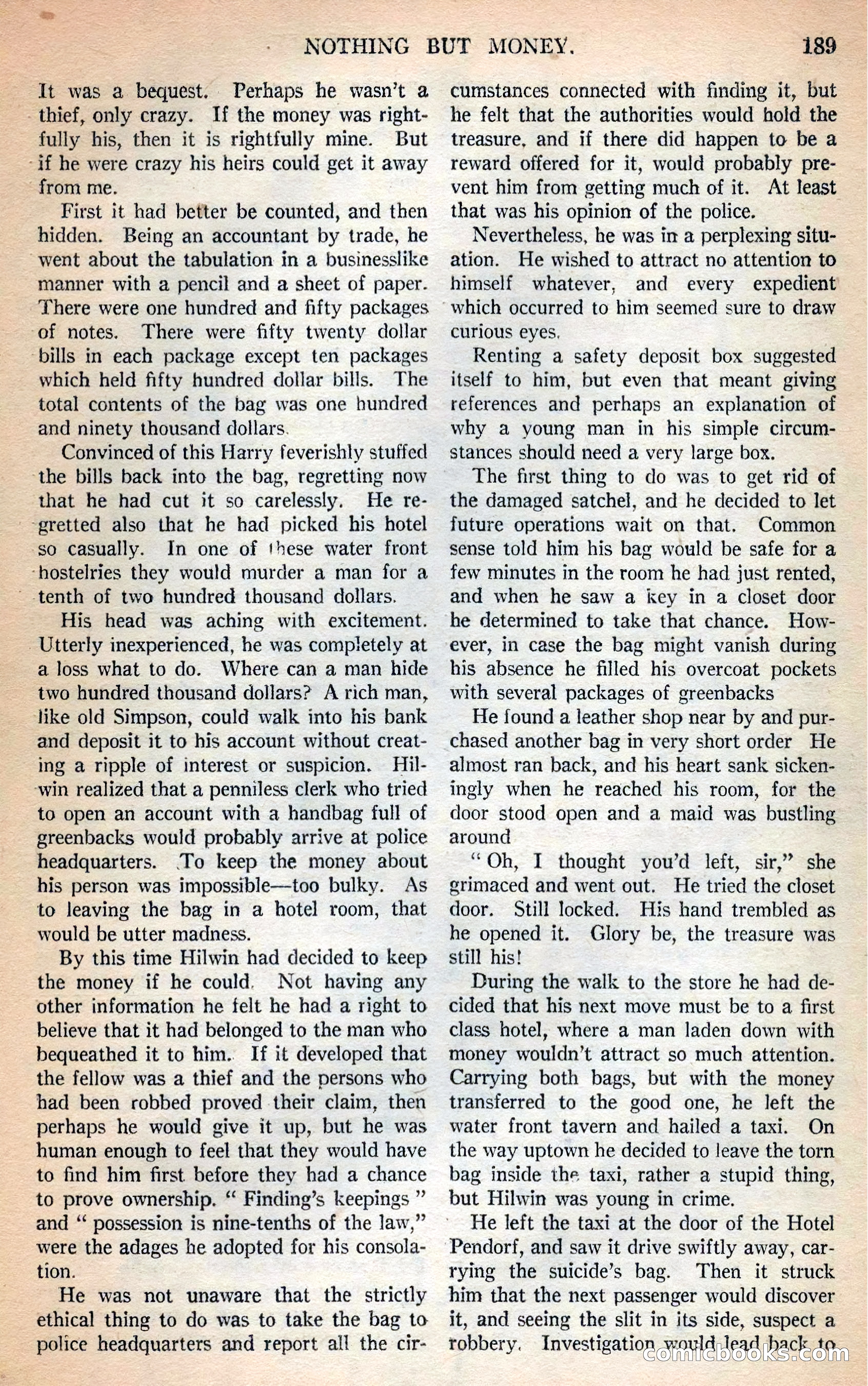
A restored page from Pulp Fiction, 1924. Page through the whole issue in the reader above.
📄 Transcribed text from this page (OCR, searchable)
Machine-transcribed from the original scan — historical spelling and the odd misread are preserved.
NOTHING BUT MONEY. It was a bequest. Perhaps he wasn’t a thief, only crazy. If the money was right- fully his, then it is rightfully mine. But -if he were crazy his heirs could get it away from me. First it had better be counted, and then hidden. Being an accountant by trade, he went about the tabulation in a businesslike manner with a pencil and a sheet of paper. There were one hundred and fifty packages of notes. There were fifty twenty dollar ‘bills in each package except ten packages which held fifty hundred dollar bills. The total contents of the bag was one hundred and ninety thousand dollars. Convinced of this Harry feverishly stuffed the bills back into the bag, regretting now that he had cut it so carelessly. He re- --gretted also that he had picked his hotel ‘so casually. In one of these water front ‘hostelries they would murder a man for a ~ tenth of two hundred thousand dollars. His head was aching with excitement. Utterly inexperienced, he was completely at a loss what to do. Where can a man hide two hundred thousand dollars? A rich man, like old Simpson, could walk into his bank and deposit it to his account without creat- ing a ripple of interest or suspicion. Hil- -win realized that a penniless clerk who tried to open an account with a handbag full of greenbacks would probably arrive at police headquarters. .To keep the money about his person was impossible—too bulky. As to leaving the bag in a hotel room, that would be utter madness. By this time Hilwin had decided to keep the money if he could. Not having any other information he felt he had a right to believe that it had belonged to the man who bequeathed it to him.. If it developed that the fellow was a thief and the persons who had been robbed proved their claim, then perhaps he would give it up, but he was human enough to feel that they would have to find him first before they had a chance to prove ownership. “ Finding’s keepings ” and “ possession is nine-tenths of the law,” were the adages he adopted for his consola- tion. He was not unaware that the strictly ethical thing to do was to take the bag to police headquarters and report all the cir- 189 cumstances connected with finding it, but he felt that the authorities would hold the treasure, and if there did happen to be a reward offered for it, would probably pre- vent him from getting much of it. At least that was his opinion of the police. Nevertheless, he was in a perplexing situ- ation. He wished to attract no attention to himself whatever, and every expedient ~which occurred to him seemed sure to draw curious eyes, Renting a safety deposit box suggested itself to him, but even that meant giving references and perhaps an explanation of why a young man in his simple circum- stances should need a very large box. The first thing to do was to get rid of the damaged satchel, and he decided to let future operations wait on that. Common sense told him his bag would be safe for a few minutes in the room he had just rented, and when he saw a key in a closet door he determined to take that chance. How- ever, in case the bag might vanish during his absence he filled his overcoat pockets with several packages of greenbacks He found a leather shop near by and pur- chased another bag in very short order He almost ran back, and his heart sank sicken- ingly when he reached his room, for the door stood open and a maid was bustling around “Oh, I thought you’d left, sir,” she grimaced and went out. He tried the closet door. Still locked. His hand trembled as he opened it. Glory be, the treasure was still his! During the walk to the store he had de- cided that his next move must be to a first class hotel, where a man laden down with money wouldn’t attract so much attention. Carrying both bags, but with the money transferred to the good one, he left the water front tavern and hailed a taxi. On the way uptown he decided to leave the torn bag inside the taxi, rather a stupid thing, but Hilwin was young in crime. He left the taxi at the door of the Hotel Pendorf, and saw it drive swiftly away, car- rying the suicide’s bag. Then it struck him that the next passenger would discover it, and seeing the slit in its side, suspect a robbery. Investigation would lead hack. to.