
Pulp Fiction, 1924 · page 45 of 166
Argosy All-Story Weekly — page 45: what you’re looking at
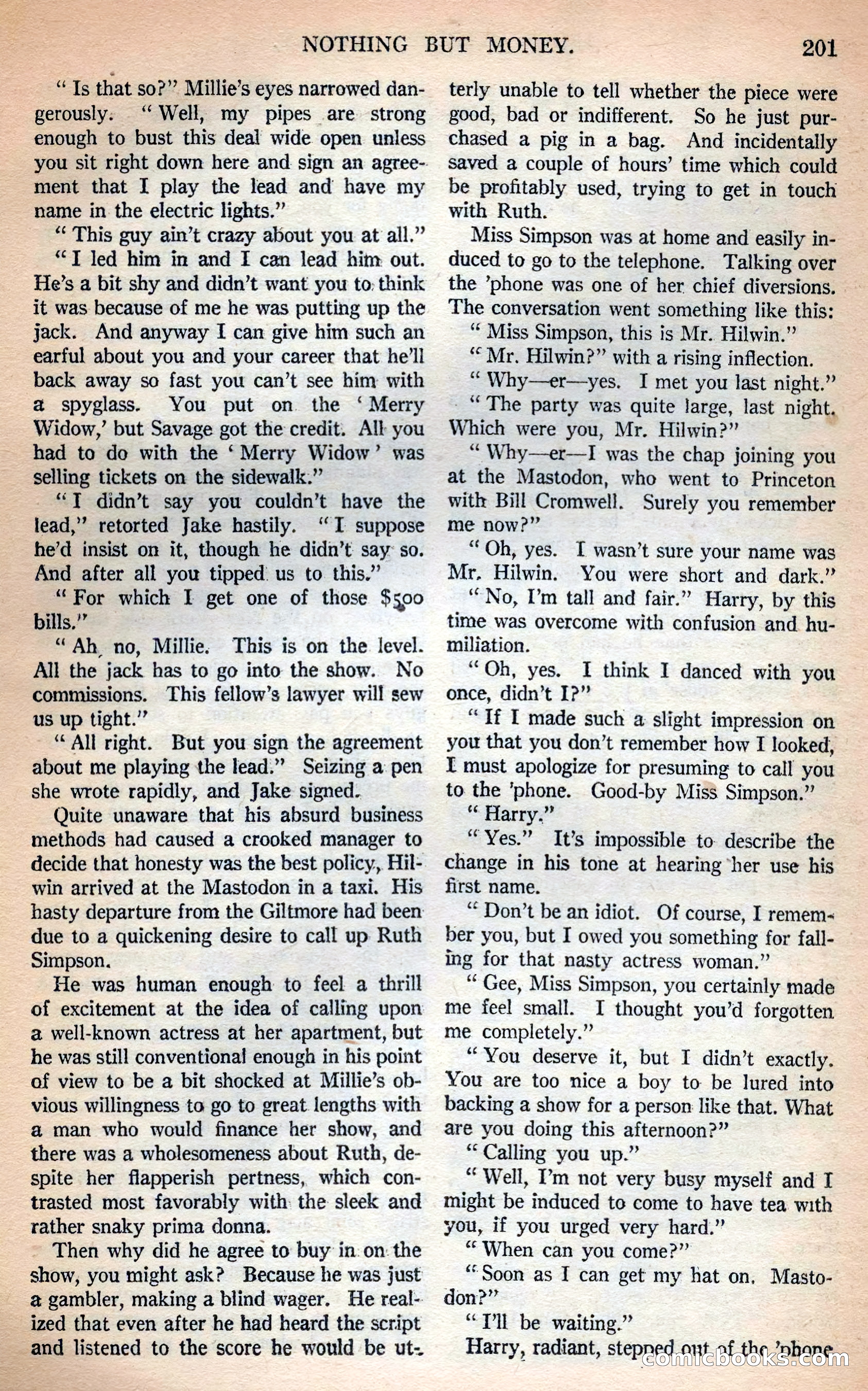
A restored page from Pulp Fiction, 1924. Page through the whole issue in the reader above.
📄 Transcribed text from this page (OCR, searchable)
Machine-transcribed from the original scan — historical spelling and the odd misread are preserved.
NOTHING BUT MONEY. “Ts that so?” Millie’s eyes narrowed dan- gerously: ‘‘ Well, my pipes are strong enough to bust this deal wide open unless you sit right down here and sign an agree-. ment that I play the lead and have my name in the electric lights.” “ This guy ain’t crazy about you at all.” “T led him in and I can lead him out. He’s a bit shy and didn’t want you to: think it was because of me he was putting up the jack. And anyway I can give him such an earful about you and your career that he'll back away so fast you can’t see him with a spyglass. You put on the ‘ Merry Widow,’ but Savage got the credit. Alb you had to do with the ‘Merry Widow’ was selling tickets on the sidewalk.” “T didn’t say you couldn’t have the lead,”’ retorted Jake hastily. ‘I suppose he’d insist on it, though he didn’t say: so. And after all you tipped: us to this.’ “For which I get one of those $500 bills.” “Ah no, Millie. This is on the level. All the jack has to go into the show. No commissions. This fellow’s lawyer will sew us up tight.” “All right. But you sign the agreement about me playing the lead.” Seizing a pen she wrote rapidly, and Jake signed. Quite unaware that his absurd business methods had caused a crooked manager to decide that honesty was the best policy, Hil- win arrived at the Mastodon in a taxi. His hasty departure from the Giltmore had been due to a quickening desire to call up Ruth Simpson. He was human enough to feel a thrill of excitement at the idea of calling upon a well-known actress at her apartment, but he was still conventional enough in his point of view to be a bit shocked at Millie’s ob- vious willingness to go to great lengths with @ man who would finance her show, and there was a wholesomeness about Ruth, de- spite her flapperish pertness, which con- trasted most favorably with: the sleek and rather snaky prima donna. - Then why did he agree to buy in on: the show, you might ask? Because he was just a gambler, making a blind wager. He real-. ized that even after he had heard the script _and listened to the score he would be ut~ 201 terly unable to tell whether the piece were good, bad or indifferent. So he just pur- chased a pig in a bag. And incidentally — saved a couple of hours’ time which could be profitably used, trying to get in touch with Ruth. Miss Simpson was at home and easily in- duced to go to the telephone. Talking over the ’phone was one of her chief diversions. — The conversation went something like this: ‘* Miss Simpson, this is Mr. Hilwin.” Mr. Hilwin?” with a rising inflection. ‘ Why—er—yes. I met you last night.” _“ The party was quite large, last night, Which were you, Mr. Hilwin>?” “ Why—er—I was the chap joining you at the Mastodon, who went to Princeton with Bill Cromwell. Surely you remember me now?” “Oh, yes. I wasn’t sure your name was Mr. Hilwin. You were short and dark.” “No, I’m tall and fair.” Harry, by this time was overcome with confusion and hu- miliation. “Oh, yes. I think I danced with you once, didn’t I?” “If I made such a slight impression on you that you don’t remember how I looked, I must apologize for presuming to call you to the ‘phone. Good-by Miss Simpson.” 6 Harry.” “Yes.” It’s impossible to describe the change in his tone at hearing “her use his first name. “Don’t be an idiot. Of course, I remem- ber you, but I owed you something for fall- ing for that nasty actress woman.” “Gee, Miss Simpson, you certainly made me feel small. I thought you’d forgotten me completely.” “You deserve it, but I didn’t exactly. You are too nice a boy to be lured into backing a show for a person like that. What are you doing this afternoon?” * Calling you up.” “Well, I’m not very busy myself and I might be induced to come to have tea with you, if you urged very hard.” “When can you come?” “Soon as I can get my hat on, Masto- don?” “TIL be waiting.” Harry, radiant, stepped outafthe ohare. |