
Pulp Fiction, 1924 · page 72 of 166
Argosy All-Story Weekly — page 72: what you’re looking at
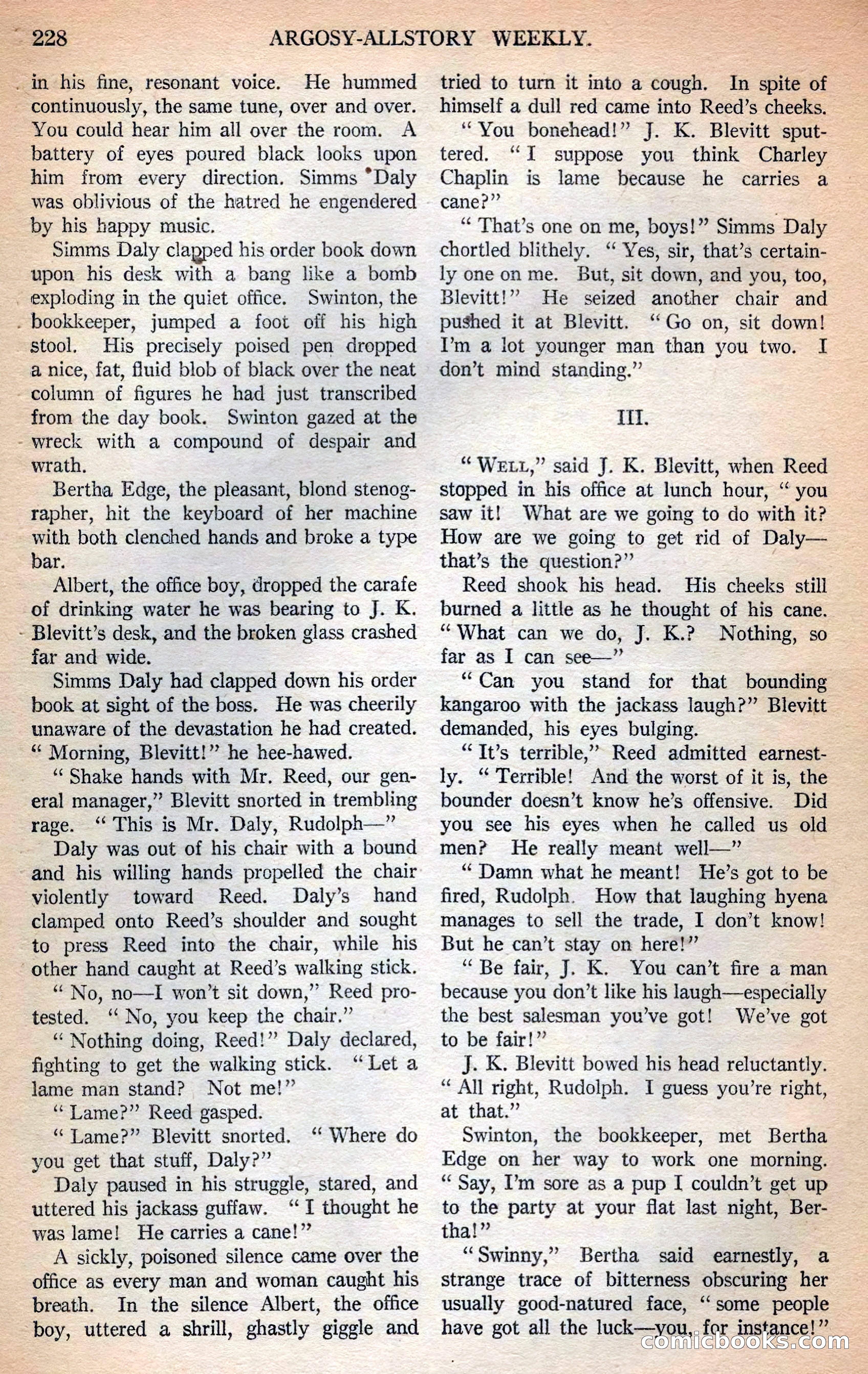
A restored page from Pulp Fiction, 1924. Page through the whole issue in the reader above.
📄 Transcribed text from this page (OCR, searchable)
Machine-transcribed from the original scan — historical spelling and the odd misread are preserved.
~ 228 . in his fine, resonant voice. He hummed - continuously, the same tune, over and over. You could hear him all over the room. A battery of eyes poured black looks upon him from every direction. Simms “Daly was oblivious of the hatred he engendered by his happy music. Simms Daly clapped his order book down upon his desk with a bang like a bomb _ exploding in the quiet office. Swinton, the . bookkeeper, jumped a foot off his high stool. His precisely poised pen dropped a nice, fat, fluid blob of black over the neat -column of figures he had just transcribed from the day book. Swinton gazed at the - wreck with a compound of despair and wrath. Bertha Edge, the pleasant, blond stenog- rapher, hit the keyboard of her machine with both clenched hands and broke a type bar. Albert, the office boy, dropped the carafe of drinking water he was bearing to J. K. - Blevitt’s desk, and the broken glass crashed far and wide. Simms Daly had clapped down his order book at sight of the boss. He was cheerily unaware of the devastation he had created. “ Morning, Blevitt!”” he hee-hawed. ‘‘ Shake hands with Mr. Reed, our gen- eral manager,” Blevitt snorted in trembling rage. ‘ This is Mr. Daly, Rudolph—” Daly was out of his chair with a bound -and his willing hands propelled the chair violently toward Reed. Daly’s hand clamped onto Reed’s shoulder and sought to press Reed into the chair, while his other hand caught at Reed’s walking stick. “No, no—I won’t sit down,” Reed pro- tested. ‘‘ No, you keep the chair.” “ Nothing doing, Reed!” Daly declared, fighting to get the walking stick. “Let a lame man stand? Not me!” “Lame?” Reed gasped. “ Lame?” Blevitt snorted. ‘“‘ Where do you get that stuff, Daly?” Daly paused in his struggle, stared, and uttered his jackass guffaw. ‘I thought he was lame! He carries a cane!” A sickly, poisoned silence came over the office as every man and woman caught his breath. In the silence Albert, the office boy, uttered a shrill, ghastly giggle and ARGOSY-ALLSTORY WEEKLY. | tried to turn it into a cough. In spite of — himself a dull red came into Reed’s cheeks. “You bonehead!” J. K. Blevitt sput- tered. Chaplin is lame because he carries a cane?” ‘“ That’s one on me, boys!” Simms Daly chortled blithely. “ Yes, sir, that’s certain- ly one on me. But, sit down, and you, too, Blevitt!” He seized another chair and pushed it at Blevitt. ‘“‘Go on, sit down! I’m a lot younger man than you two. I don’t mind standing.” TIT, “WELL,” said J. K. Blevitt, when Reed stopped in his office at lunch hour, “ you saw it! What are we going to do with it? How are we going to get rid of Daly— that’s the question?” Reed shook his head. His cheeks still burned a little as he thought of his cane. “What can we do, J. K.? Nothing, so far as I can see—” “Can you stand for that bounding kangaroo with the jackass laugh?” Blevitt demanded, his eyes bulging. “It’s terrible,” Reed admitted earnest- ly. “ Terrible! And the worst of it is, the bounder doesn’t know he’s offensive. Did you see his eyes when he called us old men? He really meant well—” “Damn what he meant! He’s got to be fired, Rudolph. How that laughing hyena manages to sell the trade, I don’t know! But he can’t stay on here!” “ Be fair, J. K. You can’t fire a man because you don’t like his laugh—especially the best salesman you’ve got! We’ve got to be fair!” J. K. Blevitt bowed his head reluctantly. “All right, Rudolph. I guess you’re right, at that.” Swinton, the bookkeeper, met Bertha Edge on her way to work one morning. “Say, I’m sore as a pup [ couldn’t get up to the party at your flat last night, Ber- tha!” “Swinny,” Bertha said earnestly, a strange trace of bitterness obscuring her usually good-natured face, ‘‘some people ‘I suppose you think Charley have got all the luck— you, for r Anstancel ee Dim