
Pulp Fiction, 1924 · page 8 of 166
Argosy All-Story Weekly — page 8: what you’re looking at
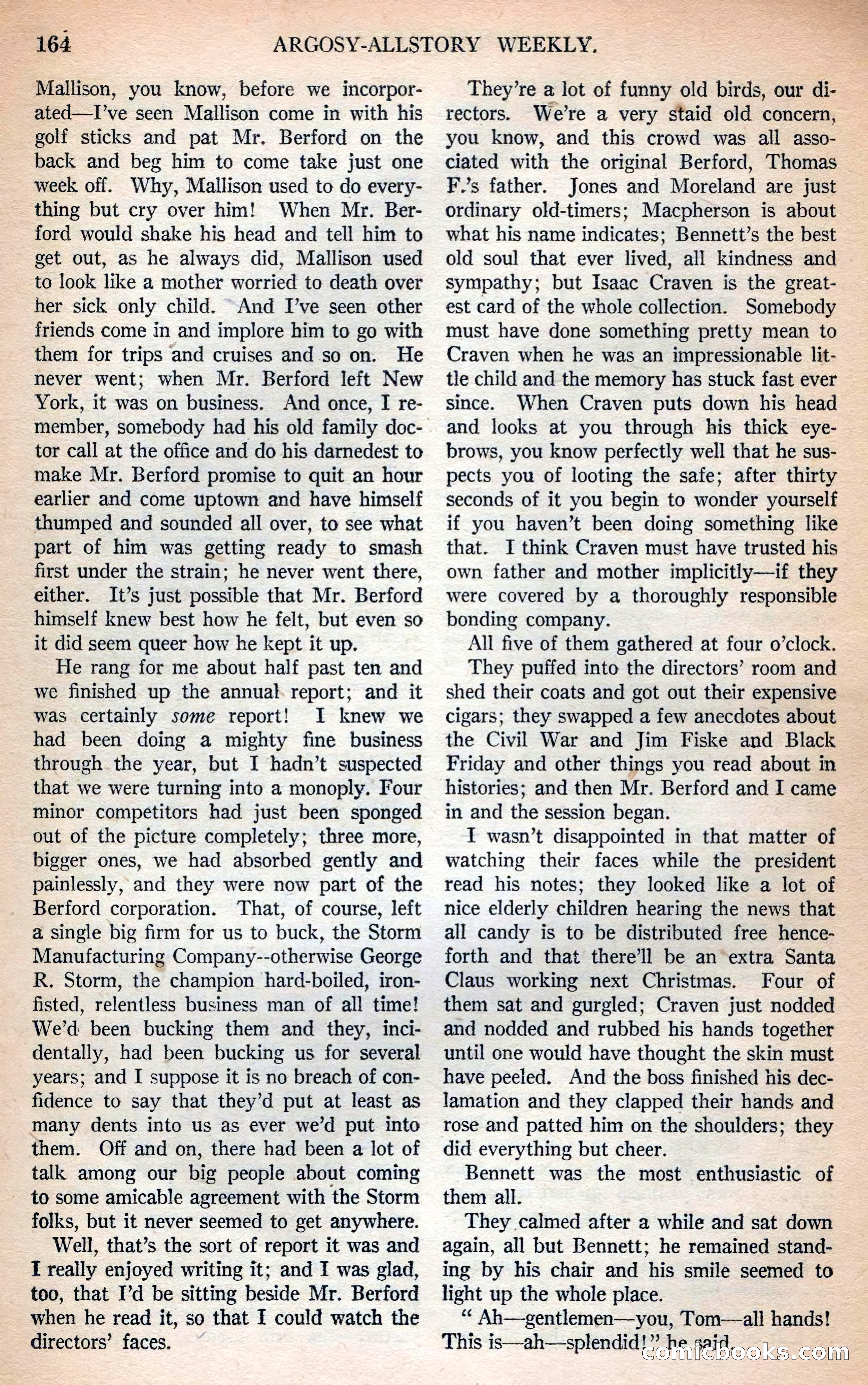
A restored page from Pulp Fiction, 1924. Page through the whole issue in the reader above.
📄 Transcribed text from this page (OCR, searchable)
Machine-transcribed from the original scan — historical spelling and the odd misread are preserved.
164 Mallison, you know, before we incorpor- ated—I’ve seen Mallison come in with his golf sticks and pat Mr. Berford on the back and beg him to come take just one week off. Why, Mallison used to do every- thing but cry over him! When Mr. Ber- ford would shake his head and tell him to get out, as he always did, Mallison used to look like a mother worried to death over her sick only child. And I’ve seen other friends come in and implore him to go with them for trips and cruises and so on. He never went; when Mr. Berford left New York, it was on business. And once, I re- member, somebody had his old family doc- tor call at the office and do his darnedest to make Mr. Berford promise to quit an hour earlier and come uptown and have himself thumped and sounded all over, to see what part of him was getting ready to smash first under the strain; he never went there, either. It’s just possible that Mr. Berford himself knew best how he felt, but even so it did seem queer how he kept it up. He rang for me about half past ten and we finished up the annual report; and it was certainly some report! I knew we had been doing a mighty fine business through the year, but I hadn’t suspected that we were turning into a monoply. Four minor competitors had just been sponged out of the picture completely; three more, bigger ones, we had absorbed gently and painlessly, and they were now part of the Berford corporation. That, of course, left a single big firm for us to buck, the Storm Manufacturing Company--otherwise George R. Storm, the champion hard-boiled, iron- fisted, relentless business man of all time! We’d been bucking them and they, inci- dentally, had been bucking us for several years; and I suppose it is no breach of con- fidence to say that they’d put at least as many dents into us as ever we’d put into them. Off and on, there had been a lot of talk among our big people about coming - to some amicable agreement with the Storm folks, but it never seemed to get anywhere. Well, that’s the sort of report it was and I really enjoyed writing it; and I was glad, too, that I’d be sitting beside Mr. Berford when he read it, so that I could watch the directors’ faces. ARGOSY-ALLSTORY WEEKLY. They’re a lot of funny old birds, our di- rectors. We're a very staid old concern, you know, and this crowd was all asso- ciated with the original Berford, Thomas F.’s father. Jones and Moreland are just ordinary old-timers; Macpherson is about what his name indicates; Bennett’s the best old soul that ever lived, all kindness and sympathy; but Isaac Craven is the great- est card of the whole collection. Somebody must have done something pretty mean to Craven when he was an impressionable lit- tle child and the memory has stuck fast ever since. When Craven puts down his head and looks at you through his thick eye- brows, you know perfectly well that he sus- pects you of looting the safe; after thirty seconds of it you begin to wonder yourself if you haven’t been doing something like that. I think Craven must have trusted his own father and mother implicitly—if they were covered by a thoroughly responsible bonding company. All five of them gathered at four o’clock. They puffed into the directors’ room and shed their coats and got out their expensive cigars; they swapped a few anecdotes about the Civil War and Jim Fiske and Black Friday and other things you read about in histories; and then Mr. Berford and I came in and the session began. I wasn’t disappointed in that matter of watching their faces while the president read his notes; they looked like a lot of nice elderly children hearing the news that all candy is to be distributed free hence- forth and that there'll be an extra Santa Claus working next Christmas. Four of them sat and gurgled; Craven just nodded and nodded and rubbed his hands together until one would have thought the skin must have peeled. And the boss finished his dec- lamation and they clapped their hands and rose and patted him on the shoulders; they did everything but cheer. Bennett was the most enthusiastic of them all. They calmed after a while and sat down again, all but Bennett; he remained stand- ing by his chair and his smile seemed to light up the whole place. “¢ Ah—gentlemen—you, Tom—all hands! This is—ah—splendid!?”-he gai. vc are