
Pulp Fiction, 1924 · page 89 of 166
Argosy All-Story Weekly — page 89: what you’re looking at
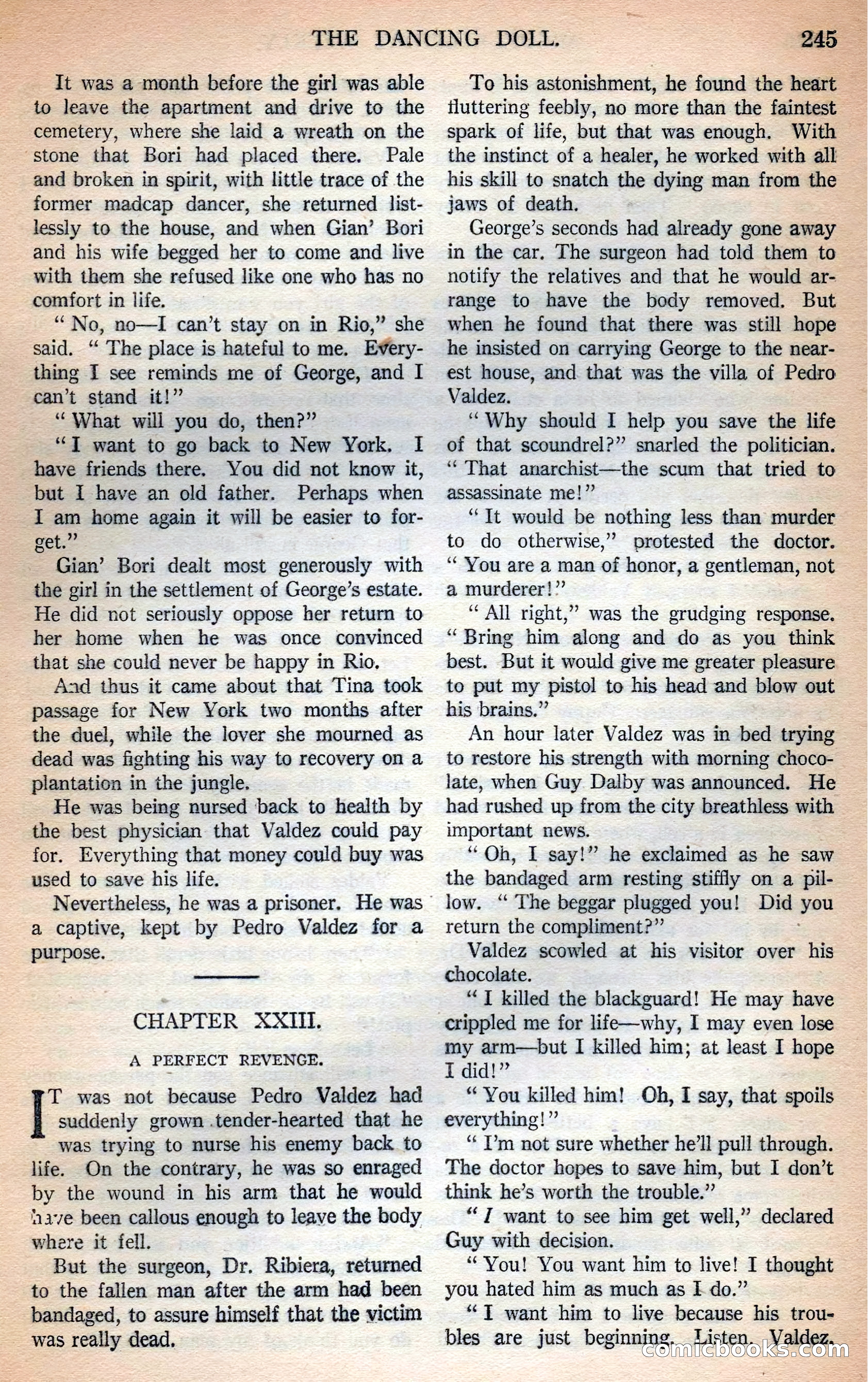
A restored page from Pulp Fiction, 1924. Page through the whole issue in the reader above.
📄 Transcribed text from this page (OCR, searchable)
Machine-transcribed from the original scan — historical spelling and the odd misread are preserved.
0 AON eee goes THE DANCING DOLL, It was a month before the girl was able to leave the apartment and drive to the cemetery, where she laid a wreath on the ‘stone that Bori had placed there. Pale and broken in spirit, with little trace of the former madcap dancer, she returned list- lessly to the house, and when Gian’ Bori and his wife begged her to come and live with them she refused like one who has no comfort in life. “No, no—I can’t stay on in Rio,” she said. “ The place is hateful to me. Every- thing I see reminds me of George, and I can’t stand it!” ‘“What will you do, then?” “IT want to go back to New York. I have friends there. You did not know it, but I have an old father. Perhaps when I am home again it will be easier to for- get.” Gian’ Bori dealt most generously with the girl in the settlement of George’s estate. He did not seriously oppose her return to her home when he was once convinced that she could never be happy in Rio, Aad thus it came about that Tina took passage for New York two months after the duel, while the lover she mourned as dead was fighting his way to recovery on a plantation in the jungle. He was being nursed back to health by the best physician that Valdez could pay for. Everything that money could buy was used to save his life. Nevertheless, he was a prisoner. He was a captive, kept by Pedro Valdez for a purpose. CHAPTER XXIII A PERFECT REVENGE. T was not because Pedro Valdez had suddenly grown .tender-hearted that he was trying to nurse his enemy back to life. On the contrary, he was so enraged by the wound in his arm that he would have been callous enough to leave the body where it fell. But the surgeon, Dr. Ribiera, returned to the fallen man after the arm had been bandaged, to assure himself that the victim was really dead. low. “ The beggar plugged you! To his astonishment, he found the heart fluttering feebly, no more than the faintest spark of life, but that was enough. With the instinct of a healer, he worked with all his skill to snatch the dying man from the jaws of death. George’s seconds had already gone away in the car. The surgeon had told them to notify the relatives and that he would ar- range to have the body removed. But when he found that there was still hope he insisted on carrying George to the near- est house, and that was the villa of Pedro Valdez. ‘“Why should I help you save the life of that scoundrel?” snarled the politician. “That anarchist—the scum that tried to assassinate me!” “It would be nothing less than murder to do otherwise,” protested the doctor. “You are a man of honor, a gentleman, not a murderer!”’ ‘All right,” was the grudging respense. “Bring him along and do as you think best. But it would give me greater pleasure to put my pistol to his head and blow out his brains.” An hour later Valdez was in bed trying to restore his strength with morning choco- late, when Guy Dalby was announced. He had rushed up from the city breathless with important news. “Oh, IL say!” he exclaimed as he saw the bandaged arm resting stiffly on a pil- Did you return the compliment?” Valdez scowled at his visitor over his chocolate. “T killed the blackguard! He may have crippled me for life—why, I may even lose my arm—but I killed him; at least I hope I did!” “You killed him! Oh, I say, that spoils everything!” “1m not sure whether he’ll pull through. The doctor hepes to save him, but I don’t think he’s worth the trouble.” “TI want to see him get well,” declared Guy with decision. “You! You want him to live! I thought you hated him as much as I do.” “IT want him to live because his trou- bles are just beginning —Hasten. Valdes “