
Pulp Fiction, 1924 · page 92 of 166
Argosy All-Story Weekly — page 92: what you’re looking at
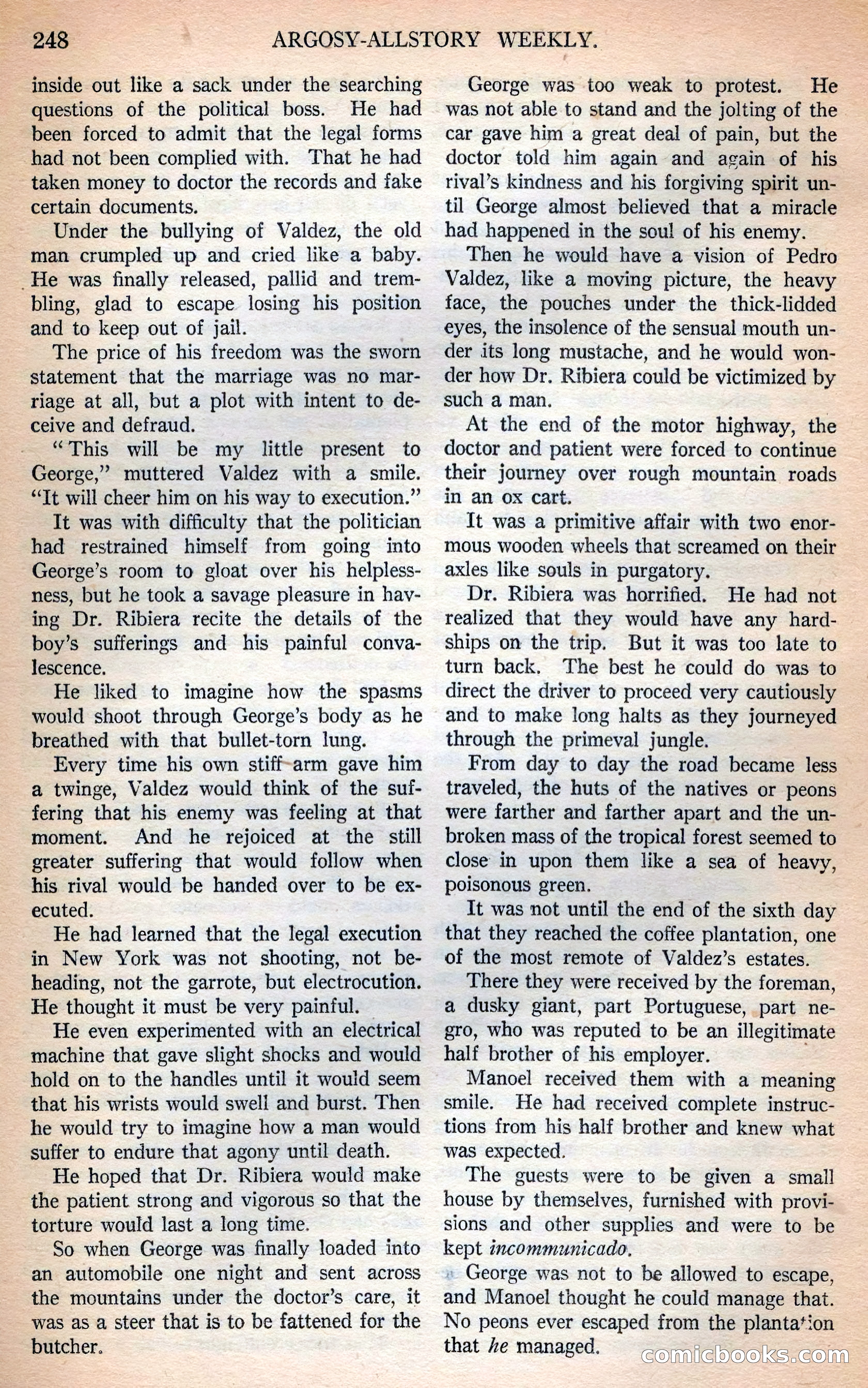
A restored page from Pulp Fiction, 1924. Page through the whole issue in the reader above.
📄 Transcribed text from this page (OCR, searchable)
Machine-transcribed from the original scan — historical spelling and the odd misread are preserved.
248 inside out like a sack under the searching questions of the political boss. He had been forced to admit that the legal forms had not been complied with. That he had taken money to doctor the records and fake certain documents. Under the bullying of Valdez, the old man crumpled up and cried like a baby. He was finally released, pallid and trem- bling, glad to escape losing his position and to keep out of jail. The price of his freedom was the sworn statement that the marriage was no mar- riage at all, but a plot with intent to de- ceive and defraud. “This will be my little present to George,” muttered Valdez with a smile. “Tt will cheer him on his way to execution.” It was with difficulty that the politician had restrained himself from going into George’s room to gloat over his helpless- ness, but he took a savage pleasure in hav- ing Dr. Ribiera recite the details of the boy’s sufferings and his painful conva- lescence. He liked to imagine how the spasms would shoot through George’s body as he breathed with that bullet-torn lung. Every time his own stiff-arm gave him a twinge, Valdez would think of the suf- fering that his enemy was feeling at that moment. And he rejoiced at the still greater suffering that would follow when his rival would be handed over to be ex- ecuted. He had learned that the legal execution in New York was not shooting, not be- heading, not the garrote, but electrocution. He thought it must be very painful. He even experimented with an electrical machine that gave slight shocks and would hold on to the handles until it would seem that his wrists would swell and burst. Then he would try to imagine how a man would suffer to endure that agony until death. He hoped that Dr. Ribiera would make the patient strong and vigorous so that the torture would last a long time. So when George was finally loaded into an automobile one night and sent across the mountains under the doctor’s care, it was as a steer that is to be fattened for the butcher. ARGOSY-ALLSTORY WEEKLY. George was too weak to protest. He was not able to stand and the jolting of the car gave him a great deal of pain, but the doctor told him again and again of his rival’s kindness and his forgiving spirit un- til George almost believed that a miracle had happened in the soul! of his enemy. Then he would have a vision of Pedro Valdez, like a moving picture, the heavy face, the pouches under the thick-lidded eyes, the insolence of the sensual mouth un- der its long mustache, and he would won- der how Dr. Ribiera could be victimized by such a man. : At the end of the motor highway, the doctor and patient were forced to continue their journey over rough mountain roads in an ox cart. It was a primitive affair with two enor- mous wooden wheels that screamed on their axles like souls in purgatory. Dr. Ribiera was horrified. He had not realized that they would have any hard- ships on the trip. But it was too late to turn back. The best he could do was to direct the driver to proceed very cautiously and to make long halts as they journeyed through the primeval jungle. From day to day the road became less traveled, the huts of the natives or peons were farther and farther apart and the un- broken mass of the tropical forest seemed to close in upon them like a sea of heavy, poisonous green. It was not until the end of the sixth day that they reached the coffee plantation, one of the most remote of Valdez’s estates. There they were received by the foreman, a dusky giant, part Portuguese, part ne- gro, who was reputed to be an illegitimate half brother of his employer. Manoel received them with a meaning smile. He had received complete instruc- tions from his half brother and knew what was expected. The guests were to be given a small house by themselves, furnished with provi- sions and other supplies and were to be kept incommunicado, » George was not to be allowed to escape, and Manoel thought he could manage that. No peons ever escaped from the plantation that he managed. aa michaalke com