
Pulp Fiction, 1925 · page 15 of 184
Argosy All-Story Weekly, February 7, 1925 — page 15: what you’re looking at
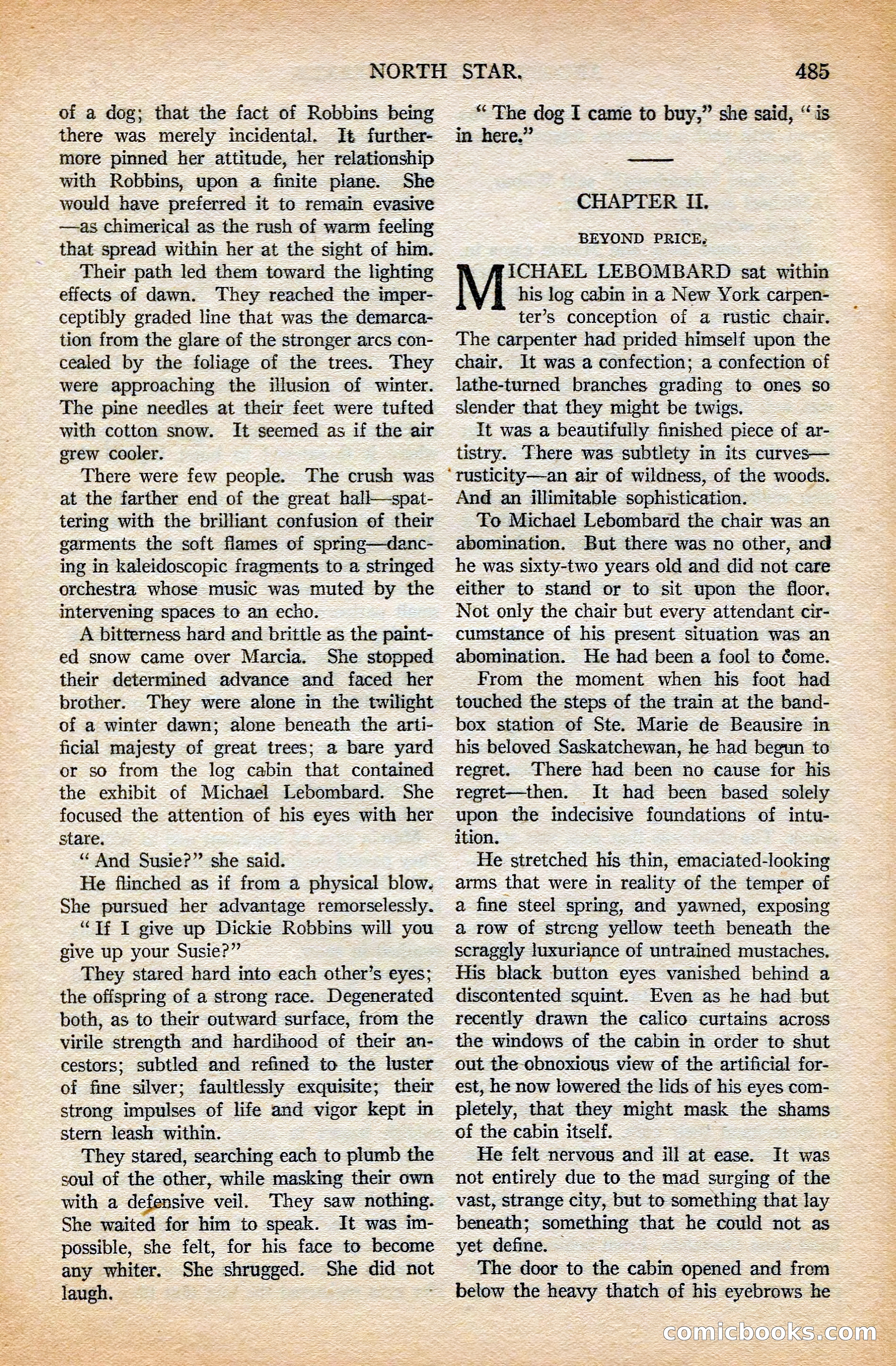
A restored page from Pulp Fiction, 1925. Page through the whole issue in the reader above.
📄 Transcribed text from this page (OCR, searchable)
Machine-transcribed from the original scan — historical spelling and the odd misread are preserved.
NORTH STAR, of a dog; that the fact of Robbins being there was merely incidental. I¢ further- more pinned her attitude, her relationship with Robbins, upon a = ‘plane. She would have peice it to remain evasive —as chimerical as the rush of warm feeling that spread within her at the sight of him. Their path led them toward the lighting effects of dawn. They reached the imper- ceptibly graded line that was the demarca- tion from the glare of the stronger arcs con- cealed by the foliage of the trees. They were approaching the illusion of winter. The pine needles at their feet were tufted with cotton snow. It seemed as if the air grew cooler. There were few people. The crush was at the farther end of the great hall—spat- tering with the brilliant confusion ef their garments the soft flames of spring—danc- ing in kaleidoscopic fragments to a stringed orchestra whose music was muted by the intervening spaces to an echo. 7 A bitterness hard and brittle as the paint- ed snow came over Marcia. She stopped their determined advance and faced her brother. They were alone in the twilight of a winter dawn; alone beneath the arti- ficial majesty of great trees; a bare yard or so from the log cabin that contained the exhibit of Michael Lebombard. She focused the attention of his eyes with her stare. “And Susie?” she said. He flinched as if from a physical blow. She pursued her advantage remorselessly. “Tf I give up Dickie Robbins will you give up your Susie?” They stared hard into each other’s eyes; the offspring of a strong race. Degenerated both, as to their outward surface, from the virile strength and hardiheod of their an- cestors; subtled and refined to the luster of fine silver; faultlessly exquisite; their strong impulses of life and vigor kept in stern leash within. They stared, searching each to plumb the soul of the other, while masking their own with a defensive veil. They saw nothing. She waited for him to speak. It was im- possible, she felt, for his face to become any whiter. She shrugged. She did not laugh. | “ The dog I camie to buy,” she said, “is in here.” CHAPTER II. BEYOND PRICE. ICHAEL LEBOMBARD sat within his log cabin in a New York carpen- ter’s conception of a rustic chair. The carpenter had prided himself upon the chair. It was a confection; a confection of lathe-turned branches grading to ones so slender that they might be twigs. It was a beautifully finished piece of ar- tistry. There was subtlety in its curves— ‘rusticity—an air of wildness, of the woods. And an illimitable sophistication. To Michael Lebombard the chair was an abomination. But there was no other, and he was sixty-two years old and did not care either to stand or to sit upon the floor. Not only the chair but every attendant cir- cumstance of his present situation was an abomination. He had been a fool to ¢ome. From the moment when his foot had touched the steps of the train at the band- box station of Ste. Marie de Beausire in his beloved Saskatchewan, he had beeun to regret. There had been no cause for his regret—then. It had been based solely upon the indecisive foundations of intu- ation. He stretched his thin, emaciated-looking arms that were in reality of the temper of a fine steel spring, and yawned, exposing a row of streng yellow teeth beneath the scragely luxuriance of untrained mustaches. Eis black button eyes vanished behind a discontented squint. Even as he had but recently drawn the calico curtains across the windows of the cabin in order te shut out the obnoxious view of the artificial for- est, he now lowered the lids of his eyes com- pletely, that they might mask the shams of the cabin itself. He felt nervous and ill at ease. It was not entirely due to the mad surging of the vast, strange city, but to something that lay heneath: something that he coud not as yet define. 3 The door to the cabin opened and from below the heavy thatch of his eyebrows he 485 Ais ay Ctl nit en M4 Heh Gy duly: YY) Per Neen CONNIE IOS ‘€O