
Pulp Fiction, 1925 · page 25 of 184
Argosy All-Story Weekly, February 7, 1925 — page 25: what you’re looking at
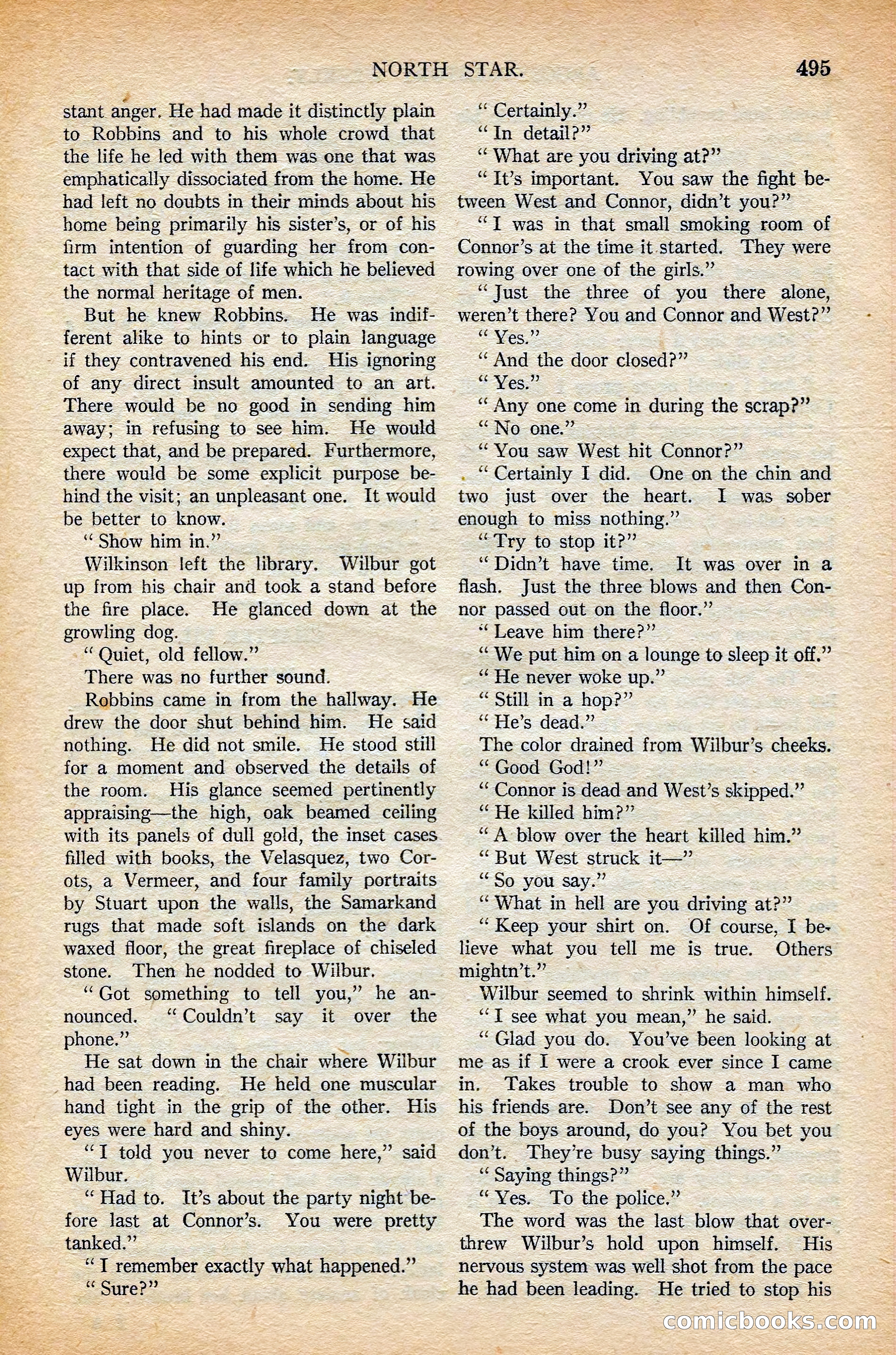
A restored page from Pulp Fiction, 1925. Page through the whole issue in the reader above.
📄 Transcribed text from this page (OCR, searchable)
Machine-transcribed from the original scan — historical spelling and the odd misread are preserved.
NORTH stant. anger. He had made it distinctly plain to Robbins and to his whole crowd that the life he led with them was ene that was emphatically dissociated from the home. He had left no doubts in their minds about his home being primarily his sister’s, or of his firm intention of guarding her from con- tact with that side of life which he believed the normal heritage of men. _ But he knew Robbins. He was indif- ferent alike to hints or to plain language - if they contravened his end. His ignoring of any direct insult amounted to an art. There would be no good in sending him away; in refusing to see him. He would expect that, and be prepared. Furthermore, there would be some explicit purpose be- hind the visit; an unpleasant one. It would be better to know. 5 ‘¢ Show him in.” Wilkinson left the library. Wilbur got up from his chair and took a stand before the fire place. He glanced down at the growling dog. “Quiet, old fellow.” There was no further sound. _ Rebbins came in from the hallway. He drew the door shut behind him. He said nothing. He did not smile. He stood still for a moment and observed the details of the room. His glance seemed pertinently appraising—the high, oak beamed ceiling with its panels of dull gold, the inset cases filled with books, the Velasquez, two Cor- ots, a Vermeer, and four family portraits by Stuart upon the walls, the Samarkand rugs that made soft islands on the dark waxed floor, the great fireplace of chiseled stone. Then he nodded to Wilbur, “Got something to tell you,” he an- nounced. ‘Couldn’t say it over the phone.” He sat down in the chair where Wilbur -had been reading. He held one muscular hand tight in the grip of the other. His eyes were hard and shiny. “IT told you never to come here,” said Wilbur. “Had to. It’s about the party night be- fore last at Connor’s. You were pretty tanked.” 3 “T remember exactly what happened.” —surer ” STAR. “ Certainly.” “In detail?” “What are you driving at?” “It’s important. You saw the fight be- tween West and Connor, didn’t your” “J was in that Saal smoking room of Connor’s ai the time it started. They were rowing over one of the girls.” | “Just the three of you there alone, weren’t there? You and Connor and West?” 4 Yes.” | ‘And the door closed?” ce Yes. bb] “¢ Any one come in during the scrap?” “No one.’ “You saw West hit Connor? “ Certainly I did. One on the chin and eS just over the heart. I was sober enough to miss nothing.” 7 ‘““Try to stop it?” ‘““Didn’t have time. It was over in a flash. Just the three blows and then Con- nor passed out on the floor.” “Leave him there?” ‘We put him on a lounge to sleep it off.” “He never woke up.” “ Still in a hop?” ‘“ He’s dead.” The color drained from Wilbur’s cheeks. “Good God!” “Connor is dead and West’s skipped.” “He killed hime” ‘““A blow over the heart killed him.” “But West struck it—” “What in hell are you driving at?” ‘“ Keep your shirt on. Of course, I be- lieve what you tell me is true. Others mightn’t.” Wilbur seemed to shrink within himself. ‘I see what you mean,” he said. “Glad you do. You’ve been looking at me as if I were a crook ever since I came in. Takes trouble to show a man who his friends are. Don’t see any of the rest of the boys around, do you? You bet you don’t. They’re busy saying things.” “« Saying things?” “Yes. To the police.” The word was the last blow that over- threw Wilbur’s hold upon himself. His nervous system was well shot from the pace he had been leading. He tried to stop his Gomicbooks.co