
Pulp Fiction, 1925 · page 119 of 182
Argosy All-Story Weekly, April 4, 1925 — page 119: what you’re looking at
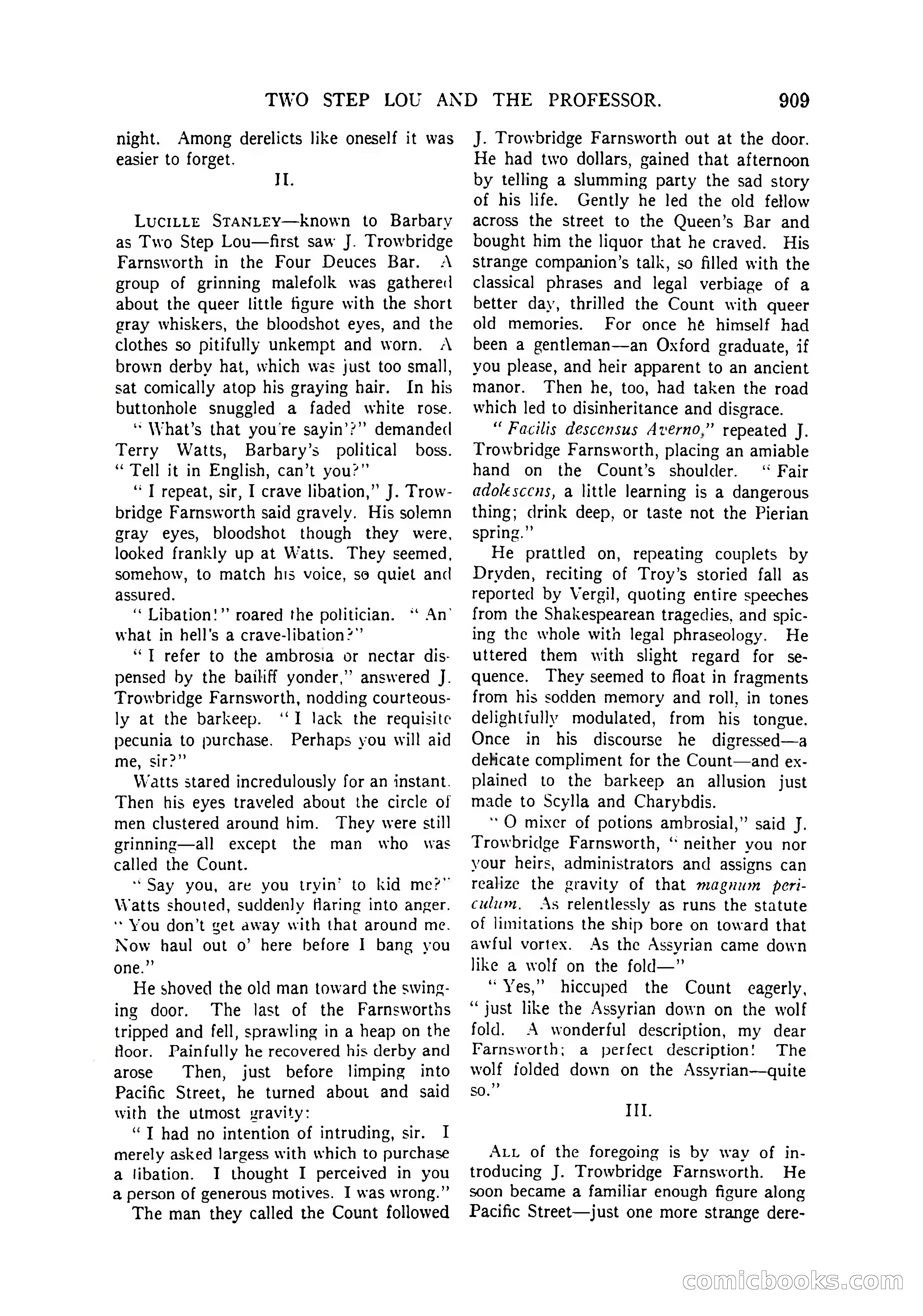
A restored page from Pulp Fiction, 1925. Page through the whole issue in the reader above.
📄 Transcribed text from this page (OCR, searchable)
Machine-transcribed from the original scan — historical spelling and the odd misread are preserved.
TWO STEP LOU AND THE PROFESSOR. night. Among derelicts like oneself it was easier to forget. II. LUCILLE STANLEY—known to Barbary as Two Step Lou—first saw J. Trowbridge Farnsworth in the Four Deuces Bar. A group of grinning malefolk was gathered about the queer little fgure with the short gray whiskers, the bloodshot eyes, and the clothes so pitifully unkempt and worn. <A brown derby hat, which was just too small, sat comically atop his graying hair. In his buttonhole snuggled a faded white rose. ‘ What’s that you're sayin’?” demanded Terry Watts, Barbary’s political boss. “Tell it in English, can’t you?” ‘“T repeat, sir, I crave libation,” J. Trow- bridge Farnsworth said gravely. His solemn gray eyes, bloodshot though they were, looked frankly up at Watts. They seemed, somehow, to match his voice, se quiet anc assured. ‘“‘ Libation!”’ roared the politician. what in hell's a crave-libation?”’ ‘““T refer to the ambrosia or nectar dis- pensed by the bailiff yonder,” answered J. Trowbridge Farnsworth, nodding courteous- ly at the barkeep. ‘‘I lack the requisite pecunia to purchase. Perhaps you will aid me, sir?” Watts stared incredulously for an instant. Then his eyes traveled about the circle of men clustered around him. They were still grinning—all except the man who was called the Count. ‘Say you, are you tryin’ to kid me?” Watts shouted, suddenly faring into anger. ‘You don’t get away with that around me. Now haul out o’ here before I bang you one.”’ He shoved the old man toward the swing- ing door. The last of the Farnswortns tripped and fell, sprawling in a heap on the oor. Painfully he recovered his derby and arose Then, just before limping into Pacific Street, he turned about and said with the utmost gravity: “JT had no intention of intruding, sir. I merely asked largess with which to purchase a libation. I thought I perceived in you a person of generous motives. I was wrong.” The man they called the Count followed “ An’ 909 J. Trowbridge Farnsworth out at the door. He had two dollars, gained that afternoon by telling a slumming party the sad story of his life. Gently he led the old fellow across the street to the Queen’s Bar and bought him the liquor that he craved. His Strange companion’s talk, so filled with the classical phrases and legal verbiage of a better day, thrilled the Count with queer old memories. For once hé himself had been a gentleman—an Oxford graduate, if you please, and heir apparent to an ancient manor. Then he, too, had taken the road which led to disinheritance and disgrace. “ Facilis descensus Averno,” repeated J. Trowbridge Farnsworth, placing an amiable hand on the Count’s shoulder. ‘ Fair adoléscens, a little learning is a dangerous thing; drink deep, or taste not the Pierian spring.” He prattled on, repeating couplets by Dryden, reciting of Troy’s storied fall as reported by Vergil, quoting entire speeches from the Shakespearean tragedies, and spic- ing the whole witn legal phraseology. He uttered them with slight regard for se- quence. They seemed to float in fragments from his sodden memory and roll, in tones delightiully modulated, from his tongue. Once in his discourse he digressed—a delhcate compliment for the Count—and ex- plained to the barkeep an allusion just made to Scylla and Charybdis. ‘OQ mixer of potions ambrosial,” said J. Trowbridge Farnsworth, ‘ neither vou nor your heirs, administrators and assigns can realize the gravity of that magnum peri- culum, As relentlessly as runs the statute of limitations the ship bore on toward that awful vortex. As the Assyrian came down like a wolf on the fold—” “ Yes,” hiccuped the Count eagerly, “just like the Assyrian down on the wolf fold. A wonderful description, my dear Farnsworth; a perfect description! The wolf folded down on the Assyrian—quite so.” III. ALL of the foregoing is by way of in- troducing J. Trowbridge Farnsworth. He soon became a familiar enough figure along Pacific Street—Jjust one more strange dere- Conn GIOok