
Pulp Fiction, 1925 · page 117 of 172
Argosy All-Story Weekly — page 117: what you’re looking at
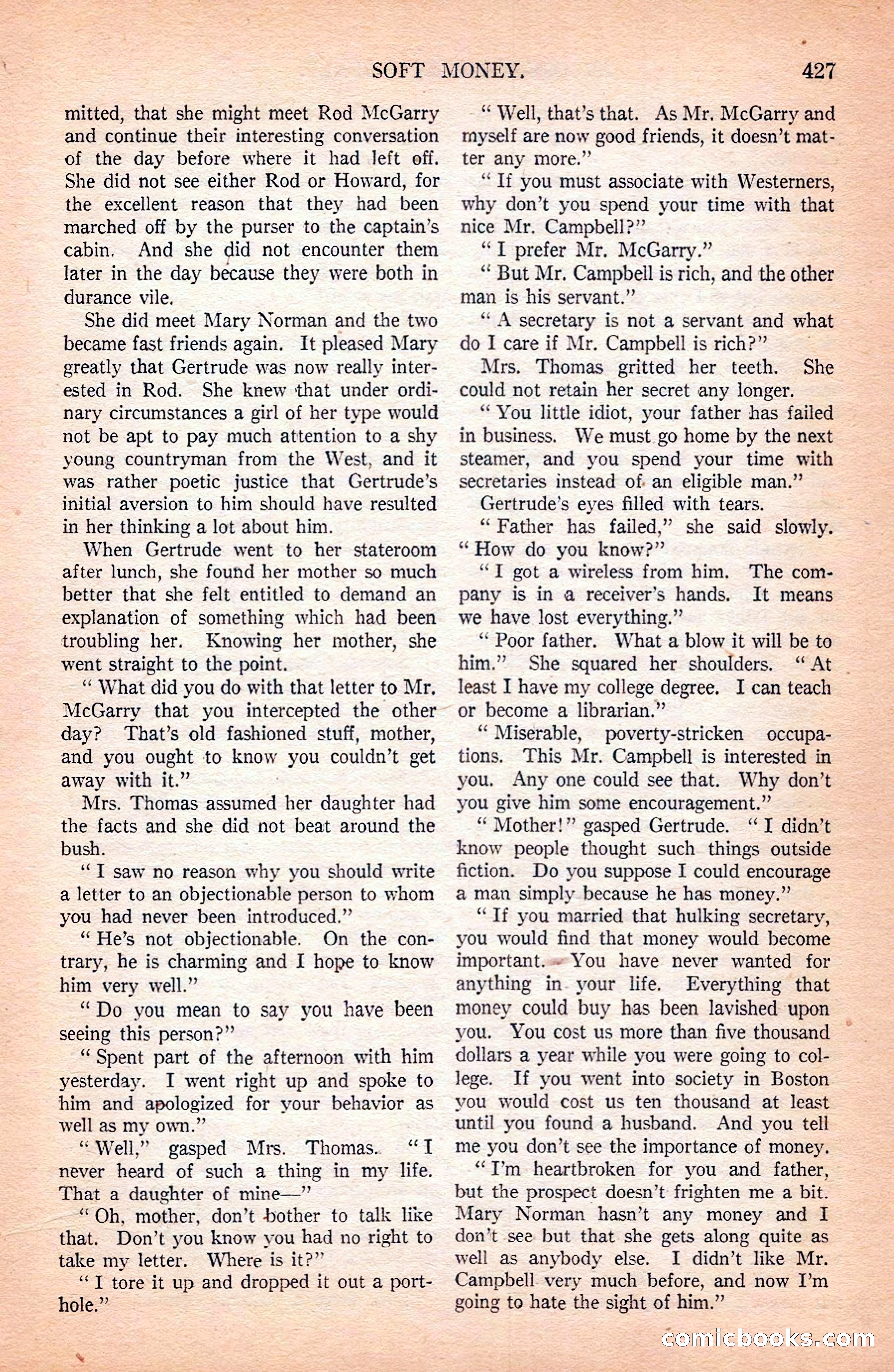
A restored page from Pulp Fiction, 1925. Page through the whole issue in the reader above.
📄 Transcribed text from this page (OCR, searchable)
Machine-transcribed from the original scan — historical spelling and the odd misread are preserved.
SOFT mitted, that she might meet Rod McGarry and continue their interesting conversation of the day before where it had left off. She did not see either Rod or Howard, for the excellent reason that they had been marched off by the purser to the captain’s cabin. And she did not encounter them later in the day because they were both in durance vile. She did meet Mary Norman and the two became fast friends again. It pleased Mary greatly that Gertrude was now really inter- ested in Rod. She knew that under ordi- nary circumstances a girl of her type would not be apt to pay much attention to a shy young countryman from the West, and it was rather poetic justice that Gertrude’s initial aversion to him should have resulted in her thinking a lot about him. When Gertrude went to her stateroom after lunch, she found her mother so much better that she felt entitled to demand an explanation of something which had been troubling her. Knowing her mother, she went straight to the point. ‘‘ What did you do with that letter to Mr. McGarry that you intercepted the other day? That’s old fashioned stuff, mother, and you ought to know you couldn’t get away with it.” Mrs. Thomas assumed her daughter had the facts and she did not beat around the bush. ‘“T saw no reason why you should write a letter to an objectionable person to whom you had never been introduced.” * He’s not objectionable. On the con- trary, he is charming and I hope to know him very well.” “Do you mean to say you have been seeing this person?” “Spent part of the afternoon with him yesterday. I went right up and spoke to him and apologized for your behavior as well as my own.” “Well,” gasped Mrs. Thomas. “TI never heard of such a thing in my life. That a daughter of mine—”’ “Oh, mother, don’t bother to talk like that. Don’t you know you had no right to take my letter. Where is it?” ‘“‘T tore it up and dropped it out a port- hole.” MONEY, 427 ‘Well, that’s that. As Mr. McGarry and myself are now good friends, it doesn’t mat-. ter any more.”’ : ‘If you must associate with Westerners, why don’t you spend your time with that nice Mr. Campbell?” “1 prefer Mr. McGarry.” “ But Mr. Campbell is rich, and the other man is his servant.” ‘““ A secretary is not a servant and what do I care if Mr. Campbell is rich?” Mrs. Thomas gritted her teeth. She could not retain her secret any longer. ** You little idiot, your father has failed in business. We must go home by the next steamer, and you spend your time with secretaries instead of. an eligible man.” Gertrude’s eyes filled with tears. “Father has failed,” she said slowly. “ How do you know?” “TI got a wireless from him. The com- pany is in @ receiver’s hands. It means we have lost everything.” ‘“* Poor father. What a blow it will be to him.” She squared her shoulders. “ At - least I have my college degree. I can teach or become a librarian.” “Miserable, poverty-stricken occupa- tions. This Mr. Campbell is interested in you. Any one could see that. Why don’t you give him some encouragement.” ‘“* Mother!” gasped Gertrude. “I didn’t know people thought such things outside fiction. Do you suppose I could encourage a man simply because he has money.” “If you married that hulking secretary, you would find that money would become important. «You have never wanted for anything in. your life. Everything that money could buy has been lavished upon you. You cost us more than five thousand dollars a year while you were going to col- lege. If you went into society in Boston vou would cost us ten thousand at least until you found a husband. And you tell me you don’t see the importance of money. *1’m heartbroken for you and father, | but the prospect doesn’t frighten me a bit. Mary Norman hasn’t any money and I don’t see but that she gets along quite as well as anybody else. I didn’t like Mr. Campbell very much before, and now I’m going to hate the sight of him.” oO Eomichbooks (S@)