
Pulp Fiction, 1925 · page 14 of 172
Argosy All-Story Weekly — page 14: what you’re looking at
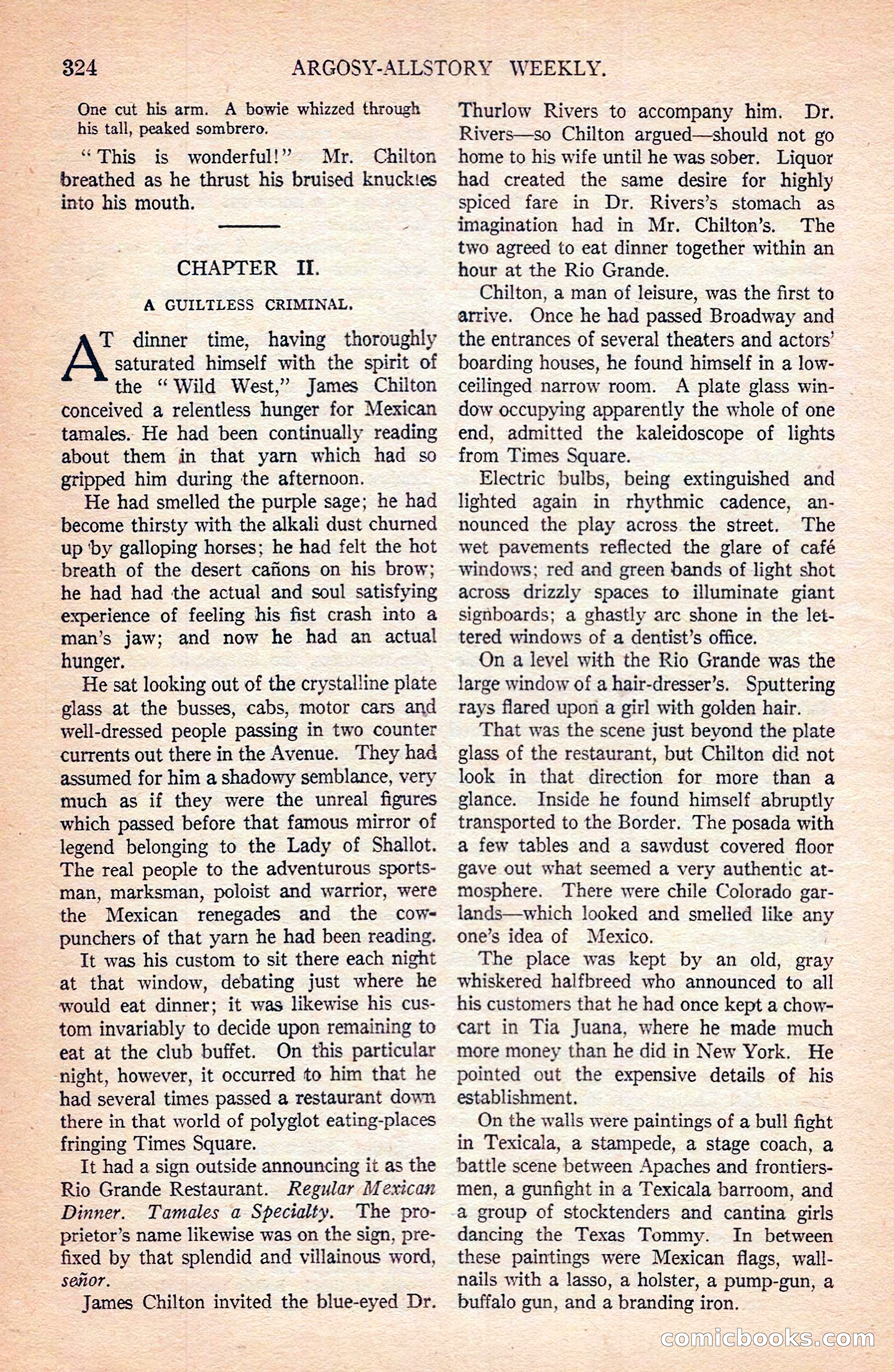
A restored page from Pulp Fiction, 1925. Page through the whole issue in the reader above.
📄 Transcribed text from this page (OCR, searchable)
Machine-transcribed from the original scan — historical spelling and the odd misread are preserved.
324 One cut his arm. A bowie whizzed through his tall, peaked sombrero. “This is wonderful!” Mr. Chilton breathed as he thrust his bruised knucktes into his mouth. CHAPTER Ii. A GUILTLESS CRIMINAL. T dinner time, having thoroughly A saturated himself with the spirit of the “Wild West,” James Chilton conceived a relentless hunger for Mexican tamales. He had been continually reading about them in that yarn which had so gripped him during the afternoon. He had smelled the purple sage; he had become thirsty with the alkali dust churned up ‘by galloping horses; he had felt the hot -breath of the desert cafions on his brow; he had had the actual and soul satisfying experience of feeling his fist crash into a man’s jaw; and now he had an actual hunger. He sat looking out of the crystalline plate glass at the busses, cabs, motor cars and well-dressed people passing in two counter currents out there in the Avenue. They had assumed for him a shadowy semblance, very much as if they were the unreal figures which passed before that famous mirror of ‘legend belonging to the Lady of Shallot. The real people to the adventurous sports- man, marksman, poloist and warrior, were the Mexican renegades and the cow- punchers of that yarn he had been reading. It was his custom to sit there each night at that window, debating just where he would eat dinner; it was likewise his cus- tom invariably to decide upon remaining to eat at the club buffet. On this particular night, however, it occurred to him that he had several times passed a restaurant down there in that world of polyglot eating-places fringing Times Square. It had a sign outside announcing it as the Rio Grande Restaurant. Regular Mexican Dinner. Tamales a Specialty. The pro- prietor’s name likewise was on the sign, pre- fixed by that splendid and villainous word, senor. James Chilton invited the blue-eyed Dr. ARGOSY-ALLSTORY WEEKLY, Thurlow Rivers to accompany him. Dr. Rivers—so Chilton argued—should not go home to his wife until he was sober. Liquor had created the same desire for highly spiced fare in Dr. Rivers’s stomach as imagination had in Mr. Chilton’s. The two agreed to eat dinner together within an hour at the Rio Grande. Chilton, a man of leisure, was the first to arrive. Once he had passed Broadway and the entrances of several theaters and actors’ boarding houses, he found himself in a low- ceilinged narrow room. A plate glass win- - dow occupying apparently the whole of one end, admitted the kaleidoscope of lights from Times Square. Electric bulbs, being extinguished and lighted again in rhythmic cadence, an- nounced the play across the street. The wet pavements reflected the glare of café windows; red and green bands of light shot across drizzly spaces to illuminate giant signboards; a ghastly arc shone in the let- tered windows of a dentist’s office. On a level with the Rio Grande was the large window of a hair-dresser’s. Sputtering rays flared upon a girl with golden hair. That was the scene just beyond the plate glass of the restaurant, but Chilton did not look in that direction for more than a glance. Inside he found himself abruptly transported to the Border. The posada with a few tables and a sawdust covered floor gave out what seemed a very authentic at- mosphere. There were chile Colorado gar- lands—which looked and smelled like any one’s idea of Mexico. , The place was kept by an old, gray whiskered halfbreed who announced to all his customers that he had once kept a chow- cart in Tia Juana, where he made much more money than he did in New York. He pointed out the expensive details of his establishment. On the walls were paintings of a bull fight in Texicala, a stampede, a stage coach, a battle scene between Apaches and frontiers- men, a gunfight in a Texicala barroom, and a group of stocktenders and cantina girls dancing the Texas Tommy. In between these paintings were Mexican flags, wall- nails with a lasso, a holster, a pump-gun, a buffalo gun, and a branding iron. EOMIGIOO S (S@)