
Pulp Fiction, 1925 · page 20 of 172
Argosy All-Story Weekly — page 20: what you’re looking at
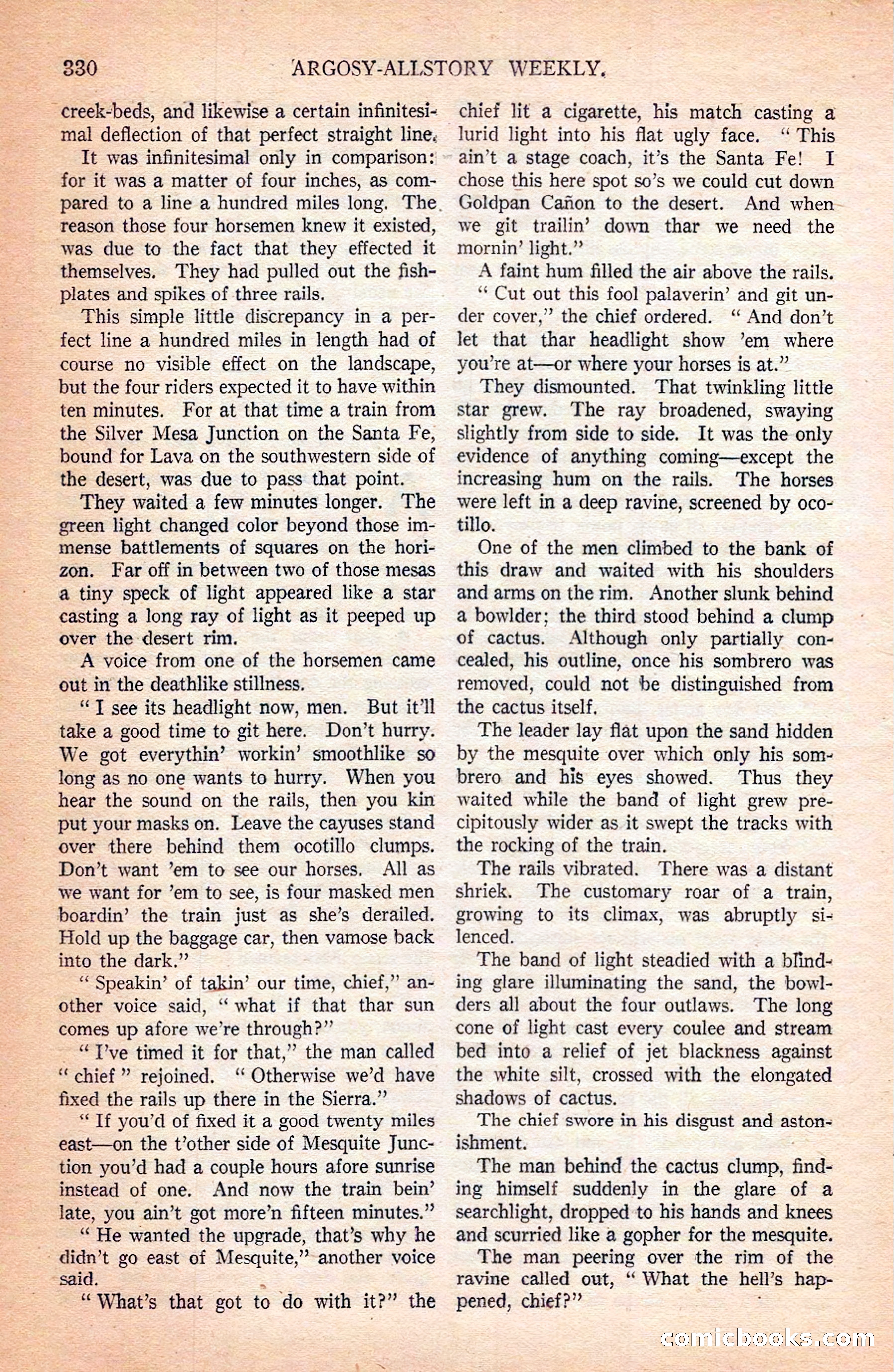
A restored page from Pulp Fiction, 1925. Page through the whole issue in the reader above.
📄 Transcribed text from this page (OCR, searchable)
Machine-transcribed from the original scan — historical spelling and the odd misread are preserved.
= 980) -¢reek-beds, and likewise a certain infinitesi- mal deflection of that perfect straight line. It was infinitesimal only in comparison: for it was a matter of four inches, as com- pared to a line a hundred miles long. The. _ Teason those four horsemen knew it existed, ‘was due to the fact that they effected it themselves. They had pulled out the fish- plates and spikes of three rails. This simple little discrepancy in a per- fect line a hundred miles in length had of course no visible effect on the landscape, but the four riders expected it to have within ten minutes. For at that time a train from the Silver Mesa Junction on the Santa Fe, bound for Lava on the southwestern side of the desert, was due to pass that point. They waited a few minutes longer. The green light changed color beyond those im- mense battlements of squares on the hori- zon. Far off in between two of those mesas a tiny speck of light appeared like a star casting a long ray of light as it peeped up over the desert rim. A voice from one of the horsemen came out in the deathlike stillness. “T see its headlight now, men. But it’ll take a good time to git here. Don’t hurry. We got everythin’ workin’ smoothlike so long as no one wants to hurry. When you hear the sound on the rails, then you kin put your masks on. Leave the cayuses stand over there behind them ocotillo clumps. Don’t want ’em to see our horses, All as we want for ’em to see, is four masked men boardin’ the train just as she’s derailed. Hold up the baggage car, then vamose back into the dark.” ‘“ Speakin’ of takin’ our time, chief,” an- other voice said, “ what if that thar sun comes up afore we’re through?”’ “ve timed it for that,” the man called “chief” rejoined. ‘‘ Otherwise we’d have fixed the rails up there in the Sierra.” * If you’d of fixed it a good twenty miles east—on the t’other side of Mesquite Junc- tion you’d had a couple hours afore sunrise instead of one. And now the train bein’ late, you ain’t got more’n fifteen minutes.” “ He wanted the upgrade, that’s why he - didn’t go east of Mesquite,” another voice said. es aes that got to do with ite” the ARGOSY-ALLSTORY WEEKLY. chief lit a cigarette, his match casting a lurid light into his flat ugly face. ‘“ This ain’t a stage coach, it’s the Santa Fe! I chose this here spot so’s we could cut down Goldpan Cafon to the desert. And when we git trailin’ down thar we need the mornin’ light.” A faint hum filled the air above the rails. “Cut out this fool palaverin’ and git un- der cover,” the chief ordered. ‘ And don’t let that thar headlight show ’em where you’re at—or where your horses is at.” They dismounted. That twinkling little star grew. ‘The ray broadened, swaying slightly from side to side. It was the only evidence of anything coming—except the increasing hum on the rails. The horses were left in a deep ravine, screened by oco- tillo. One of the men climbed to the bank of this draw and waited with his shoulders and arms on the rim. Another slunk behind a bowlder; the third stood behind a clump of cactus. Although only partially con- cealed, his outline, once his sombrero was removed, could not be distinguished from the cactus itself, The leader lay flat upon the sand hidden by the mesquite over which only his som~- brero and his eyes showed. Thus they waited while the band of light grew pre- cipitously wider as it swept the tracks with the rocking of the train. The rails vibrated. There was a distant shriek. The customary roar of a train, growing to its climax, was abruptly si- lenced. The band of light steadied with a blind- ing glare illuminating the sand, the bowl- ders all about the four outlaws. The long cone of light cast every coulee and stream bed into a relief of jet blackness against the white silt, crossed with the elongated shadows of cactus. The chief swore in his disgust and aston- ishment. The man behind the cactus clump, find- ing himself suddenly in the glare of a searchlight, dropped to his hands and knees and scurried like a gopher for the mesquite. The man peering over the rim of the ravine called out, “‘ What the hell's hap- pened, chief?” Eomichooks (S@)