
Pulp Fiction, 1925 · page 30 of 172
Argosy All-Story Weekly — page 30: what you’re looking at
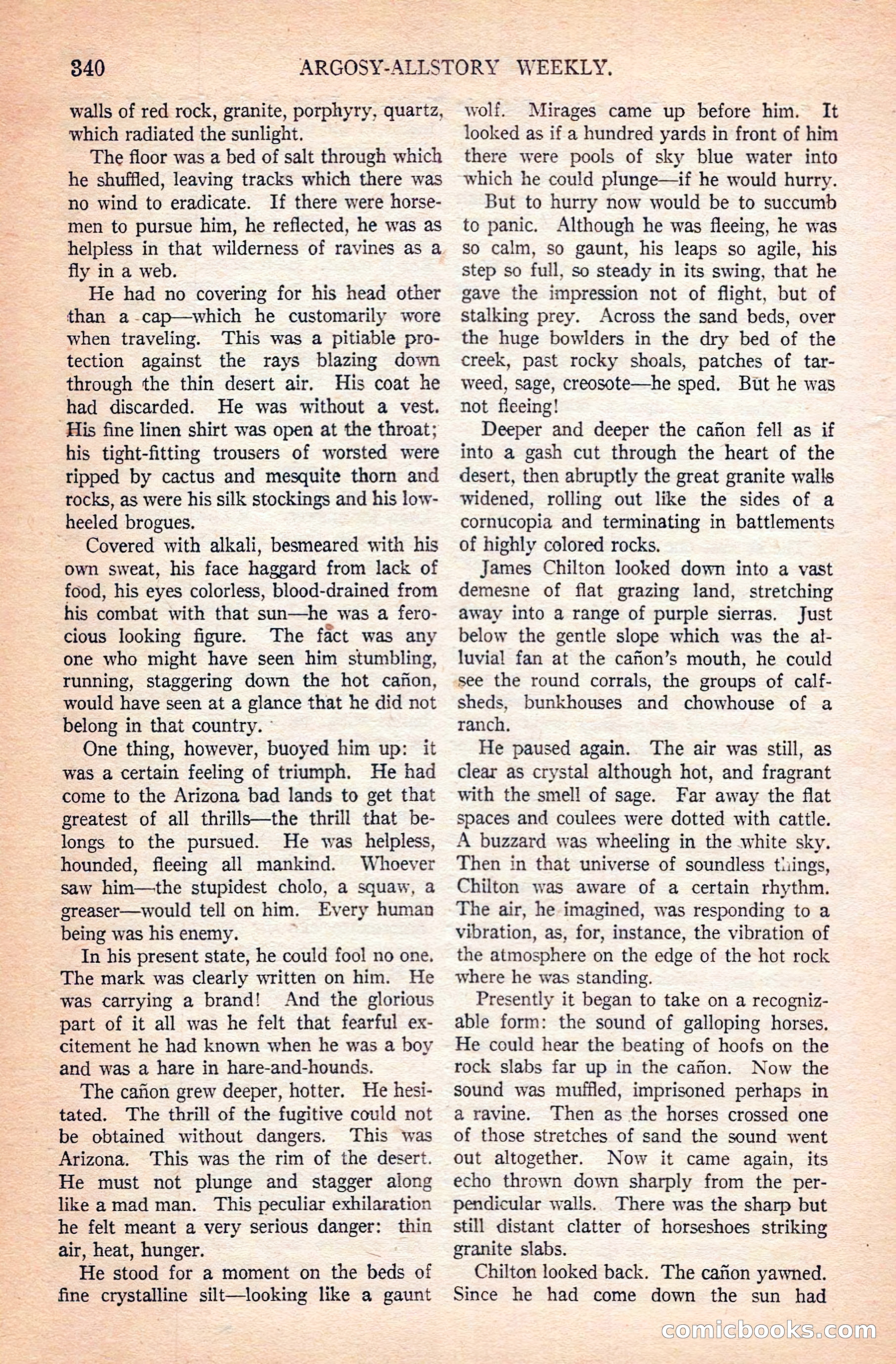
A restored page from Pulp Fiction, 1925. Page through the whole issue in the reader above.
📄 Transcribed text from this page (OCR, searchable)
Machine-transcribed from the original scan — historical spelling and the odd misread are preserved.
340 walls of red rock, granite, porphyry, quartz, which radiated the sunlight. The floor was a bed of salt through which he shuffled, leaving tracks which there was no wind to eradicate. If there were horse- men to pursue him, he reflected, he was as helpless in that wilderness of ravines as a fly in a web. He had no covering for his head other than a-cap—which he customarily wore when traveling. This was a pitiable pro- tection against the rays blazing down through the thin desert air. His coat he had discarded. He was without a vest. ‘His fine linen shirt was open at the throat; his tight-fitting trousers of worsted were ripped by cactus and mesquite thorn and rocks, as were his silk stockings and his low- heeled brogues. ~ Covered with alkali, besmeared with his own sweat, his face haggard from lack of food, his eyes colorless, blood-drained from his combat with that sun—he was a fero- cious looking figure. The fact was any one who might have seen him stumbling, running, staggering down the hot canon, would have seen at a glance that he did not belong in that country. ° One thing, however, buoyed him up: it was a certain feeling of triumph. He had come to the Arizona bad lands to get that greatest of all thrills—the thrill that be- longs to the pursued. He was helpless, hounded, fleeing all mankind. Whoever saw him—the stupidest cholo, a squaw, a greaser—would tell on him. Every human being was his enemy. In his present state, he could fool no one. The mark was clearly written on him. He was carrying a brand! And the glorious part of it all was he felt that fearful ex- citement he had known when he was a boy and was a hare in hare-and-hounds. The cafion grew deeper, hotter. He hesi- tated. The thrill of the fugitive could not be obtained without dangers. This was Arizona. This was the rim of the desert. He must not plunge and stagger along like amad man. This peculiar exhilaration he felt meant a very serious danger: thin air, heat, hunger. : He stood for a moment on the beds of fine crystalline silt—looking like a gaunt ARGOSY-ALLSTORY WEEKLY. wolf. Mirages came up before him. It looked as if a hundred yards in front of him there were pools of sky blue water into which he could plunge—if he would hurry. But to hurry now would be to succumb to panic. Although he was fleeing, he was so calm, so gaunt, his leaps so agile, his step so full, so steady in its swing, that he gave the impression not of flight, but of stalking prey. Across the sand beds, over the huge bowlders in the dry bed of the creek, past rocky shoals, patches of tar- weed, sage, creosote—he sped. But he was not fleeing! Deeper and deeper the cafion fell as if into a gash cut through the heart of the desert, then abruptly the great granite walls widened, rolling out like the sides of a cornucopia and terminating in battlements of highly colored rocks. James Chilton looked down into a vast demesne of flat grazing land, stretching away into a range of purple sierras. Just below the gentle slope which was the al- luvial fan at the cafion’s mouth, he could see the round corrals, the groups of calf- sheds, bunkhouses and chowhouse of a ranch. He paused again. The air was still, as clear as crystal although hot, and fragrant with the smell of sage. Far away the flat spaces and coulees were dotted with catile. A buzzard was wheeling in the white sky. Then in that universe of soundless tuings, Chilton was aware of a certain rhythm. The air, he imagined, was responding to a vibration, as, for, instance, the vibration of the atmosphere on the edge of the hot rock where he was standing. Presently it began to take on a recogniz- able form: the sound of galloping horses. He could hear the beating of hoofs on the rock slabs far up in the cafion. Now the sound was muffled, imprisoned perhaps in a ravine. Then as the horses crossed one of those stretches of sand the sound went out altogether. Now it came again, its cho thrown down sharply from the per- pendicular walls. There was the sharp but still distant clatter of horseshoes striking granite slabs. Chilton looked back. The cafion yawned. Since he had come down the sun had oO CoOMmicloooKks (S@)