
Pulp Fiction, 1925 · page 103 of 168
Argosy All-Story Weekly, July 11, 1925 — page 103: what you’re looking at
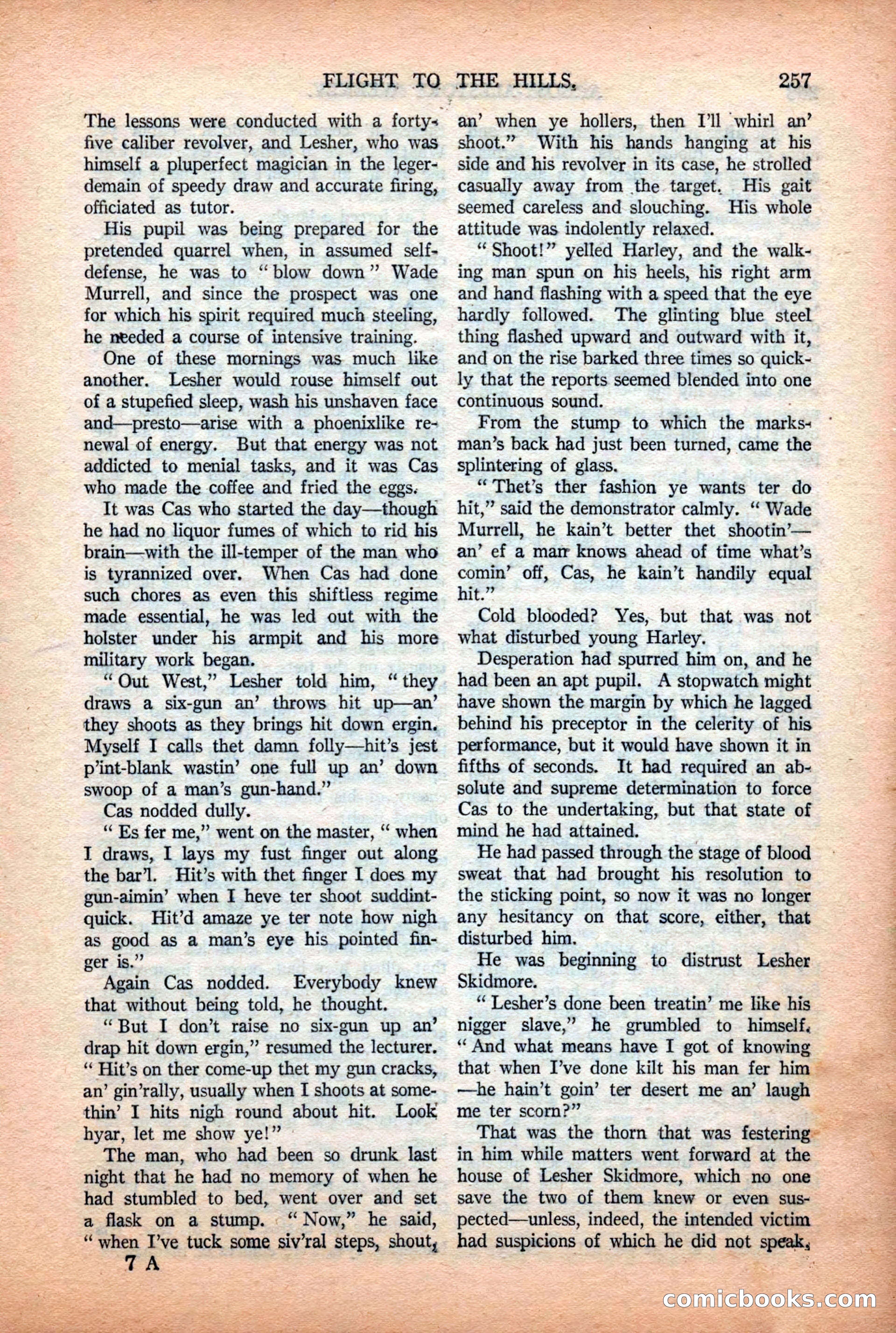
A restored page from Pulp Fiction, 1925. Page through the whole issue in the reader above.
📄 Transcribed text from this page (OCR, searchable)
Machine-transcribed from the original scan — historical spelling and the odd misread are preserved.
Oe oe a gE PO eg ee = — ees os “sain th FLIGHT TO The lessons were conducted with a fortys five caliber revolver, and Lesher, who was himself a pluperfect magician in the leger- demain of speedy draw and accurate firing, officiated as tutor. His pupil was being prepared for the pretended quarrel when, in assumed self- defense, he was to “ blow down” Wade Murrell, and since the prospect was one for which his spirit required much steeling, he needed a course of intensive training. One of these mornings was much like another. Lesher would rouse himself out of a stupefied sleep, wash his unshaven face and—presto—arise with a phoenixlike re- newal of energy. But that energy was not addicted to menial tasks, and it was Cas who made the coffee and fried the eggs. It was Cas who started the day—though he had no liquor fumes of which to rid his brain—with the ill-temper of the man who is tyrannized over. When Cas had done such chores as even this shiftless regime made essential, he was led out with the holster under his armpit and his more military work began. “Out West,” Lesher told him, “ they draws a six-gun an’ throws hit up—an’ they shoots as they brings hit down ergin. Myself I calls thet damn folly—hit’s jest p’int-blank wastin’ one full up an’ down swoop of a man’s gun-hand.” Cas nodded dully. “ Es fer me,” went on the master, “‘ when IT draws, I lays my fust finger out along the bar’l. Hit’s with thet finger I does my gun-aimin’ when I heve ter shoot suddint- quick. Hit’d amaze ye ter note how nigh as good as a man’s eye his pointed fin- ger is.” Again Cas nodded. Everybody knew that without being told, he thought. “But I don’t raise no six-gun up an’ drap hit down ergin,” resumed the lecturer. ‘ Hit’s on ther come-up thet my gun cracks, an’ gin’rally, usually when I shoots at some- thin’ I hits nigh round about hit. Look hyar, let me show ye!” The man, who had been so drunk last night that he had no memory of when he had stumbled to bed, went over and set a flask on a stump. . “ Now,” he said, Ses : 5 ee ee T've tuck some siv ‘ral steps, shout, THE HILLS, > 257 an’ when ye hollers, then I'll whirl an’ | 2 shoot.” With his hands hanging at his z side and his revolver in its case, he strolled casually away from the target. His gait — seemed careless and slouching. His whole attitude was indolently relaxed. “Shoot!” yelled Harley, and the walk- ing man spun on his heels, his right arm and hand flashing with a speed that the eye hardly followed. The glinting blue steel thing flashed upward and outward with it, and on the rise barked three times so quick- ly that the reports seemed blended into one continuous sound. From the stump to which the wiagk3 man’s back had just been turned, came the splintering of glass. “Thet’s ther fashion ye wants ter do hit,” said the demonstrator calmly. “ Wade Murrell, he kain’t better thet shootin’— an’ ef a marr knows ahead of time what’s comin’ off, Cas, he kain’t handily equal hit.” Cold blooded? Yes, but that was not what disturbed young Harley. Desperation had spurred him on, and he ; had been an apt pupil. A stopwatch might | have shown the margin by which he lagged behind his preceptor in the celerity of his performance, but it would have shown it in fifths of seconds. It had required an ab- solute and supreme determination to force = Cas to the undertaking, but that state of 2 mind he had attained. | He had passed through the stage of blood sweat that had brought his resolution to the sticking point, so now it was no longer any hesitancy on that score, either, that disturbed him. He was beginning to distrust Lesher Skidmore. “ Lesher’s done been treatin’ me like his nigger slave,” he grumbled to himself, “And what means have I got of knowing that when I’ve done kilt his man fer hime —he hain’t goin’ ter desert me an’ laugh me ter scorn?” ats That was the thorn that was festering in him while matters went forward at the house of Lesher Skidmore, which no one save the two of them knew or even sus- pected—unless, indeed, the intended victim — had suspicions of which he’ did not pe