
Pulp Fiction, 1925 · page 126 of 168
Argosy All-Story Weekly, July 11, 1925 — page 126: what you’re looking at
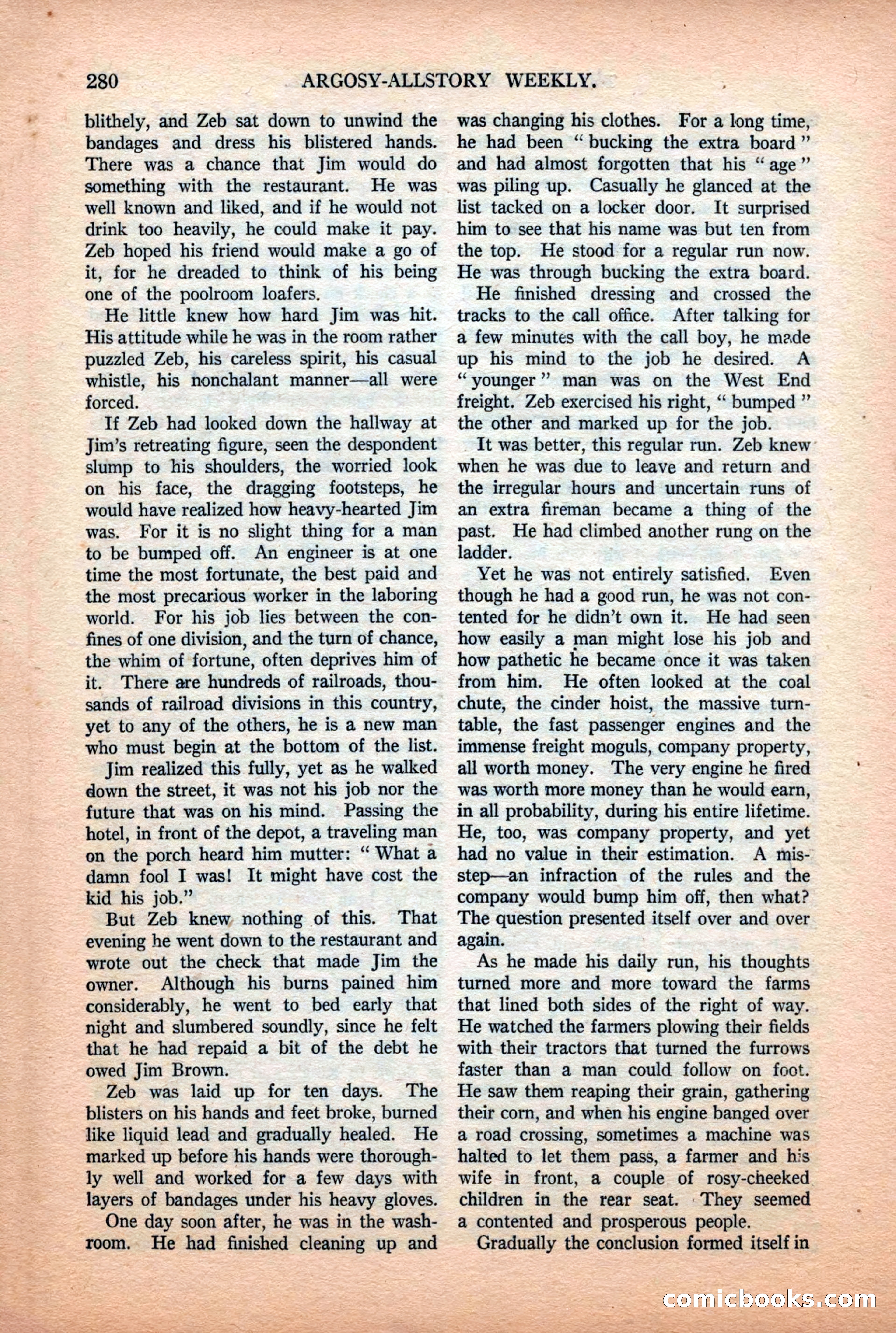
A restored page from Pulp Fiction, 1925. Page through the whole issue in the reader above.
📄 Transcribed text from this page (OCR, searchable)
Machine-transcribed from the original scan — historical spelling and the odd misread are preserved.
280 blithely, and Zeb sat down to unwind the bandages and dress his blistered hands. There was a chance that Jim would do something with the restaurant. He was well known and liked, and if he would not drink too heavily, he could make it pay. Zeb hoped his friend would make a go of it, for he dreaded to think of his being one of the poolroom loafers. He little knew how hard Jim was hit. His attitude while he was in the room rather puzzled Zeb, his careless spirit, his casual whistle, his nonchalant manner—all were forced. If Zeb had looked down the hallway at Jim’s retreating figure, seen the despondent slump to his shoulders, the worried look on his face, the dragging footsteps, he would have realized how heavy-hearted Jim was. For it is no slight thing for a man to be bumped off. An engineer is at one time the most fortunate, the best paid and the most precarious worker in the laboring world. For his job lies between the con- fines of one division, and the turn of chance, the whim of fortune, often deprives him of it. There are hundreds of railroads, thou- sands of railroad divisions in this country, yet to any of the others, he is a new man who must begin at the bottom of the list. Jim realized this fully, yet as he walked down the street, it was not his job nor the future that was on his mind. Passing the hotel, in front of the depot, a traveling man on the porch heard him mutter: “ What a damn fool I was! It might have cost the kid his job.” But Zeb knew nothing of this. That evening he went down to the restaurant and wrote out the check that made Jim the owner. Although his burns pained him considerably, he went to bed early that night and slumbered soundly, since he felt that he had repaid a bit of the debt he owed Jim Brown. Zeb was laid up for ten days. The blisters on his hands and feet broke, burned like liquid lead and gradually healed. He marked up before his hands were thorough- ly well and worked for a few days with layers of bandages under his heavy gloves. One day soon after, he was in the wash- room. He had finished cleaning up and ARGOSY-ALLSTORY WEEKLY, was changing his clothes. For a long time, he had been “ bucking the extra board ” and had almost forgotten that his “age” was piling up. Casually he glanced at the list tacked on a locker door. It surprised him to see that his name was but ten from the top. He stood for a regular run now. He was through bucking the extra board. He finished dressing and crossed the tracks to the call office. After talking for a few minutes with the call boy, he made up his mind to the job he desired. A “younger”? man was on the West End freight. Zeb exercised his right, “‘ bumped ” the other and marked up for the job. It was better, this regular run. Zeb knew’ when he was due to leave and return and the irregular hours and uncertain runs of an extra fireman became a thing of the past. He had climbed another rung on the ladder. Yet he was not entirely satisfied. Even though he had a good run, he was not con- tented for he didn’t own it. He had seen how easily a man might lose his job and how pathetic he became once it was taken from him. He often looked at the coal chute, the cinder hoist, the massive turn- table, the fast passenger engines and the immense freight moguls, company property, all worth money. The very engine he fired was worth more money than he would earn, in all probability, during his entire lifetime. He, too, was company property, and yet had no value in their estimation. A mis- step—an infraction of the rules and the company would bump him off, then what? The question presented itself over and over again. As he made his daily run, his thoughts turned more and more toward the farms that lined both sides of the right of way. He watched the farmers plowing their fields with their tractors that turned the furrows faster than a man could follow on foot. He saw them reaping their grain, gathering their corn, and when his engine banged over a road crossing, sometimes a machine was halted to let them pass, a farmer and his wife in front, a couple of rosy-cheeked. children in the rear seat. _They seemed a contented and prosperous people. Gradually the conclusion formed itself in