
Pulp Fiction, 1925 · page 144 of 168
Argosy All-Story Weekly, July 11, 1925 — page 144: what you’re looking at
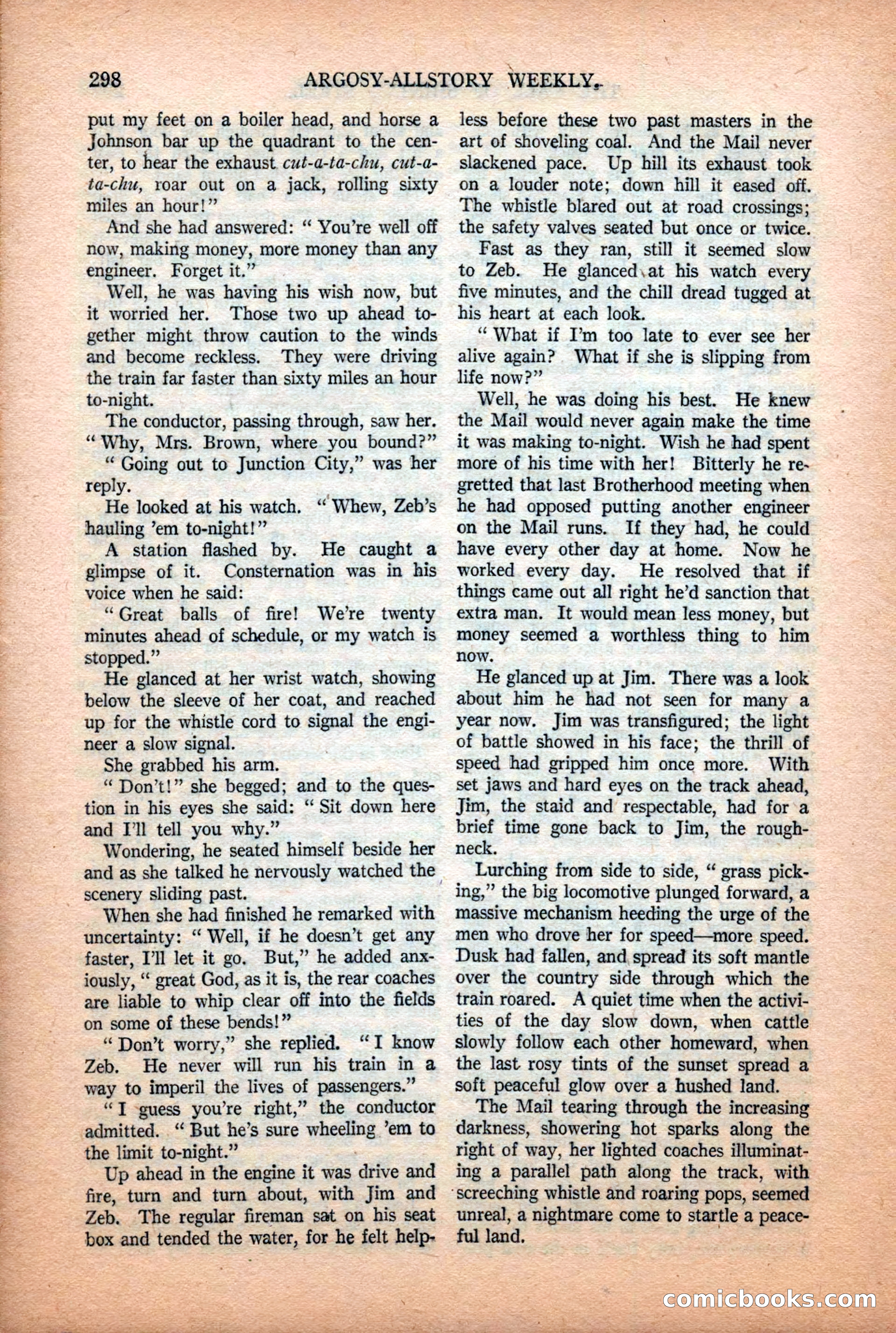
A restored page from Pulp Fiction, 1925. Page through the whole issue in the reader above.
📄 Transcribed text from this page (OCR, searchable)
Machine-transcribed from the original scan — historical spelling and the odd misread are preserved.
= , = z 4 “4 ~ i 3 AEWA a ie ; va = t As Ai ’ ia shih ade de oe asia aL AN toa ale aia al a fy ges ‘ o rnit* / : 4 ; ; ial * - Vath ay ea a’ rat - * PERS AV OS reve 4 “4 298 ARGOSY-ALLSTORY WEEKLY. put my feet on a boiler head, and horse a Johnson bar up the quadrant to the cen- ter, to hear the exhaust. cut-a-ta-chu, cut-a- ta- chu, roar out on a jack, rolling sixty miles an hour!” And she had answered: “ You’re well off now, making money, more money than any engineer. Forget it.” Well, he was having his wish now, but it worried her. Those two up ahead to- gether might throw caution to the winds and become reckless. They were driving the train far faster than sixty miles an hour to-night. The conductor, passing through, saw her. “Why, Mrs. Brown, where you bound?” “Going out to Junction City,” was her reply. He looked at his watch. ‘‘ Whew, Zeb’s hauling ’em to-night!” A station flashed by. He caught a glimpse of it. Consternation was in his voice when he said: “Great balls of fire! We're twenty minutes ahead of schedule, or my watch is stop He glanced at her wrist watch, showing below the sleeve of her coat, and reached up for the whistle cord to signal the engi- neer a slow signal. She grabbed his arm. “ Don’t!” she begged; and to the ques- tion in his eyes she said: “ Sit down here and J’ll tell you why.” Wondering, he seated himself beside her and as she talked he nervously watched the — scenery sliding past. - When she had finished he remarked with uncertainty: ‘‘ Well, if he doesn’t get any faster, I'll let it go. But,” he added anx- iously, “ great God, as it is, the rear coaches are liable to whip clear off into the fields on some of these bends!” “Don’t worry,” she replied. “I know Zeb. He never will run his train in a way to imperil the lives of passengers.” “T guess you’re right,” the conductor admitted. “‘ But he’s sure whsetng. em to the limit to-night. = Up ahead in the engine it was ‘dive and es turn and turn about, with Jim and Zeb. The regular fireman sat on his seat = 23s ox an d tended the wert, for he felt help- less before these two past masters in the art of shoveling coal. And the Mail never slackened pace. Up hill its exhaust took on a louder note; down hill it eased off. The whistle blared out at road crossings; the safety valves seated but once or twice. Fast as they ran, still it seemed slow to Zeb. He glanced\at his watch every five minutes, and the chill dread tugged at his heart at each look. “What if I’m too late to ever see her alive again? What if she is slipping from life now?” Well, he was doing his best. He knew the Mail would never again make the time it was making to-night. Wish he had spent more of his time with her! Bitterly he re- gretted that last Brotherhood meeting when he had opposed putting another engineer on the Mail runs. If they had, he could > have every other day at home. Now he worked every day. He resolved that if things came out all right he’d sanction that extra man. It would mean less money, but money seemed a worthless thing to him now. He glanced up at Jim. There was a look about him he had not seen for many a year now. Jim was transfigured; the light of battle showed in his face; the thrill of speed had gripped him once more. With set jaws and hard eyes on the track ahead, Jim, the staid and respectable, had for a brief time gone back to Jim, the rough- neck. Lurching from side to side, “ grass pick- ing,” the big locomotive plunged forward, a massive mechanism heeding the urge of the men who drove her for speed—more speed. Dusk had fallen, and spread its soft mantle over the country side through which the train roared. A quiet time when the activi- ties of the day slow down, when cattle slowly follow each other homeward, when the last rosy tints of the sunset spread a soft peaceful glow over a hushed land. The Mail tearing through the increasing darkness, showering hot sparks along the right of way, her lighted coaches illuminat- ing a parallel path along the track, with — ‘screeching whistle and roaring pops, seemed ) unreal, a nightmare come to startle a a eee. ful land.