
Pulp Fiction, 1925 · page 146 of 168
Argosy All-Story Weekly, July 11, 1925 — page 146: what you’re looking at
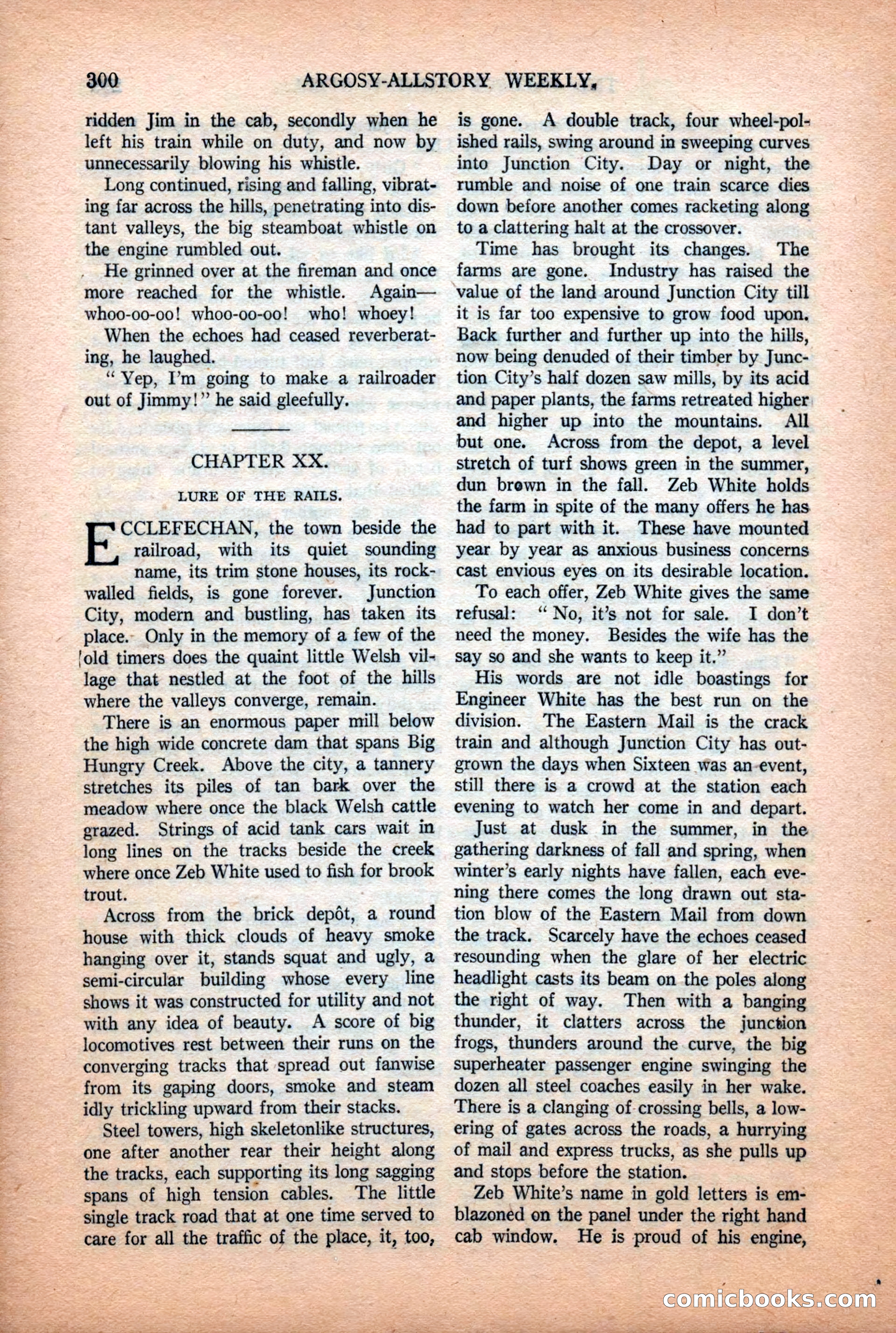
A restored page from Pulp Fiction, 1925. Page through the whole issue in the reader above.
📄 Transcribed text from this page (OCR, searchable)
Machine-transcribed from the original scan — historical spelling and the odd misread are preserved.
Teaver Mi Wish belibless tie, EP RPA OU NH PRAIA CF Merah ses / was Re Te ‘ u i 0) 5 300 ARGOSY-ALLSTORY WEEKLY, ridden Jim in the cab, secondly when he left his train while on duty, and now by unnecessarily blowing his whistle. Long continued, rising and falling, vibrat- ing far across the hills, penetrating into dis- tant valleys, the big steamboat whistle on the engine rumbled out. He grinned over at the fireman and once more reached for the whistle. Again— whoo-o0-00! whoo-o0-00! who! whoey! When the echoes had ceased reverberat- ing, he laughed. “Yep, I’m going to make a railroader out of Jimmy!” he said gleefully. CHAPTER XX. LURE OF THE RAILS. CCLEFECHAN, the town beside the railroad, with its quiet sounding name, its trim stone houses, its rock- walled fields, is gone forever. Junction City, modern and bustling, has taken its place. Only in the memory of a few of the ‘old timers does the quaint little Welsh vil- lage that nestled at the foot of the hills where the valleys converge, remain. There is an enormous paper mill below the high wide concrete dam that spans Big Hungry Creek. Above the city, a tannery stretches its piles of tan bark over the meadow where once the black Welsh cattle grazed. Strings of acid tank cars wait in long lines on the tracks beside the creek where once Zeb White used to fish for brook trout. Across from the brick depét, a round house with thick clouds of heavy smoke hanging over it, stands squat and ugly, a semi-circular building whose every line shows it was constructed for utility and not with any idea of beauty. A score of big locomotives rest between their runs on the converging tracks that spread out fanwise from its gaping doors, smoke and steam idly trickling upward from their stacks. Steel towers, high skeletonlike structures, one after another rear their height along the tracks, each supporting its long sagging spans of high tension cables. The little single track road that at one time served to care for all the traffic of the place, it, too, Pi et < a a = ee ee = <= ie ed Se * > a > ~ge Set ee ae: er Send on a _ —. > = Se . 4 a , a SS ees 5 Sot ee re a ea is gone. A double track, four wheel-pol- ished rails, swing around in sweeping curves into Junction City. Day or night, the rumble and noise of one train scarce dies down before another comes racketing along to a clattering halt at the crossover. Time has brought its changes. The farms are gone. Industry has raised the value of the land around Junction City till it is far too expensive to grow food upon, Back further and further up into the hills, now being denuded of their timber by Junc- tion City’s half dozen saw mills, by its acid and paper plants, the farms retreated higher and higher up into the mountains. All but one. Across from the depot, a level stretch of turf shows green in the summer, dun brewn in the fall. Zeb White holds the farm in spite of the many offers he has had to part with it. These have mounted year by year as anxious business concerns cast envious eyes on its desirable location. To each offer, Zeb White gives the same refusal: ‘ No, it’s not for sale. I don’t need the money. Besides the wife has the say so and she wants to keep it.” His words are not idle boastings for Engineer White has the best run on the division. The Eastern Mail is the crack train and although Junction City has out- grown the days when Sixteen was an-event, still there is a crowd at the station each evening to watch her come in and depart. Just at dusk in the summer, in the gathering darkness of fall and spring, when winter’s early nights have fallen, each eve- ning there comes the long drawn out sta- tion blow of the Eastern Mail from down the track. Scarcely have the echoes ceased resounding when the glare of her electric headlight casts its beam on the poles along the right of way. Then with a banging thunder, it clatters across the junction frogs, thunders around the curve, the big superheater passenger engine swinging the dozen all steel coaches easily in her wake. There is a clanging of crossing bells, a low- ering of gates across the roads, a hurrying of mail and express trucks, as she pulls up — and stops before the station. Zeb White’s name in gold letters is em- blazoned on the panel under the right hand cab window. He is proud of — engine,