
Pulp Fiction, 1925 · page 162 of 168
Argosy All-Story Weekly, July 11, 1925 — page 162: what you’re looking at
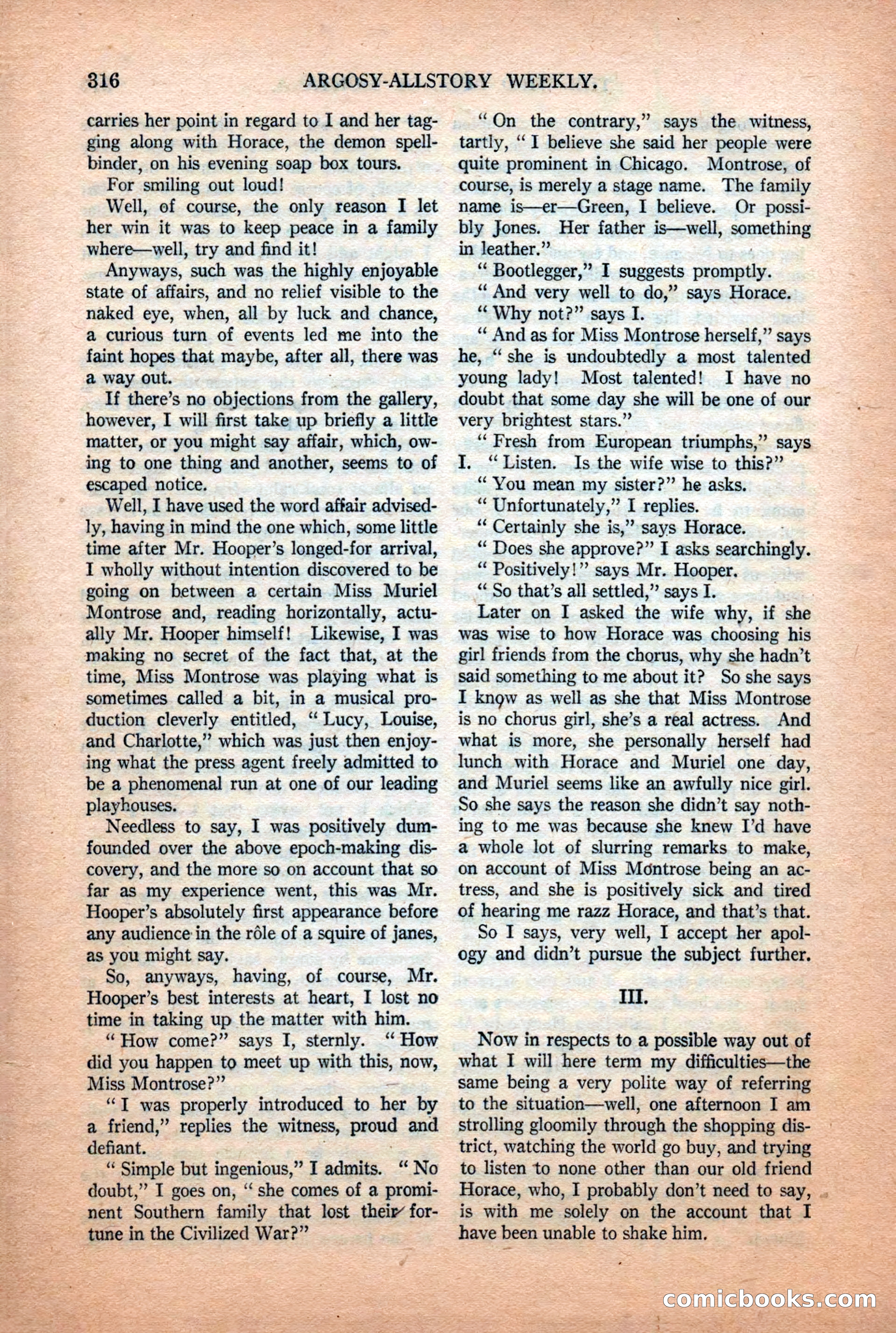
A restored page from Pulp Fiction, 1925. Page through the whole issue in the reader above.
📄 Transcribed text from this page (OCR, searchable)
Machine-transcribed from the original scan — historical spelling and the odd misread are preserved.
= a as ye bel SiN STA rs 7 > - ny 316 ARGOSY-ALLSTORY WEEKLY. carries her point in regard to I and her tag- ging along with Horace, the demon spell- binder, on his evening soap box tours. For smiling out loud! Well, of course, the only reason I let her win it was to keep peace in a family where—well, try and find it! Anyways, such was the highly enjoyable state of affairs, and no relief visible to the naked eye, when, all by luck and chance, a curious turn of events led me into the faint hopes that maybe, after all, there was a way out. If there’s no objections from the gallery, however, I will first take up briefly a little matter, or you might say affair, which, ow- ing to one thing and another, seems to of escaped notice. Well, I have used the word affair advised- ly, having in mind the one which, some little time after Mr. Hooper’s longed-for arrival, I wholly without intention discovered to be going on between a certain Miss Muriel Montrose and, reading horizontally, actu- ally Mr. Hooper himself! Likewise, I was making no secret of the fact that, at the time, Miss Montrose was playing what is sometimes called a bit, in a musical pro- duction cleverly entitled, ‘‘ Lucy, Louise, and Charlotte,” which was just then enjoy- ing what the press agent freely admitted to be a phenomenal run at one of our leading playhouses. Needless to say, I was positively dum- founded over the above epoch-making dis- covery, and the more so on account that so far as my experience went, this was Mr. Hooper’s absolutely first appearance before any audience in the réle of a squire of janes, as you might say. So, anyways, having, of course, Mr. Hooper’s best interests at heart, I lost no time in taking up the matter with him. “ How come?” says I, sternly. “ How did you happen to meet up with this, now, Miss Montrose?” “T was properly introduced to her by a friend,” replies the witness, peous and defiant. “Simple but ingenious,” I admits. ‘“ No doubt,” I goes on, “‘ she comes of a promi- nent Southern family that lost their for- Seer tune in the Civilized War?” ay Sweat, AN IN ' { \ “On the contrary,” says the. witness, tartly, ‘I believe she said her people were quite prominent in Chicago. Montrose, of course, is merely a stage name. The family name is—er—Green, I believe. Or possi- bly Jones. Her father is—well, something in leather.” ! “ Bootlegger,” I suggests promptly. “‘ And very well to do,” says Horace. “Why not?” says I. “* And as for Miss Montrose herself,” says he, “she is undoubtedly a most talented young lady! Most talented! I have no doubt that some day she will be one of our very brightest stars.” “Fresh from European triumphs,” says I. “Listen. Is the wife wise to this?” “You mean my sister?” he asks. “ Unfortunately,” I replies. “ Certainly she is,” says Horace. “ Does she approve?” I asks searchingly. “ Positively!” says Mr. Hooper. “* So that’s all settled,” says I. : Later on I asked the wife why, if she was wise to how Horace was choosing his girl friends from the chorus, why she hadn’t said something to me about it? So she says I know as well as she that Miss Montrose is no chorus girl, she’s a real actress. And what is more, she personally herself had lunch with Horace and Muriel one day, and Muriel seems like an awfully nice girl. So she says the reason she didn’t say noth- ing to me was because she knew I’d have a whole lot of slurring remarks to make, on account of Miss Montrose being an ac- tress, and she is positively sick and tired of hearing me razz Horace, and that’s that. So I says, very well, I accept her apol- ogy and didn’t pursue the subject further. II. Now in respects to a possible way out of what I will here term my difficulties—the same being a very polite way of referring to the situation—vwell, one afternoon I am strolling gloomily through the shopping dis- trict, watching the world go buy, and trying to listen to none other than our old friend Horace, who, I probably don’t need to say, . is with me solely on the account that I have been unable to shake him.