
Pulp Fiction, 1925 · page 73 of 168
Argosy All-Story Weekly, July 11, 1925 — page 73: what you’re looking at
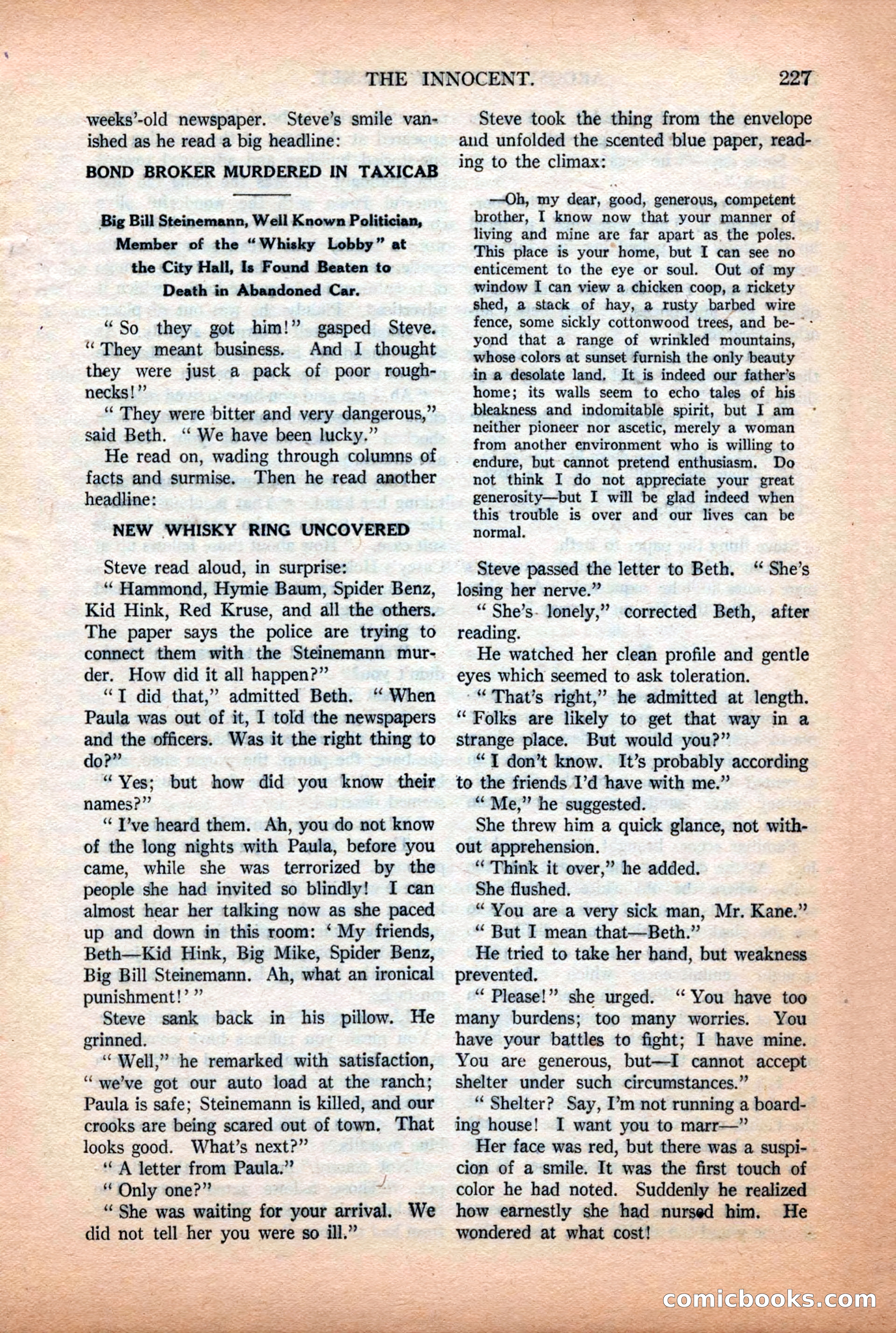
A restored page from Pulp Fiction, 1925. Page through the whole issue in the reader above.
📄 Transcribed text from this page (OCR, searchable)
Machine-transcribed from the original scan — historical spelling and the odd misread are preserved.
THE INNOCENT. weeks’-old newspaper. Steve’s smile van- ished as he read a big headline: BOND BROKER MURDERED IN TAXICAB Big Bill Steinemann, Weill Known Politician, Member of the “Whisky Lobby” at the City Hall, Is Found Beaten to Death in Abandoned Car. “So they got him!” gasped Steve. “They meant business. And I thought they were just a pack of poor rough- necks!” “They were bitter and very dangerous,” said Beth. ‘“‘ We have been lucky.” He read on, wading through columns of facts and surmise. Then he read another headline: NEW WHISKY RING UNCOVERED Steve read aloud, in surprise: “ Hammond, Hymie Baum, Spider Benz, Kid Hink, Red Kruse, and all the others. The paper says the police are trying to connect them with the Steinemann mur- der. How did it all happen?” “T did that,” admitted Beth. “ When Paula was out of it, I told the newspapers and the officers. Was it the right thing to do?” “Yes; but how did you know ‘their names?” “ T’ve heard them. Ah, you do not know of the long nights with Paula, before you came, while she was terrorized by the people she had invited so blindly! I can almost hear her talking now as she paced up and down in this room: ‘ My friends, Beth—Kid Hink, Big Mike, Spider Benz, Big Bill Steinemann. Ah, what an ironical punishment!’ ” Steve sank back in his pillow. He grinned. ; “Well,” he remarked with satisfaction, “we've got our auto load at the ranch; Paula is safe; Steinemann is killed, and our crooks are being scared out of town. That looks good. What’s next?” ‘A letter from Paula.” j ~ ™ Only one?” : “She was waiting for your arrival. We did not tell her you were so ill.” Pd 4 f 227° Steve took the thing from the envelope aud unfolded the scented ‘blue paper, read- ing to the climax: —Oh, my dear, good, generous, competent brother, I know now that your manner of living and mine are far apart as the poles. This place is your home, but I can see no enticement to the eye or soul. Out of my | window I can view a chicken coop, a rickety shed, a stack of hay, a rusty barbed wire fence, some sickly cottonwood trees, and be- ~- yond that a range of wrinkled mountains, whose colors at sunset furnish the only beauty in a desolate land, It is indeed our father’s home; its walls seem to echo tales of his bleakness and indomitable spirit, but I am neither pioneer nor ascetic, merely a woman from another environment who is willing to endure, but cannot pretend enthusiasm. Do not think I do not appreciate your great generosity—but I will be glad indeed when this trouble is over and our ives can be normal. Steve passed the letter to Beth. ‘“ She’s losing her nerve.” “* She’s- lonely,” corrected Beth, after reading. He watched her clean profile and gentle eyes which seemed to ask toleration. '“That’s right,” he admitted at length. “Folks are likely to get that way in a strange place. But would you?” “I don’t know. It’s probably according to the friends I’d have with me.” “Me,” he suggested. She threw him a quick glance, not with- out apprehension. “Think it over,” he added. She flushed. “You are a very sick man, Mr. Kane.” “ But I mean that—Beth.” ! He tried to take her hand, but weakness prevented. “ Please!” she urged. ‘“ You have too . many burdens; too many worries. You — have your battles to fight; I have mine. You are generous, but—I cannot accept shelter under such circumstances.” ae “Shelter? Say, ’mnotrunningaboard- | ing house! I want you to marr—” ae Her face was red, but there was a suspi- ae cion of a smile. It was the first touch of = ae color he had noted. Suddenly he realized how earnestly she had nursed im: pen wondered at what cost! ie eet oe