
Pulp Fiction, 1925 · page 8 of 168
Argosy All-Story Weekly, July 11, 1925 — page 8: what you’re looking at
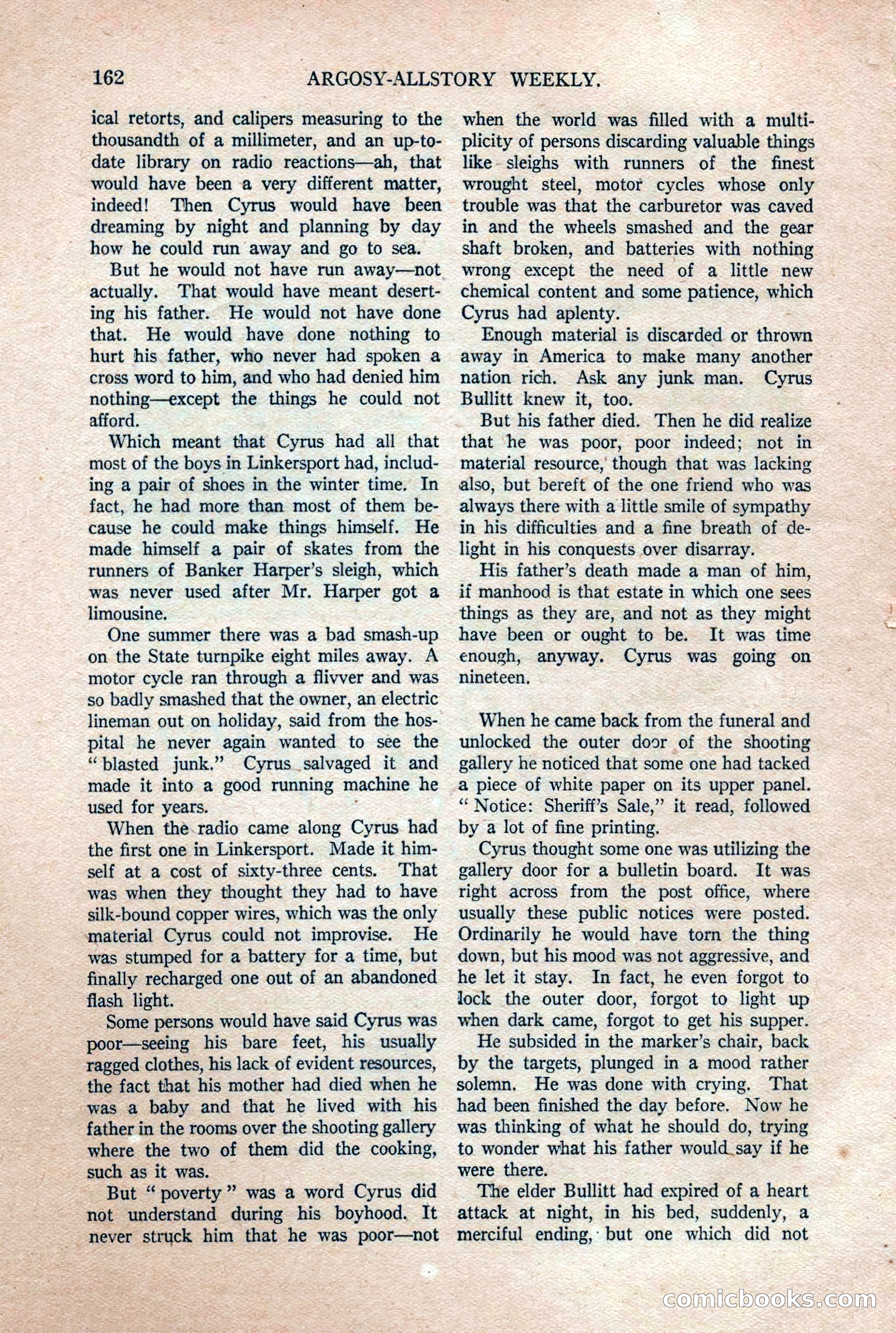
A restored page from Pulp Fiction, 1925. Page through the whole issue in the reader above.
📄 Transcribed text from this page (OCR, searchable)
Machine-transcribed from the original scan — historical spelling and the odd misread are preserved.
162 ical retorts, and calipers measuring to the thousandth of a millimeter, and an up-to- date library on radio reactions—ah, that would have been a very different matter, indeed! Then Cyrus would have been dreaming by night and planning by day how he could run away and go to sea. But he would not have run away—not actually. That would have meant desert- ing his father. He would not have done that. He would have done nothing to hurt his father, who never had spoken a cross word to him, and who had denied him nothing—except the things he could not afford. Which meant that Cyrus had all that most of the boys in Linkersport had, includ- ing a pair of shoes in the winter time. In fact, he had more than most of them be- cause he could make things himself. He made himself a pair of skates from the runners of Banker Harper’s sleigh, which was never used after Mr. Harper got a limousine. One summer there was a bad smash-up on the State turnpike eight miles away. A motor cycle ran through a flivver and was so badly smashed that the owner, an electric lineman out on holiday, said from the hos- pital he never again wanted to see the “blasted junk.” Cyrus. Salvaged it and made it into a good running machine he used for years. When thée.radio came along Cyrus had the first one in Linkersport. Made it him- self at a cost of sixty-three cents. That was when they thought they had to have silk-bound copper wires, which was the only material Cyrus could not improvise. He was stumped for a battery for a time, but finally recharged one out of an abandoned flash light. Some persons would have said Cyrus was poor—seeing his bare feet, his usually ragged clothes, his lack of evident resources, the fact that his mother had died when he was a baby and that he lived with his father in the rooms over the shooting gallery where the two of them did the cooking, such as it was. But “ poverty ” was a word Cyrus did not understand during his boyhood. It never struck him that he was poor—not ARGOSY-ALLSTORY WEEKLY. when the world was filled with a multi- plicity of persons discarding valuable things like- sleighs with runners of the finest wrought steel, motor cycles whose only trouble was that the carburetor was caved in and the wheels smashed and the gear shaft broken, and batteries with nothing wrong except the need of a little new chemical content and some patience, which Cyrus had aplenty. Enough material is discarded or dows away in America to make many another nation rich. Ask any junk man. Cyrus Bullitt knew it, too. But his father died. Then he did realize that he was poor, poor indeed; not in material resource, though that was lacking also, but bereft of the one friend who was always there with a little smile of sympathy in his difficulties and a fine breath of de- light in his conquests over disarray. His father’s death made a man of him, if manhood is that estate in which one sees things as they are, and not as they might have been or ought to be. It was time enough, anyway. Cyrus was going on nineteen, When he came back from the funeral and unlocked the outer door of the shooting gallery he noticed that some one had tacked a piece of white paper on its upper panel. ‘“* Notice: Sheriff’s Sale,” it read, followed by a lot of fine printing. Cyrus thought some one was utilizing the gallery door for a bulletin board. It was right across from the post office, where usually these public notices were posted. Ordinarily he would have torn the thing down, but his mood was not aggressive, and he let it stay. In fact, he even forgot to lock the outer door, forgot to light up when dark came, forgot to get his supper. He subsided in the marker’s chair, back by the targets, plunged in a mood rather solemn. He was done with crying. That had been finished the day before. Now he was thinking of what he should do, trying to wonder what his father would_say if he were there. The elder Bullitt had expired of a heart attack at night, in his bed, suddenly, a merciful ending, but one which did not COMIC OOOKS (EC) 5}