
Pulp Fiction, 1925 · page 85 of 168
Argosy All-Story Weekly, July 11, 1925 — page 85: what you’re looking at
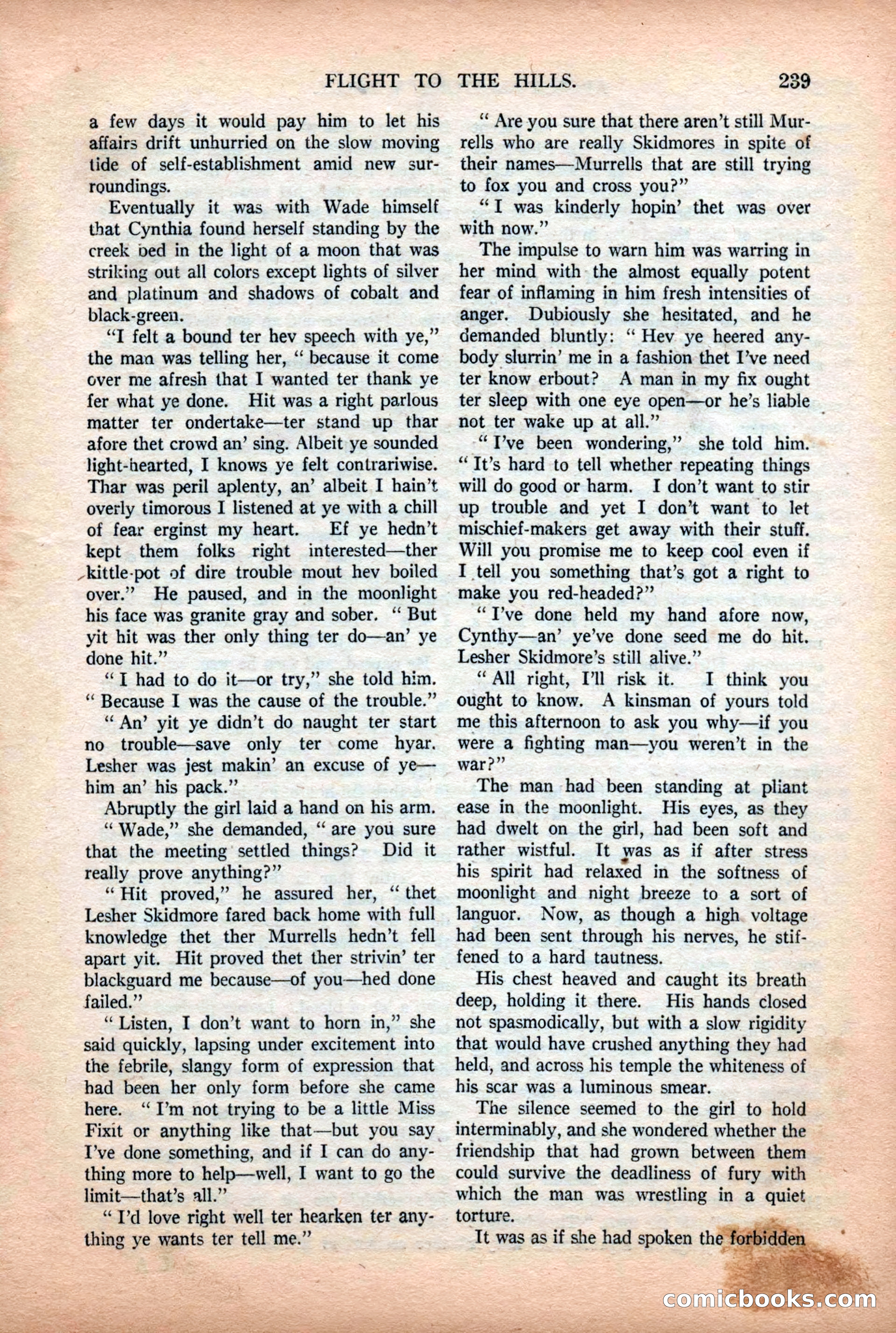
A restored page from Pulp Fiction, 1925. Page through the whole issue in the reader above.
📄 Transcribed text from this page (OCR, searchable)
Machine-transcribed from the original scan — historical spelling and the odd misread are preserved.
FLIGHT TO a few days it would pay him to let his affairs drift unhurried on the slow moving tide of self-establishment amid new sur- roundings. Eventually it was with Wade himself that Cynthia found herself standing by the creek bed in the light of a moon that was striking out all colors except lights of silver and platinum and shadows of cobalt and black-green. “T felt a bound ter hev speech with ye,” the man was telling her, ‘‘ because it come over me afresh that I wanted ter thank ye fer what ye done. Hit was a right parlous matter ter ondertake—ter stand up thar afore thet crowd an’ sing. Albeit ye sounded light-hearted, I knows ye felt contrariwise. Thar was peril aplenty, an’ albeit I hain’t overly timorous I listened at ye with a chill of fear erginst my heart. Ef ye hedn’t kept them folks right interested—ther _-kittle-pot of dire trouble mout hev boiled over.” He paused, and in the moonlight his face was granite gray and sober. “ But yit hit was ther only thing ter do—an’ ye done hit.” “‘T had to do it—or try,” she told him. ‘‘ Because I was the cause of the trouble.” ‘“ An’ yit ye didn’t do naught ter start no trouble—save only ter come hyar. Lesher was jest makin’ an excuse of ye— him an’ his pack.” Abruptly the girl laid a hand on his arm. “Wade,” she demanded, “ are you sure that the meeting settled things? Did it really prove anything?” “Hit proved,” he assured her, “ thet Lesher Skidmore fared back home with full knowledge thet ther Murrells hedn’t fell apart yit. Hit proved thet ther strivin’ ter blackguard me because—of you—hed done failed.” “Listen, I don’t want to horn in,” she said quickly, lapsing under excitement into the febrile, slangy form of expression that had been her only form before she came here. ‘I’m not trying to be a little Miss Fixit or anything like that—but you say I’ve done something, and if I can do any- thing more to help—well, I want to go the limit—that’s all.” “T’d love right well ter hearken ter any- thing ye wants ter tell me.” — f. ¢ THE HILLS. 239 ‘“ Are you sure that there aren’t still Mur- rells who are really Skidmores in spite of their names—Miurrells that are still trying to fox you and cross you?” “IT was kinderly hopin’ thet was over with now.” The impulse to warn him was warring in her mind with the almost equally potent fear of inflaming in him fresh intensities of anger. Dubiously she hesitated, and he demanded bluntly: “ Hev ye heered any- body slurrin’ me in a fashion thet I’ve need ter know erbout? A man in my fix ought ter sleep with one eye open—or he’s liable not ter wake up at all.” “T’ve been wondering,’ she told him. “It’s hard to tell whether repeating things will do good or harm. I don’t want to stir up trouble and yet I don’t want to let mischief-makers get away with their stuff. Will you promise me to keep cool even if I tell you something that’s got a right to make you red-headed?” “T’ve done held my hand afore now, Cynthy—an’ ye’ve done seed me do hit. Lesher Skidmore’s still alive.” “All right, Pll risk it. I think you ought to know. A kinsman of yours told me this afternoon to ask you why—if you were a fighting man—you weren’t in the war?” The man had been standing at pliant ease in the moonlight. His eyes, as they had dwelt on the girl, had been soft and rather wistful. It was as if after stress his spirit had relaxed in the softness of moonlight and night breeze to a sort of languor. Now, as though a high. voltage had been sent through his nerves, he stif- fened to a hard tautness. His chest heaved and caught its breath deep, holding it there. His hands closed not spasmodically, but with a slow rigidity that would have crushed anything they had held, and across his temple the whiteness of his scar was a luminous smear. The silence seemed to the girl to hold interminably, and she wondered whether the © friendship that had grown between them could survive the deadliness of fury with which the man was wrestling in a quiet torture. = Tt was as if she had spoken the: