
Pulp Fiction, 1925 · page 94 of 168
Argosy All-Story Weekly, July 11, 1925 — page 94: what you’re looking at
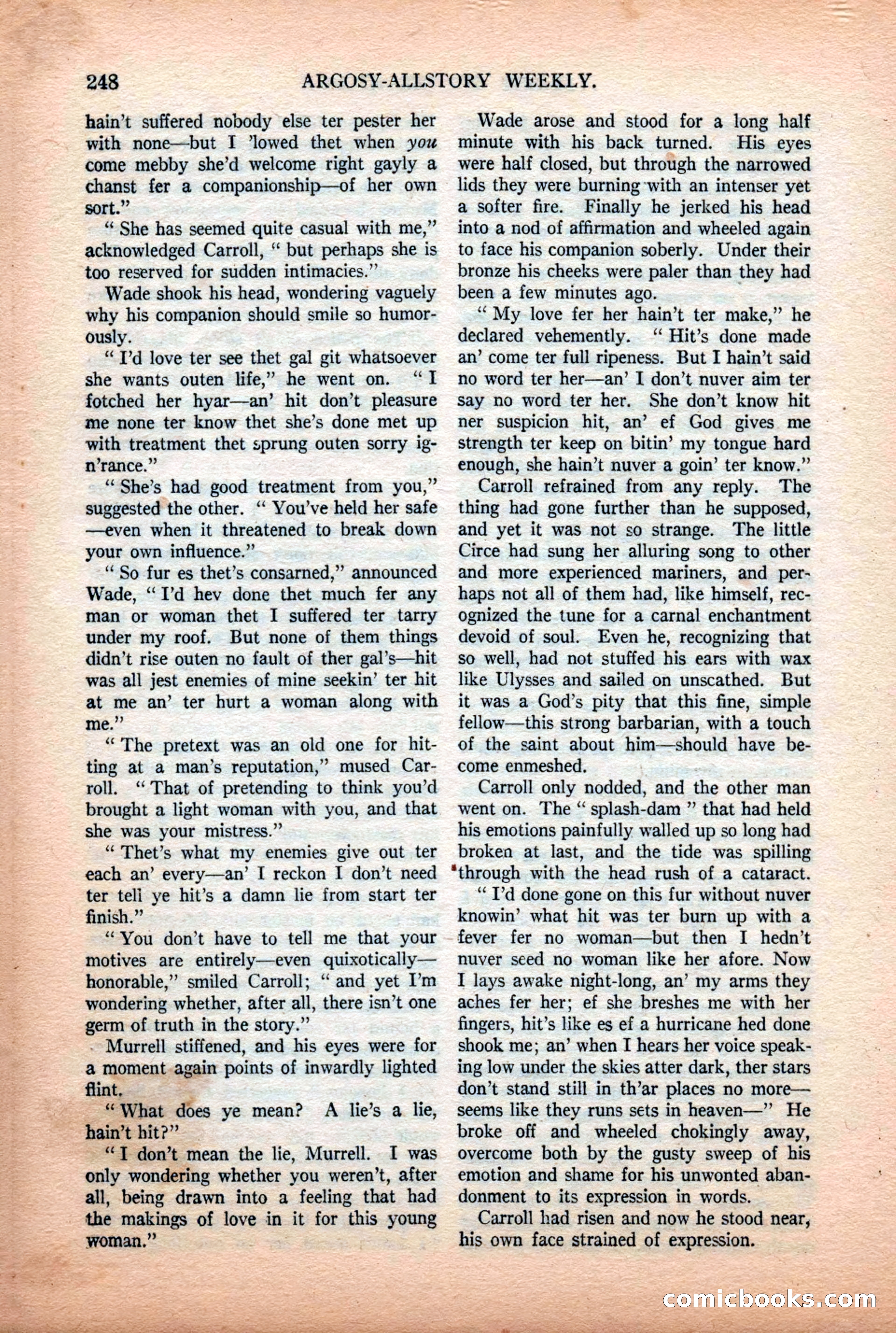
A restored page from Pulp Fiction, 1925. Page through the whole issue in the reader above.
📄 Transcribed text from this page (OCR, searchable)
Machine-transcribed from the original scan — historical spelling and the odd misread are preserved.
La oe 4 fees nea’ 7 | Phases tthe makings of love 248 hain’t suffered nobody else ter pester her with none—but I ‘lowed thet when you come mebby she’d welcome right gayly a chanst fer a companionship—of her own sort.” “ She has seemed quite casual with me,” acknowledged Carroll, “ but perhaps she is too reserved for sudden intimacies.” Wade shook his head, wondering vaguely why his companion should smile so humor- ously. “T’d love ter see thet gal git whatsoever she wants outen life,’ he went on. “I fotched her hyar—an’ hit don’t pleasure me none ter know thet she’s done met up with treatment thet sprung outen sorry ig- n’rance.” ““She’s had good treatment from you,” suggested the other. ‘‘ You’ve held her safe —even when it threatened to break down your own influence.” ‘So fur es thet’s consarned,” announced Wade, ‘“‘I’d hev done thet much fer any man or woman thet I suffered ter tarry under my roof. But none of them things didn’t rise outen no fault of ther gal’s—hit was all jest enemies of mine seekin’ ter hit at me an’ ter hurt a woman along with me.” “The pretext was an old one for hit- ting at a man’s reputation,” mused Car- roll. ‘That of pretending to think you’d brought a light woman with you, and that she was your mistress.” “ Thet’s what my enemies give out ter each an’ every—an’ I reckon I don’t need ter teli ye hit’s a damn lie from start ter finish.” “You don’t have to tell me that your motives are entirely—even quixotically— honorable,”’ smiled Carroll; ‘“ and yet I’m wondering whether, after all, there isn’t one germ of truth in the story.” - Murrell stiffened, and his eyes were for a moment.again points of inwardly lighted flint, : _ “What does ye mean? A lie’s a lie, ~ “TJ don’t mean the lie, Murrell. I was only wondering whether you weren’t, after all, being drawn into a feeling that had in it for this young ARGOSY-ALLSTORY WEEKLY. Wade arose and stood for a long half minute with his back turned. His eyes were half closed, but through the narrowed lids they were burning with an intenser yet a softer fire. Finally he jerked his head into a nod of affirmation and wheeled again to face his companion soberly. Under their bronze his cheeks were paler than they had been a few minutes ago. : ‘“ My love fer her hain’t ter make,’ he declared vehemently. ‘ Hit’s done made an’ come ter full ripeness. But I hain’t said no word ter her—an’ I don’t nuver aim ter say no word ter her. She don’t know hit ner suspicion hit, an’ ef God gives me strength ter keep on bitin’ my tongue hard enough, she hain’t nuver a goin’ ter know.” Carroll refrained from any reply. The thing had gone further than he supposed, and yet it was not so strange. The little Circe had sung her alluring song to other and more experienced mariners, and per- haps not all of them had, like himself, rec- ognized the tune for a carnal enchantment devoid of soul. Even he, recognizing that so well, had not stuffed his ears with wax like Ulysses and sailed on unscathed. But it was a God’s pity that this fine, simple fellow—this strong barbarian, with a touch of the saint about him—should have be- come enmeshed. Carroll only nodded, and the other man went on. The “ splash-dam ” that had held his emotions painfully walled up so long had broken at last, and the tide was spilling “through with the head rush of a cataract. ‘“1’d done gone on this fur without nuver knowin’ what hit was ter burn up with a fever fer no woman—but then I hedn’t nuver seed no woman like her afore. Now I lays awake night-long, an’ my arms they aches fer her; ef she breshes me with her fingers, hit’s like es ef a hurricane hed done shook me; an’ when I hears her voice speak- ing low under the skies atter dark, ther stars don’t stand still in th’ar places no more— seems like they runs sets in heaven—”’ He broke off and wheeled chokingly away, overcome both by the gusty sweep of his emotion and shame for his unwonted aban- donment to its expression in words. Carroll had risen and now he stood near, his own face strained of expression. i