
Pulp Fiction, 1925 · page 99 of 168
Argosy All-Story Weekly, July 11, 1925 — page 99: what you’re looking at
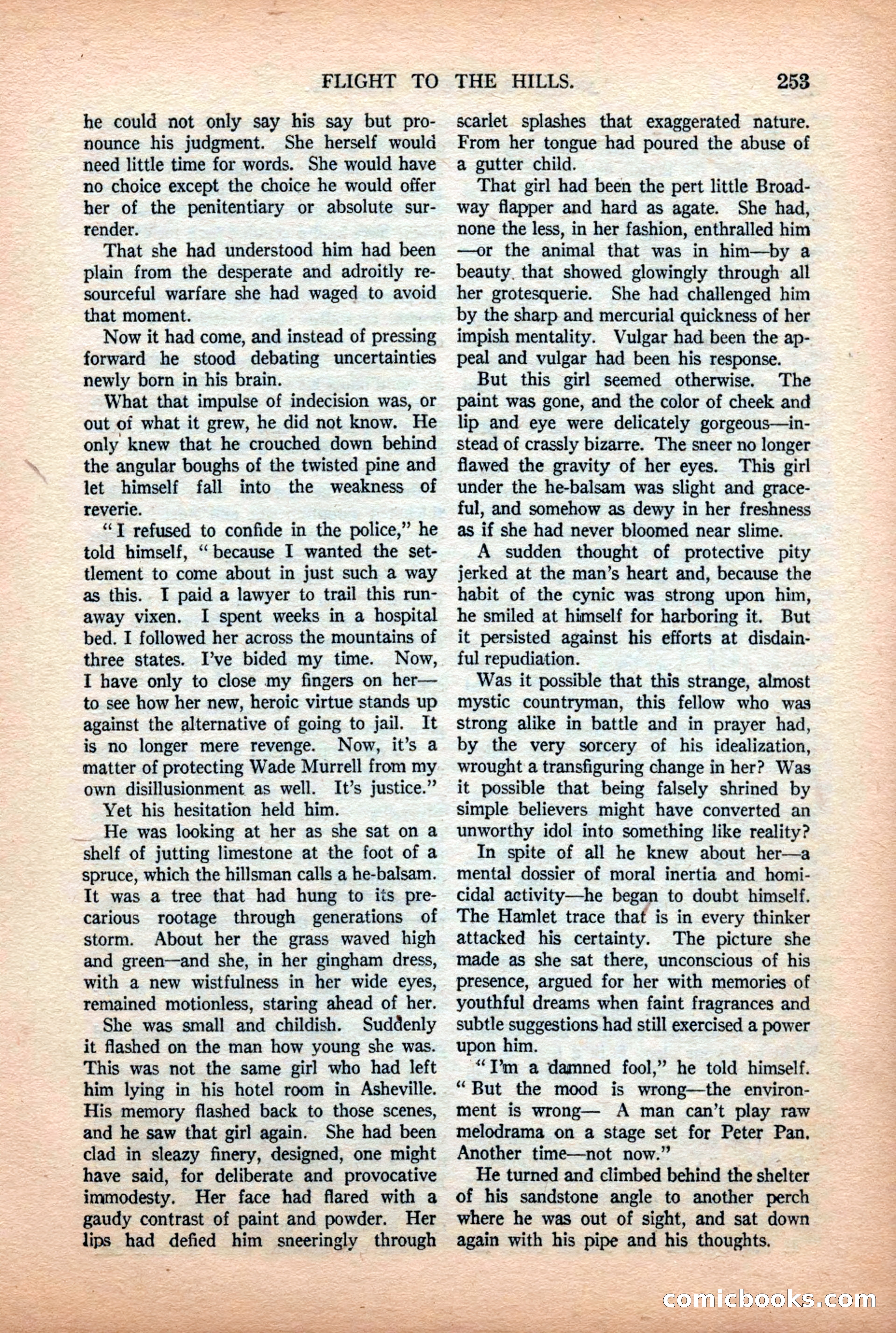
A restored page from Pulp Fiction, 1925. Page through the whole issue in the reader above.
📄 Transcribed text from this page (OCR, searchable)
Machine-transcribed from the original scan — historical spelling and the odd misread are preserved.
FLIGHT TO he could not only say his say but pro- nounce his judgment. She herself would need little time for words. She would have no choice except the choice he would offer her of the penitentiary or absolute sur- render. That she had understood him had been plain from the desperate and adroitly re- sourceful warfare she had waged to avoid that moment. Now it had come, and instead of pressing forward he stood debating uncertainties newly born in his brain. What that impulse of indecision was, or out of what it grew, he did not know. He only knew that he crouched down behind the angular boughs of the twisted pine and let himself fall into the weakness of reverie. “T refused to confide in the police,” he told himself, ‘‘ because I wanted the set- tlement to come about in just such a way as this. I paid a lawyer to trail this run- away vixen. I spent weeks in a hospital bed. I followed her across the mountains of three states. I’ve bided my time. Now, I have only to close my fingers on her— to see how her new, heroic virtue stands up against the alternative of going to jail. It is no longer mere revenge. Now, it’s a matter of protecting Wade Murrell from my own disillusionment. as well. It’s justice.” Yet his hesitation held him. __ He was looking at her as she sat on a shelf of jutting limestone at the foot of a spruce, which the hillsman calls a he-balsam. It was a tree that had hung to its pre- carious rootage through generations of storm. About her the grass waved high and green—and she, in her gingham dress, with a new wistfulness in her wide eyes, remained motionless, staring ahead of her. She was small and childish. Suddenly it flashed on the man how young she was. This was not the same girl who had left him lying in his hotel room in Asheville. His memory flashed back to those scenes, and he saw that girl again. She had been clad in sleazy finery, designed, one might have said, for deliberate and provocative immodesty. Her face had flared with a gaudy contrast of paint and powder. Her lips had defied him sneeringly through THE HILLS. 253 scarlet splashes that exaggerated nature. From her tongue had poured the abuse of a gutter child. That girl had been the pert little Broad- way flapper and hard as agate. She had, none the less, in her fashion, enthralled him —or the animal that was in him—by a beauty, that showed glowingly through: all her grotesquerie. She had challenged him by the sharp and mercurial quickness of her impish mentality. Vulgar had been the ap- peal and vulgar had been his response. But this girl seemed otherwise. The paint was gone, and the color of cheek and lip and eye were delicately gorgeous—in- stead of crassly bizarre. The sneer no longer flawed the gravity of her eyes. This girl under the he-balsam was slight and grace- ful, and somehow as dewy in her freshness as if she had never bloomed near slime. A sudden thought of protective pity jerked at the man’s heart and, because the habit of the cynic was strong upon him, he smiled at himself for harboring it. But it persisted against his efforts at disdain- ful repudiation. Was it possible that this strange, almost mystic countryman, this fellow who was strong alike in battle and in prayer had, by the very sorcery of his idealization, wrought a transfiguring change in her? Was it possible that being falsely shrined by simple believers might have converted an unworthy idol into something like reality? In spite of all he knew about her—a mental dossier of moral inertia and homi- cidal activity—he began to doubt himself. The Hamlet trace that is in every thinker attacked his certainty. The picture she made as she sat there, unconscious of his presence, argued for her with memories of youthful dreams when faint fragrances and subtle suggestions had still exercised a power upon him. “Ym a damned fool,” he told himself. “But the mood is wrong—the environ- ment is wrong— A man can’t play raw melodrama on a stage set for Peter Pan, Another time—not now.” He turned and climbed behind the shelter of his sandstone angle to another perch where he was out of sight, and sat down again with his pipe and his thoughts. (ECO) 2001 S — nit ~- - - x <- x a . - a a - > A = > ie — IY tip pip Oa * en ee es eae gre . — - a = = Ie . =F Ol ar ~ > oma = an a OPS SET ee A NT, I GO EOE ont OE i I On rl os MO BS”